The Art of Progressive Passing: Timing, Context, and Decision-Making
 By Shady Elabody
July 20, 2026
By Shady Elabody
July 20, 2026
Modern football has gradually shifted towards safer possession circulation. Recent research suggests that line-breaking passes account for only a minority of all passes, while possession-retention actions dominate modern build-up play. Teams increasingly circulate the ball around the defensive block, often progressing through the flanks before attempting to penetrate centrally.
One of the main reasons is the growing compactness of defensive structures. Central areas are now more congested than ever, making direct vertical progression more difficult and increasing the risk of losing possession and conceding counter-attacks.
In this article, I identify the key reference points that help players decide when to attempt a line-breaking pass and when to continue circulating possession. The objective is not to encourage more progressive passes, but to improve the timing and effectiveness of those decisions.
The discussion focuses primarily on the passer and the passing situation, rather than the receiver’s individual qualities. It also assumes the profile of the average professional player, not exceptional outliers such as Phil Foden or Pedri, whose technical ability allows them to receive in a box of matches or receive a fired passes in their feets, This article does not focus on the tactical mechanisms or combinations that generate line-breaking passes. Instead, each example is treated as an isolated situation to examine the passer's decision-making.
1- The distance
1.a Between Ball Carrier and Receiver
The distance between the passer and the receiver directly influences the ball’s travel time. The longer the distance, the longer the ball takes to reach its target, increasing the window of opportunity for defenders to react, anticipate, and intercept.
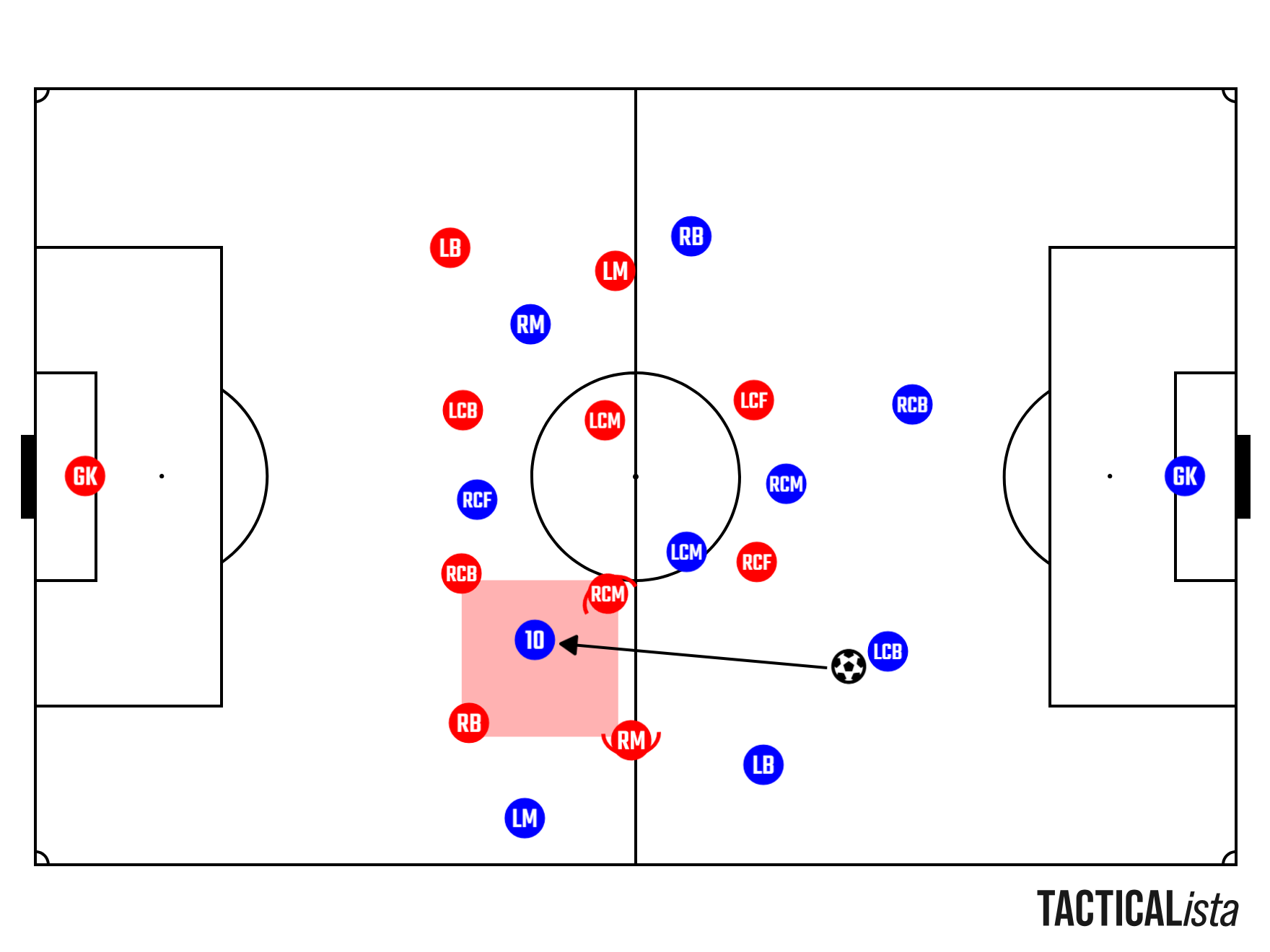
In the example below, Aymeric Laporte attempts to find Mikel Oyarzabal with a line-breaking pass. However, the distance between the two players is relatively long, meaning the ball requires more time to reach its destination. This additional travel time gives Dayot Upamecano enough time to read the pass, step into the passing lane, and make the interception.
Rather than breaking the defensive line, Spain lose possession in their own half, creating a chaotic transition and exposing themselves to an immediate counter-attacking situation.
1.b Between the ball carrier and the opponent
This example reinforces the same concept: every additional metre the ball has to travel gives the defender additional time to react. The long passing distance allows the Canadian player to anticipate the action, intercept the ball, and create a high-quality transition opportunity.
2- Body Shape
Here, we need to consider two key aspects: the body shape of the ball carrier and the body shape of the opponents closest to the ball.
2.a Opponent’s body shape
An opponent can easily intercept a line-breaking pass when their body orientation allows them to see both the ball and the intended receiver on the same horizontal line. In this situation, the defender is already in a favourable position to anticipate the pass and step into the passing lane.
The passer should therefore wait for the moment when the defender’s body orientation changes, for example, when they are turning, facing the ball, or no longer side-on. This moment reduces the defender’s ability to react quickly, allowing the pass to bypass the defensive line.
2.b Passer’s Body Shape
The passer must be intelligent enough to disguise their intentions. As discussed in ** 2.a (Opponent’s Body Shape)**, defenders can often anticipate a line-breaking pass by reading the ball carrier’s body shape and visual cues.
To reduce this advantage, the ball carrier should use their body orientation as a deception tool. By shaping as if they intend to play in one direction before delivering the pass elsewhere, they force the defender to shift their body weight or attention away from the true passing lane.
This brief moment of hesitation is often enough to prevent the defender from reacting in time, allowing the line-breaking pass to bypass the defensive line.
2.c Vertical or Diagonal Passes ?
Thanks to the references discussed in 2.a (Opponent’s Body Orientation) and 2.b (Passer’s Body Orientation), the advantage of the diagonal pass becomes clear.
The defender’s attention is naturally drawn towards the most obvious passing option directly in front of them. By disguising their intentions through their body orientation, the passer can suggest an outside pass before releasing a diagonal pass into the inside channel.
As a result, the defender is forced to react late. The combination of deception and the change in passing angle makes the pass significantly less predictable, allowing it to bypass the defensive line and reach a receiver who is outside the defender’s immediate field of anticipation.
3.Space Available to the Receiver
The space available to the receiver between the lines is another key reference point to consider. If the receiver occupies a very tight space, they are unlikely to turn and play forward, even if the line-breaking pass is completed successfully.
(As stated earlier, this analysis treats each situation as an isolated scenario, without considering tactical mechanisms or combinations that might create additional space after the reception.) Under this assumption, the passer should evaluate not only whether the receiver can receive the ball, but also whether they have enough space to control it, turn, and continue the attack.
In the example below, Cubarsi doesn’t hide his intention, the opponent’s body shape is towards the pass, and the space becomes tight more and more, so Rabiot has enought time to recover and win the ball back
here you can notice the differece of space availability to the receiver (Insigne) to Receive and turn and move forward
At the end, These reference points do not guarantee that every progressive pass will succeed, nor should they discourage players from taking calculated risks. Rather, they provide a framework for recognising when the conditions favour vertical progression and when circulating possession is the more effective solution.
Browse our collection of football analysis insights.