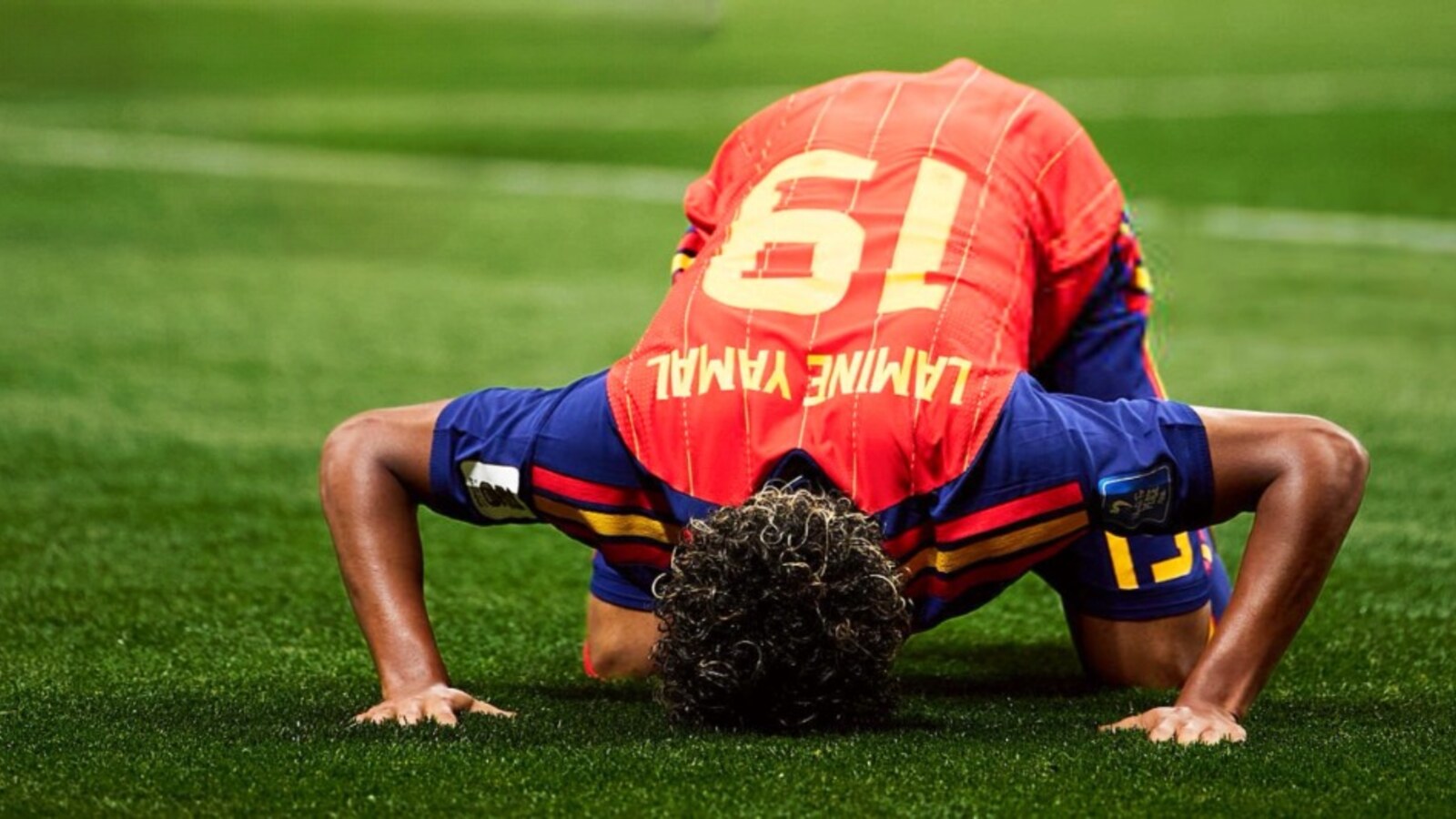
Spain 4-0 Saudi Arabia: World Cup 26 Group Stage Analysis
 By Kareem Essam
June 26, 2026
By Kareem Essam
June 26, 2026
After the draw against Cape Verde, Spain entered the Saudi match with 3 changes in the starting lineup: Lamine Yamal, Dani Olmo, and Alex Baena instead of Ferran, Fabian, and Gavi. These changes clearly changed the team’s shape, especially in the final third, and there was more variety in creating chances and more attacking solutions.
We’ll talk about Spain’s performance over three phases: how the build-up was, what changed in the final third, and the high press. We’ll also talk about the impact of Lamine Yamal, Olmo, and Baena on Spain’s shape, and at the end, we’ll answer an important question: What is the biggest problem that could face the team as it heads into the decisive stages?
Spain’s Build Up
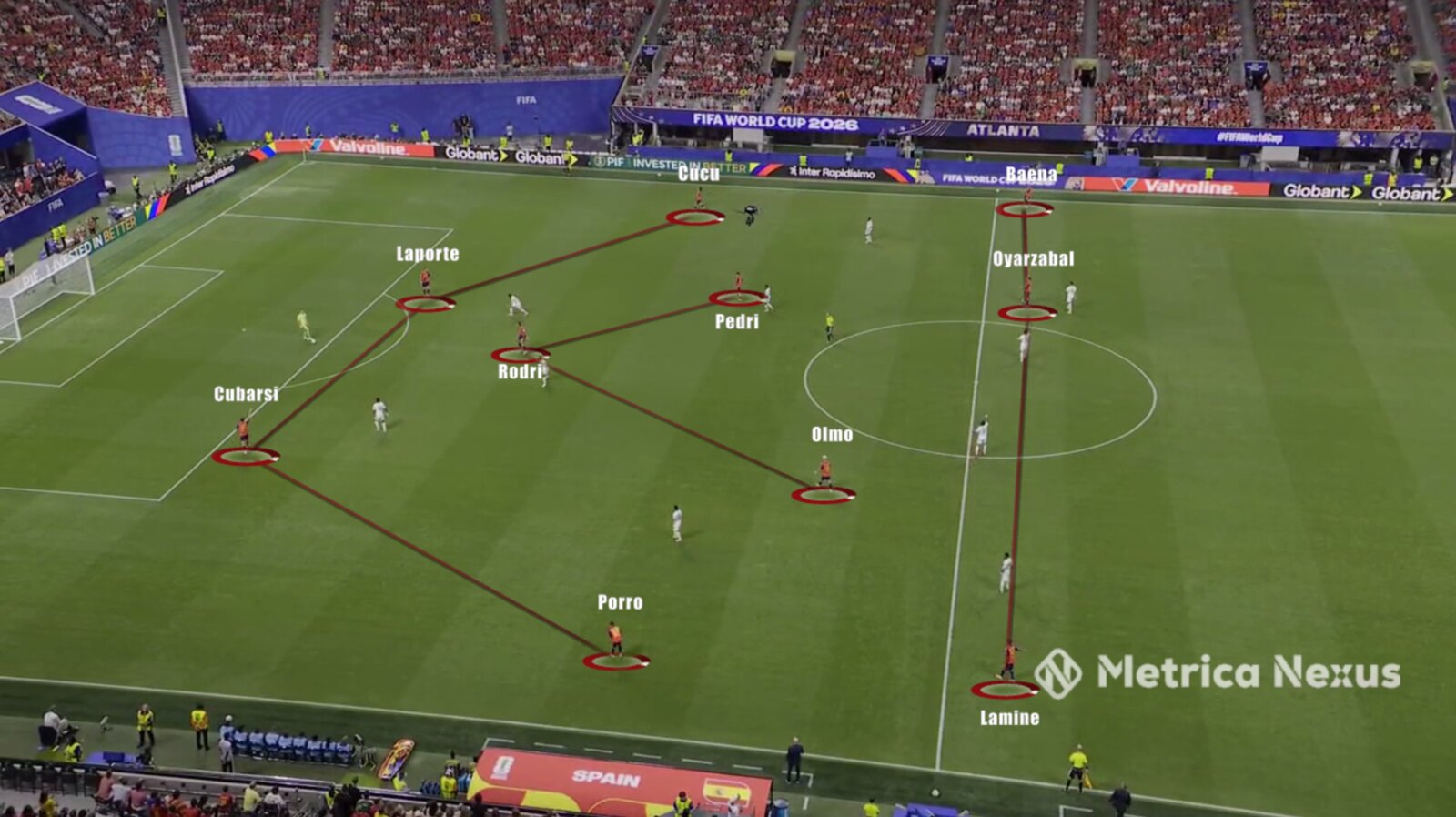
Spain’s shape with the ball was 4-3-3, Unai Simon, ahead of him Laporte and Cubarsi, with Cucurella on the left and Porro on the right. In midfield, Rodri, ahead of him Pedri and Olmo, and the attacking line was Lamine Yamal, Oyarzabal, and Baena.
Saudi Arabia in the high press were playing in a shape closer to 4-3-1-2. Al-Owais, ahead of him Lajami and Tambakti as center-backs, with Al-Ammar and Al-Harbi as full-backs. Al-Khaibari in midfield, with Saud on his right and Salem on his left, and ahead of them Nasser Al-Dawsari and Al-Juwayr, with Firas Al-Buraikan up front.
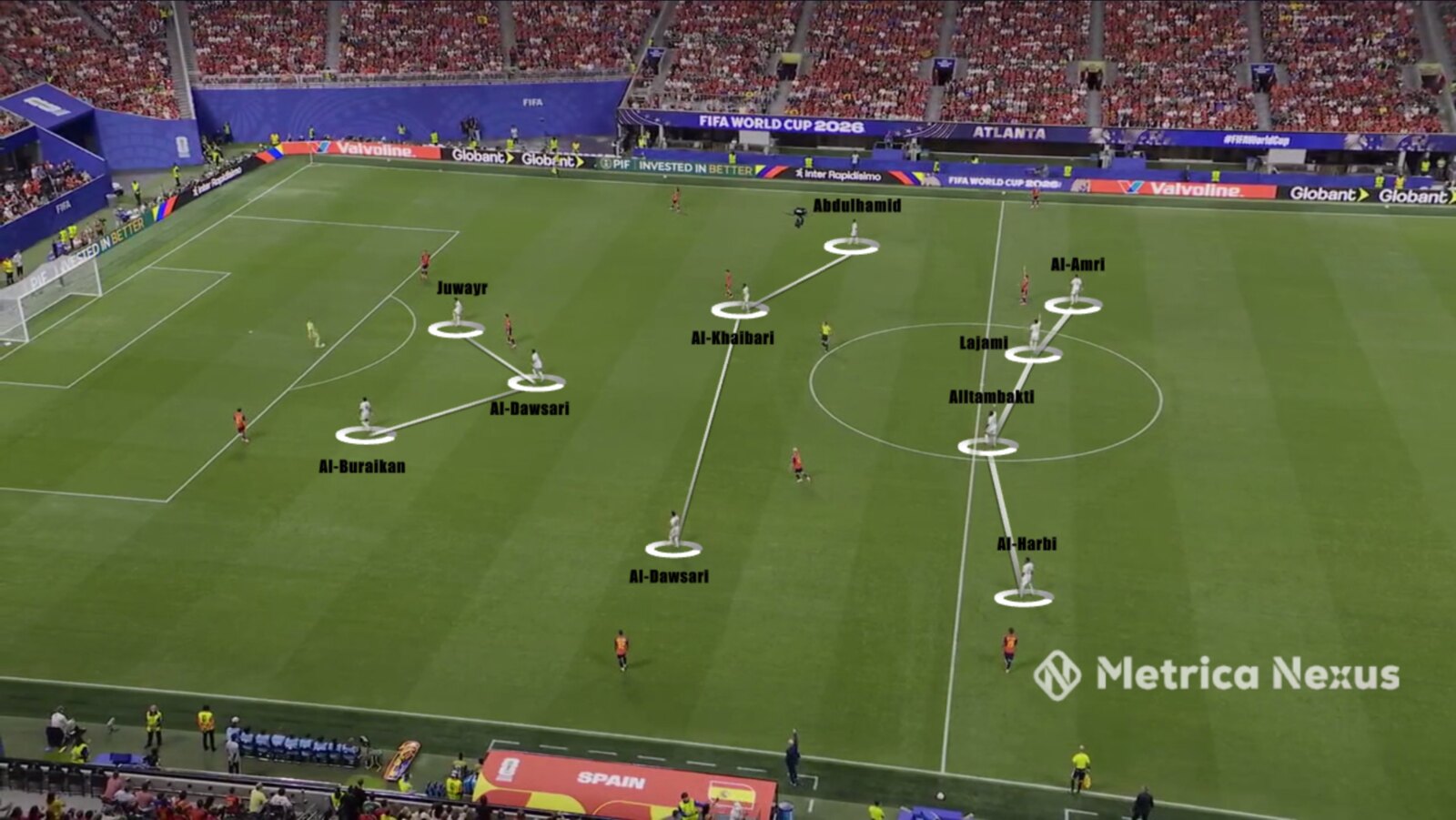
Al-Juwayr and Al-Buraikan press Laporte and Cubarsi, Nasser Al-Dawsari presses Rodri, Saud presses Cucurella, Al-Khaibari presses Pedri, and Salem Al-Dawsari presses Porro.
And from here, Saudi Arabia’s pressing problems start to show. The first one is when Olmo drops toward Porro, which puts Salem in a 2-vs-1 situation. Does he press Olmo and leave Porro, or stay with Porro and leave Olmo?
So here we’ll see Simon passing to Laporte, then the Saudi Team starts executing their press, and Olmo starts dropping. Laporte passes it back to Simon, who plays it to Olmo.
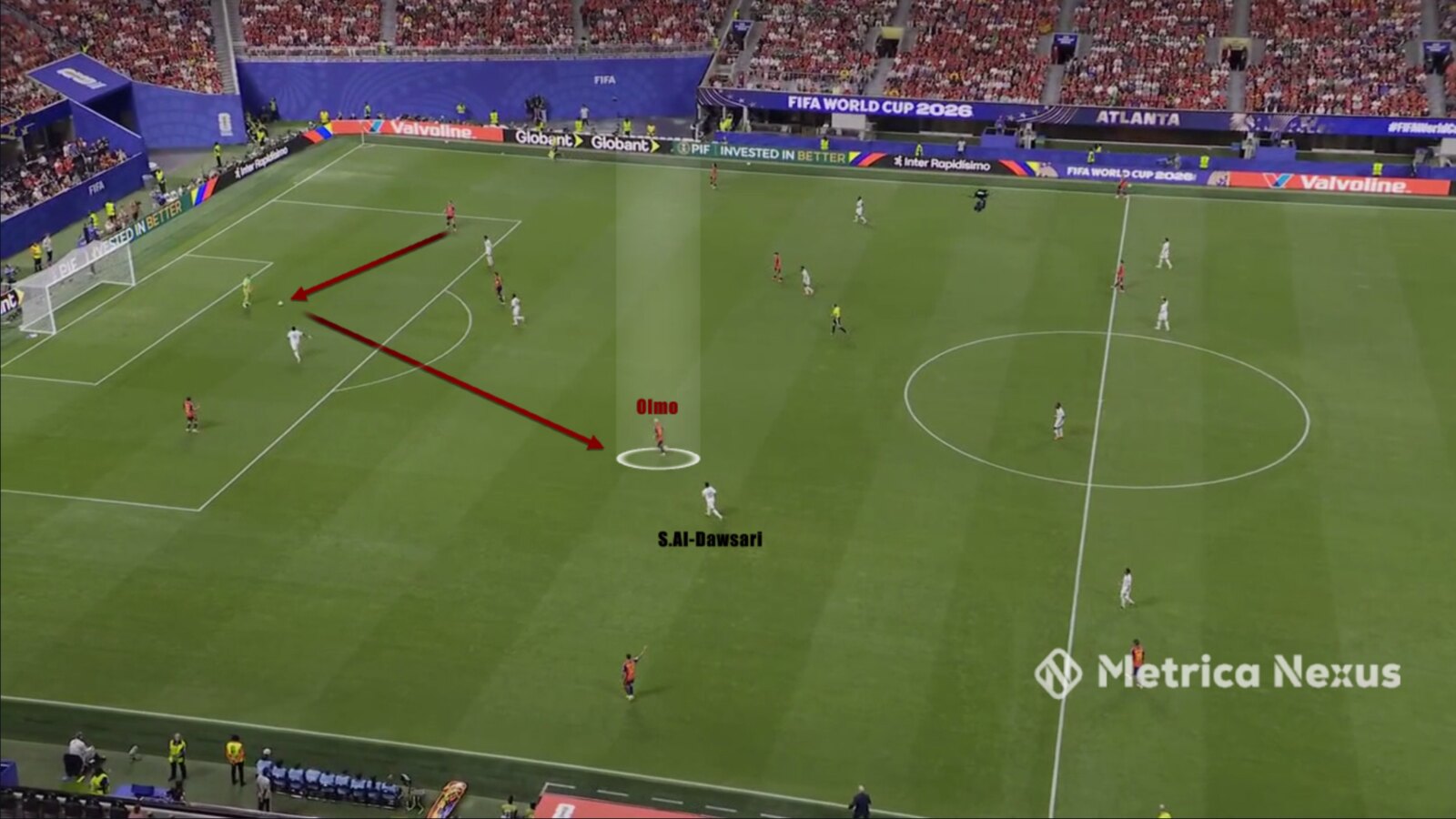
Al-Dawsari stays standing in the middle of the lane, and Olmo receives the ball with two passing options: Cubarsi or Porro. And here appears the second problem in Saudi Arabia’s press, which is that when one of Firas or Al-Juwayr presses Unai Simon, that leaves one of the two center-backs free, and reaching him becomes easy.
The second thing here is Lamine’s high positioning and how he pins Al-Harbi, which frees Porro and allows him to push forward comfortably.
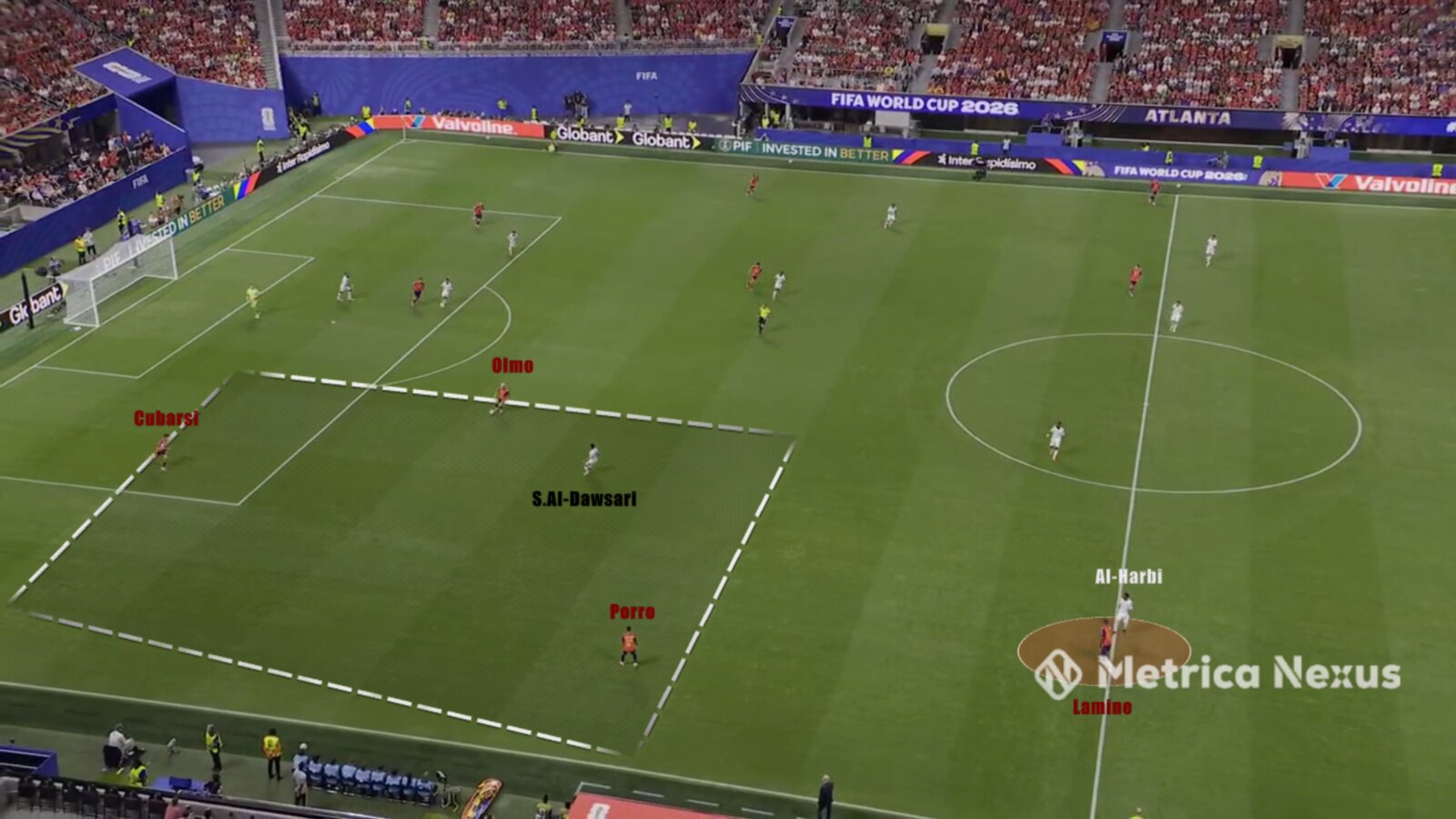
Olmo turns and passes to Lamine, who cuts inside because Porro is coming down the line.
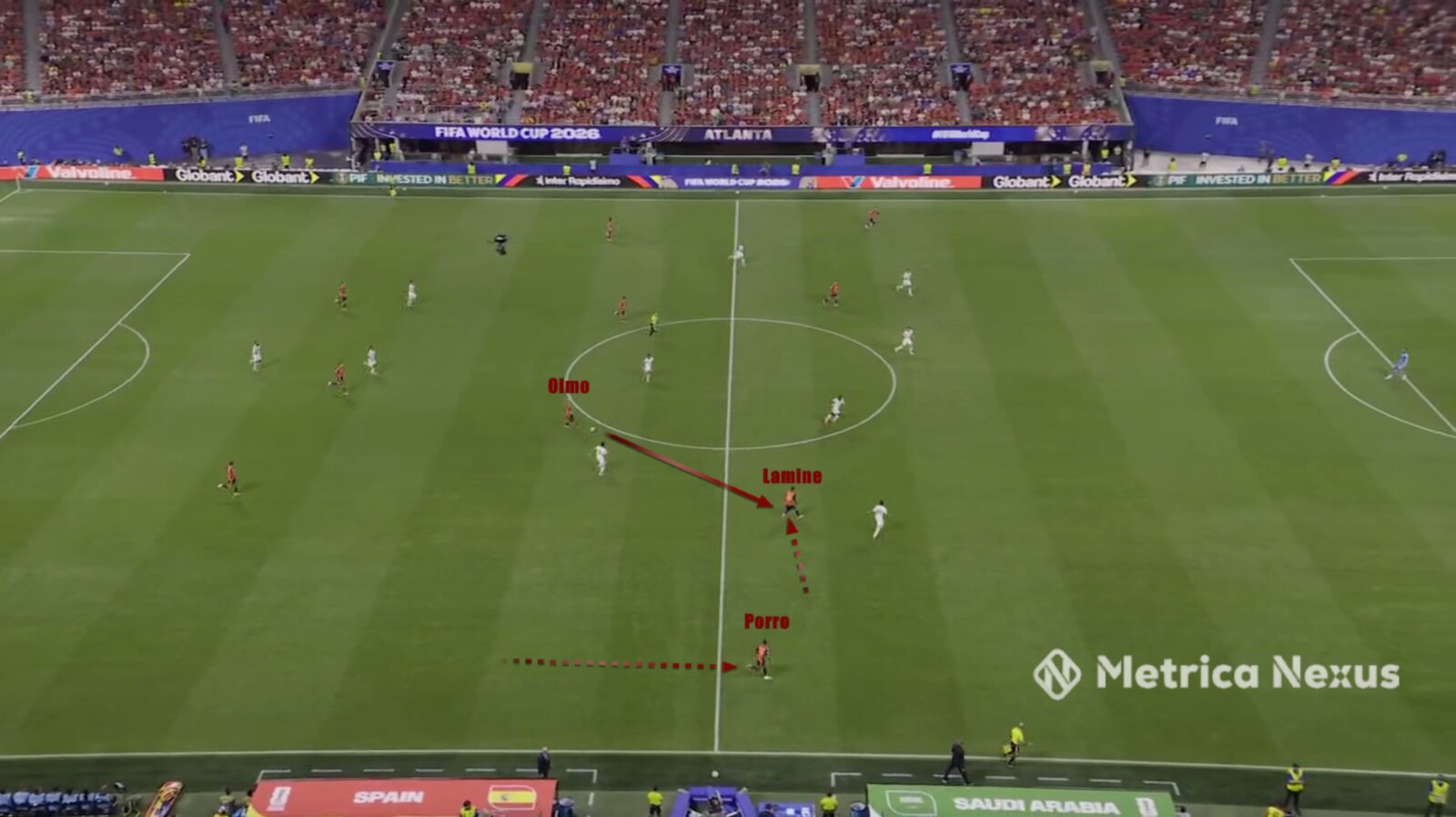
From Lamine to Porro.
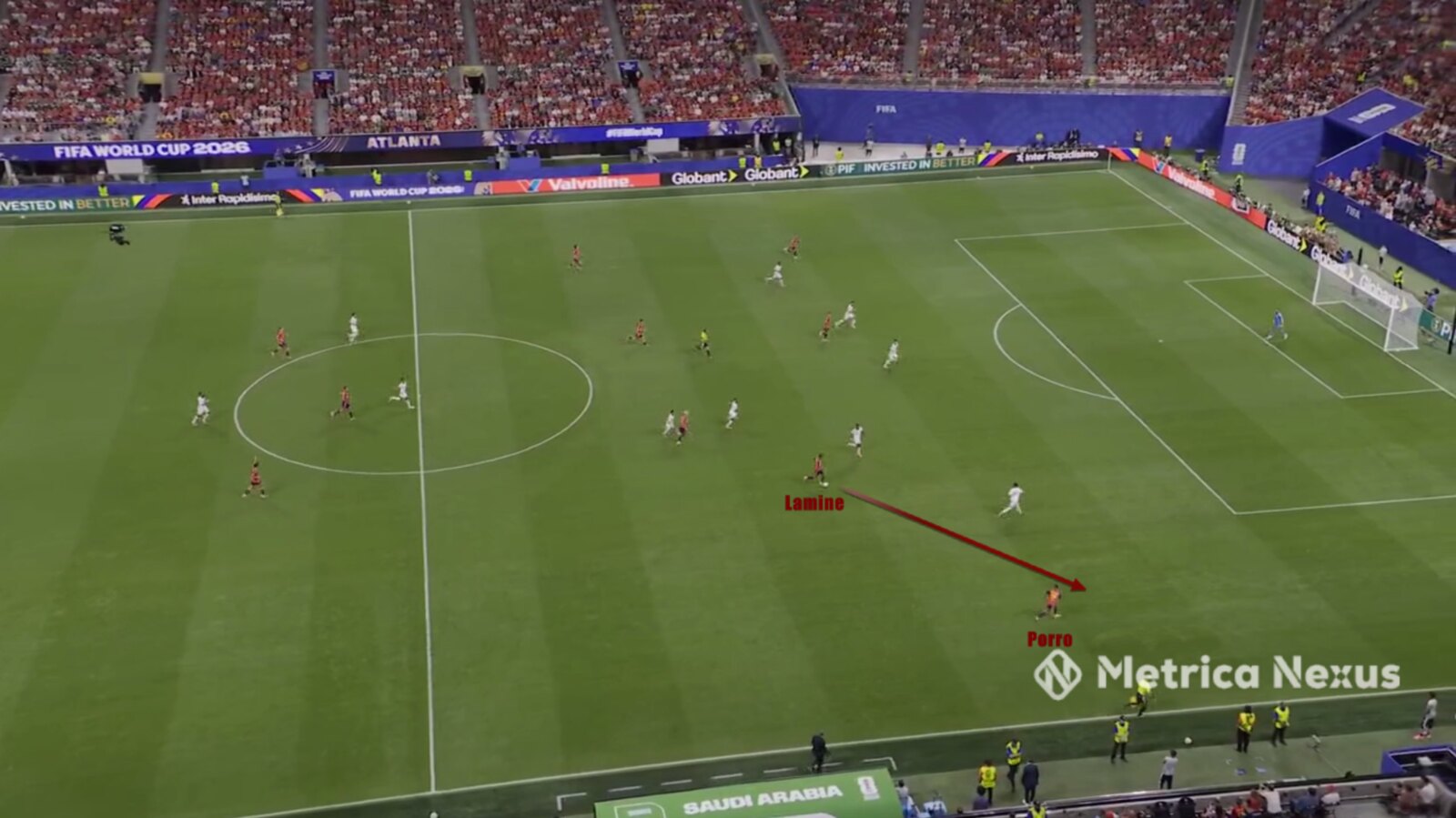
And a cross comes in, and the first defender clears it.
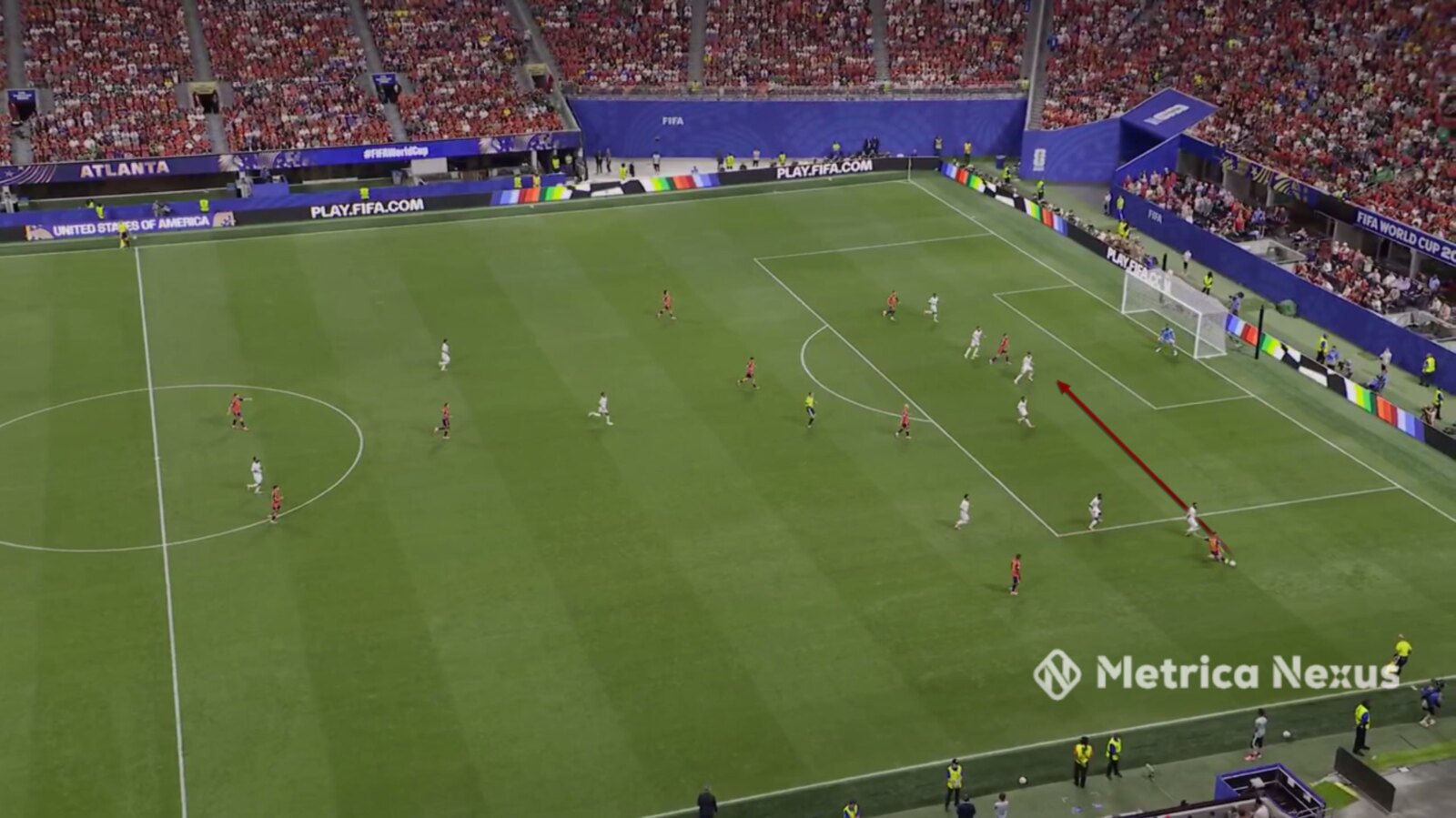
As time went on, and with Spain succeeding in playing out from the back more than once, Saudi Arabia adjusted their pressing shape to a clear 4-4-2. Nasser Al-Dawsari dropped next to Al-Khaibari as a double pivot in midfield.
One of Firas or Al-Juwayr would press the defender on the side where the ball was, while the other would mark Rodri.
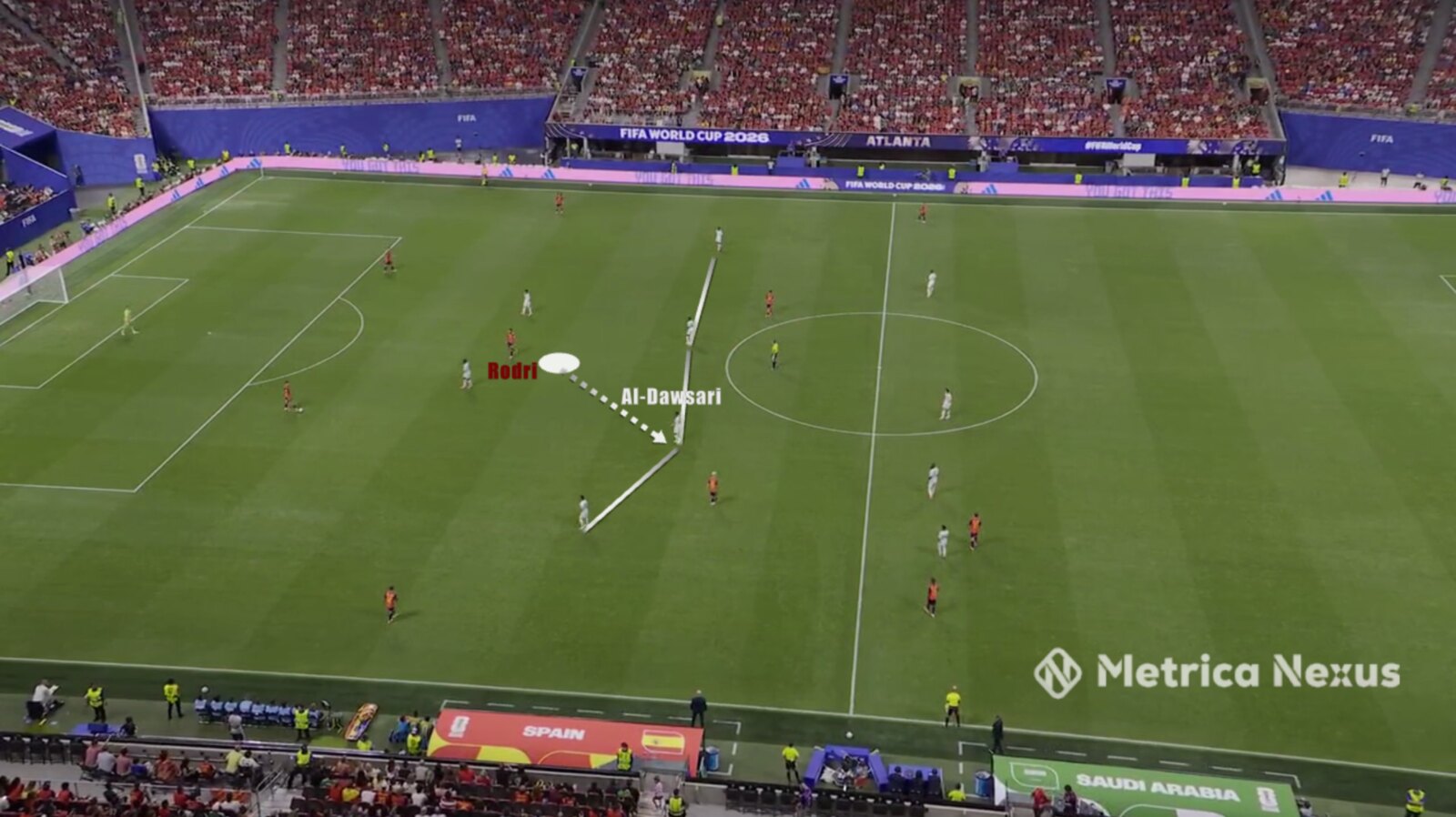
Here we'll see Firas pressing Cubarsi, and at the same time, Olmo drops, but he won't be free because Nasser Al-Dawsari is with him.
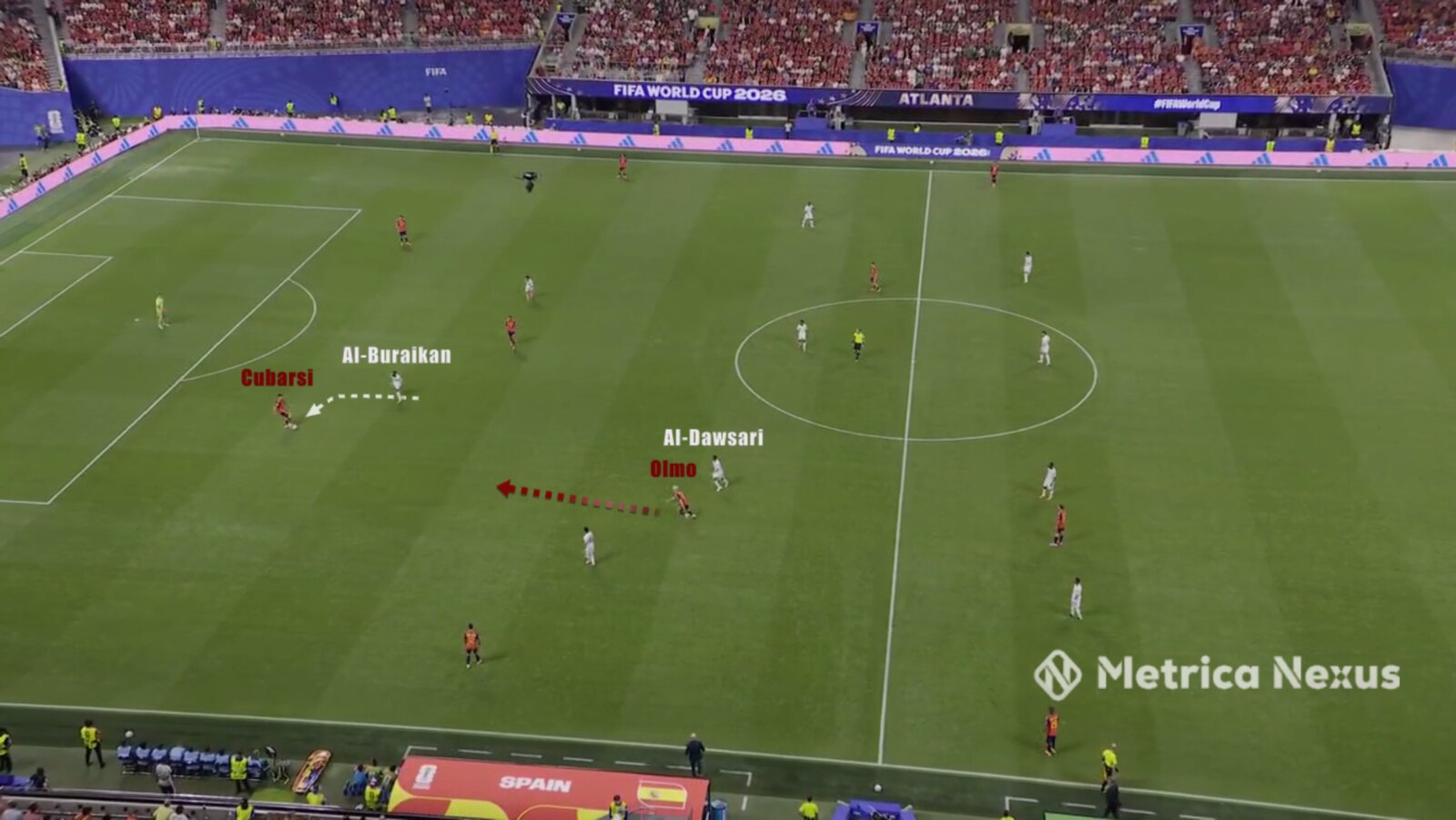
But Spain can still play out. Why? Because when Al-Juwayr moves to press Rodri, that leaves Laporte completely free, so Olmo passes it to Laporte with one touch.
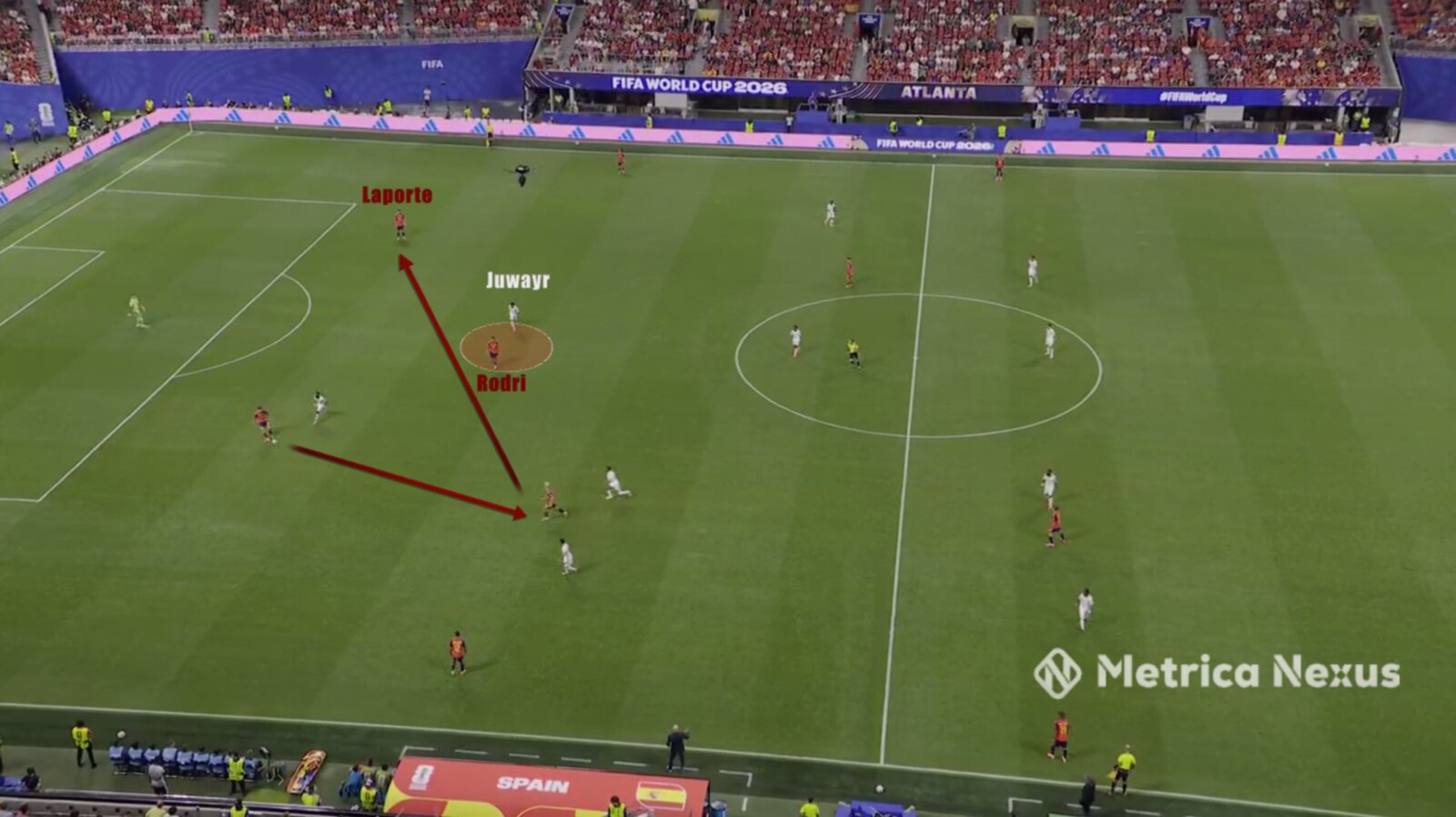
Laporte takes the ball and drives forward into a huge amount of space.
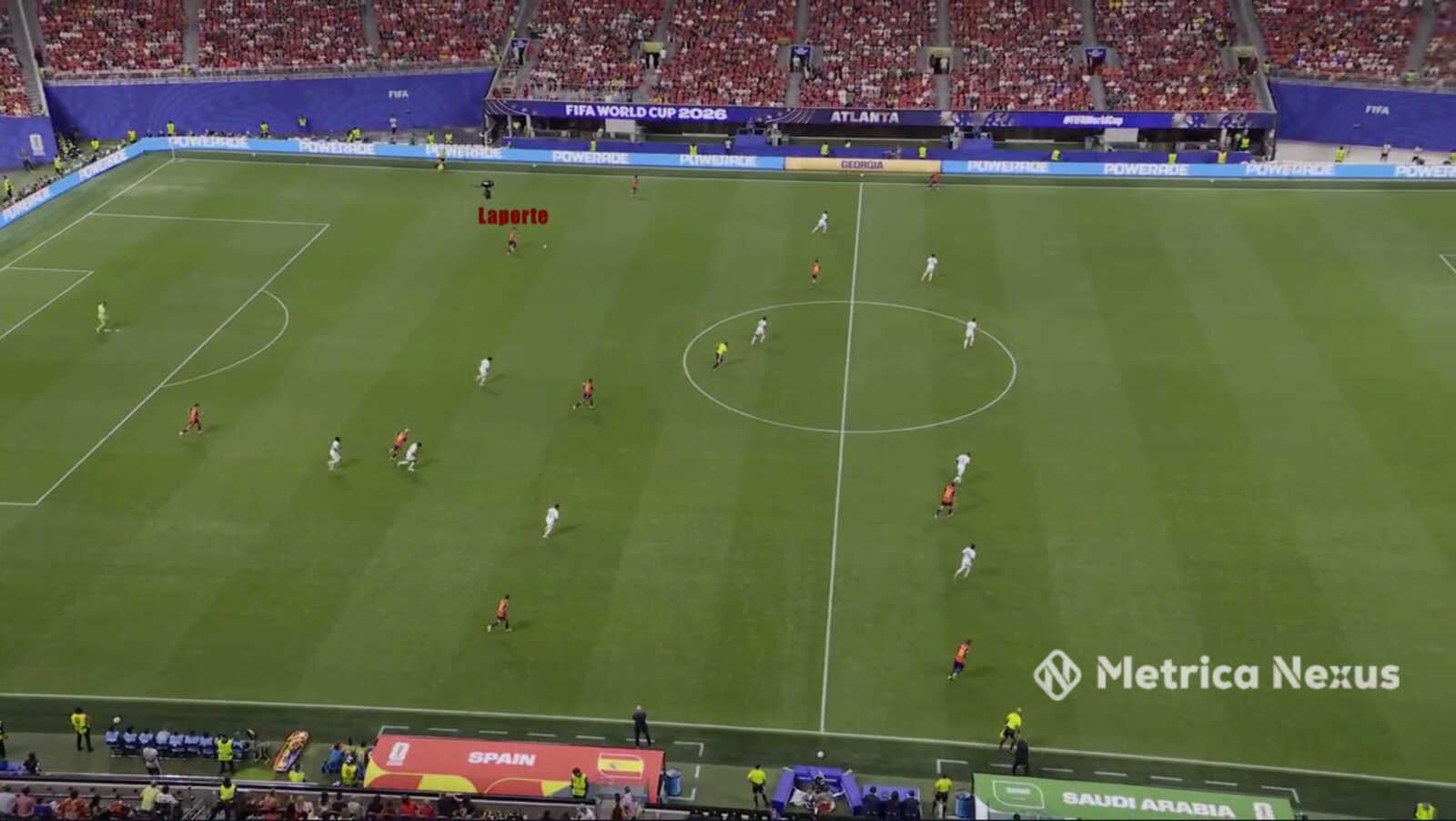
Rodri gets rid of Al-Juwayr's marking, pushes forward, and receives the ball in space.
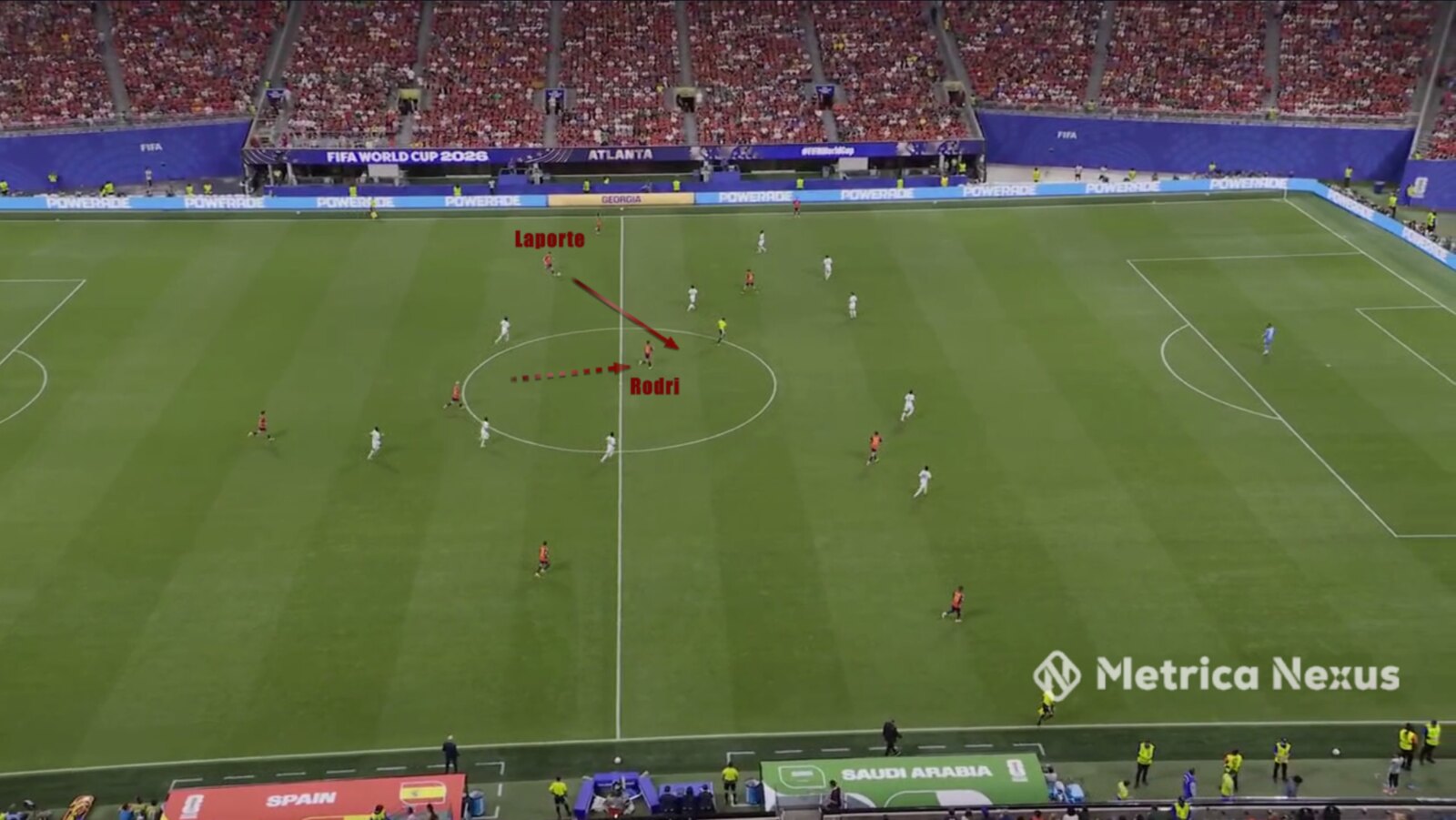
From him to Álex Baena, who sprints into the space.
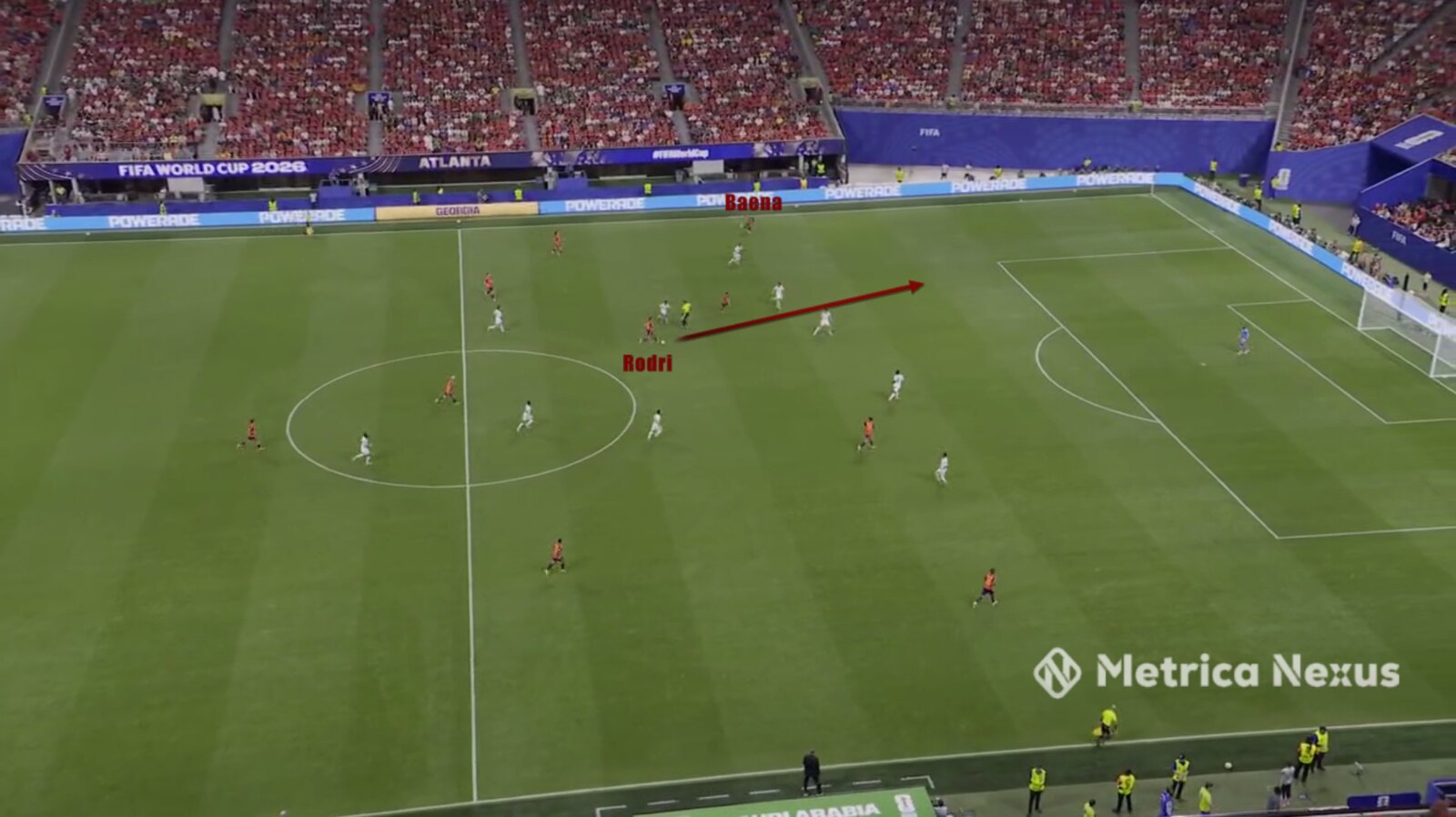
And a dangerous cross comes in, but the defender manages to clear it.
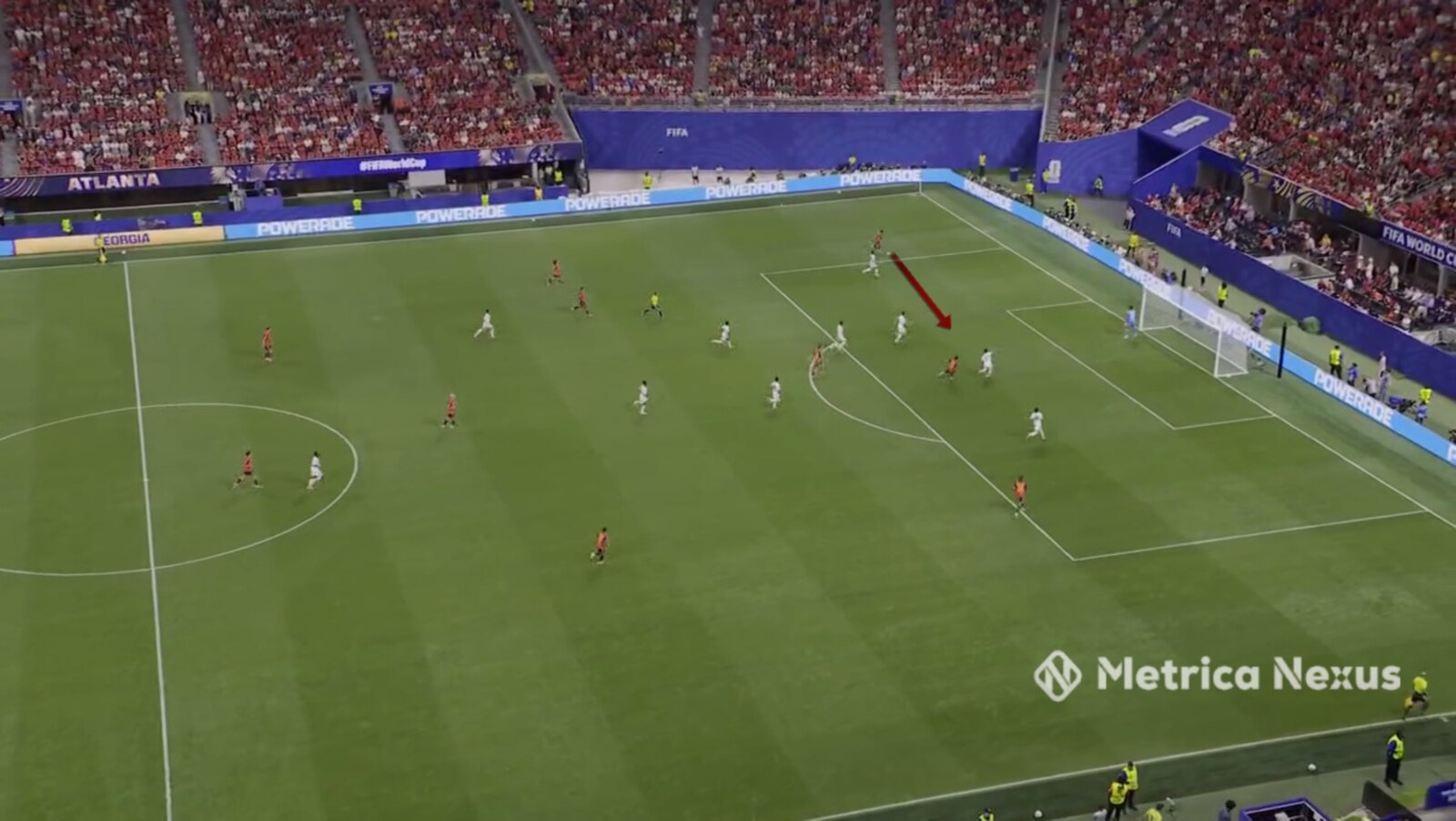
Saudi Arabia decided at the end of the first half to switch to man-to-man marking. Nasser Al-Dawsari will pick up Rodri, Tambakti will pick up Olmo, Al-Amri will pick up Baena, Lajami will pick up Oyarzabal, and Al-Harbi will pick up Lamine.
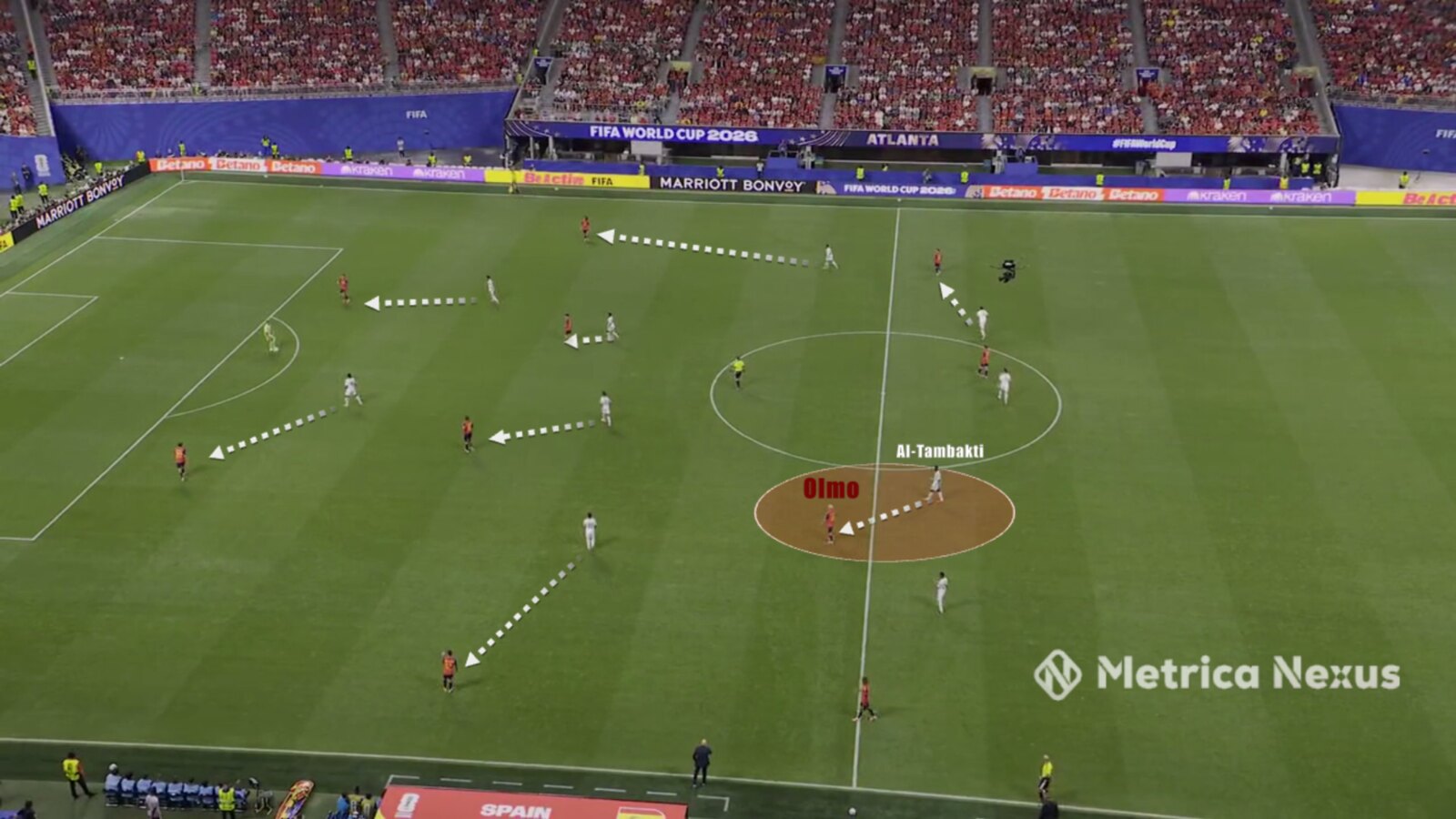
Simon passes to Cubarsi, and Al-Buraikan presses him. Olmo, at the same time, as usual, drops, but Tambakti is right behind him. Cubarsi passes to Porro.
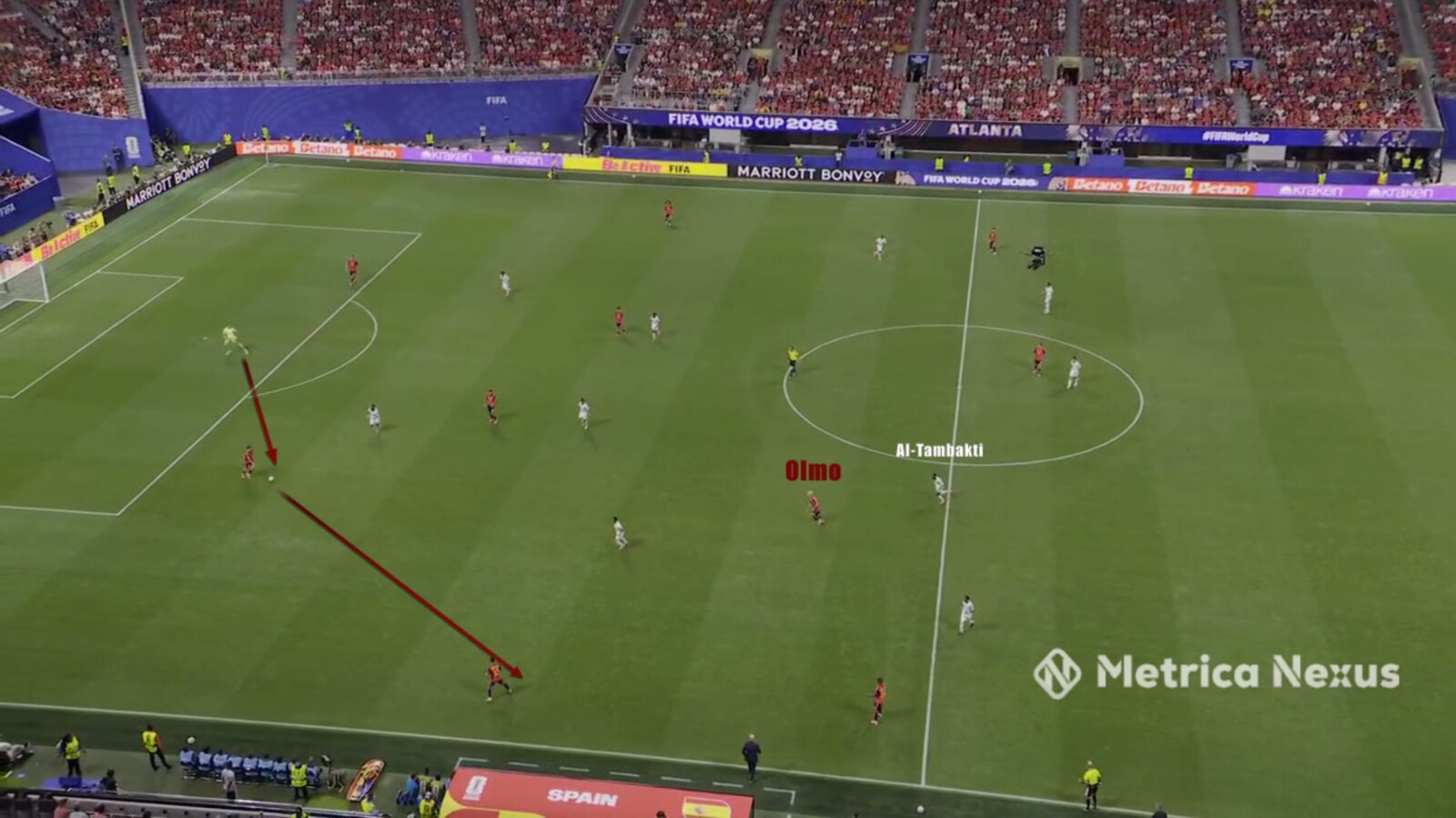
Salem presses Porro, and Lamine acts like he's going to run into space, so Al-Harbi runs with him. But Lamine changes his direction and drops to receive the ball, getting rid of Al-Harbi's marking.
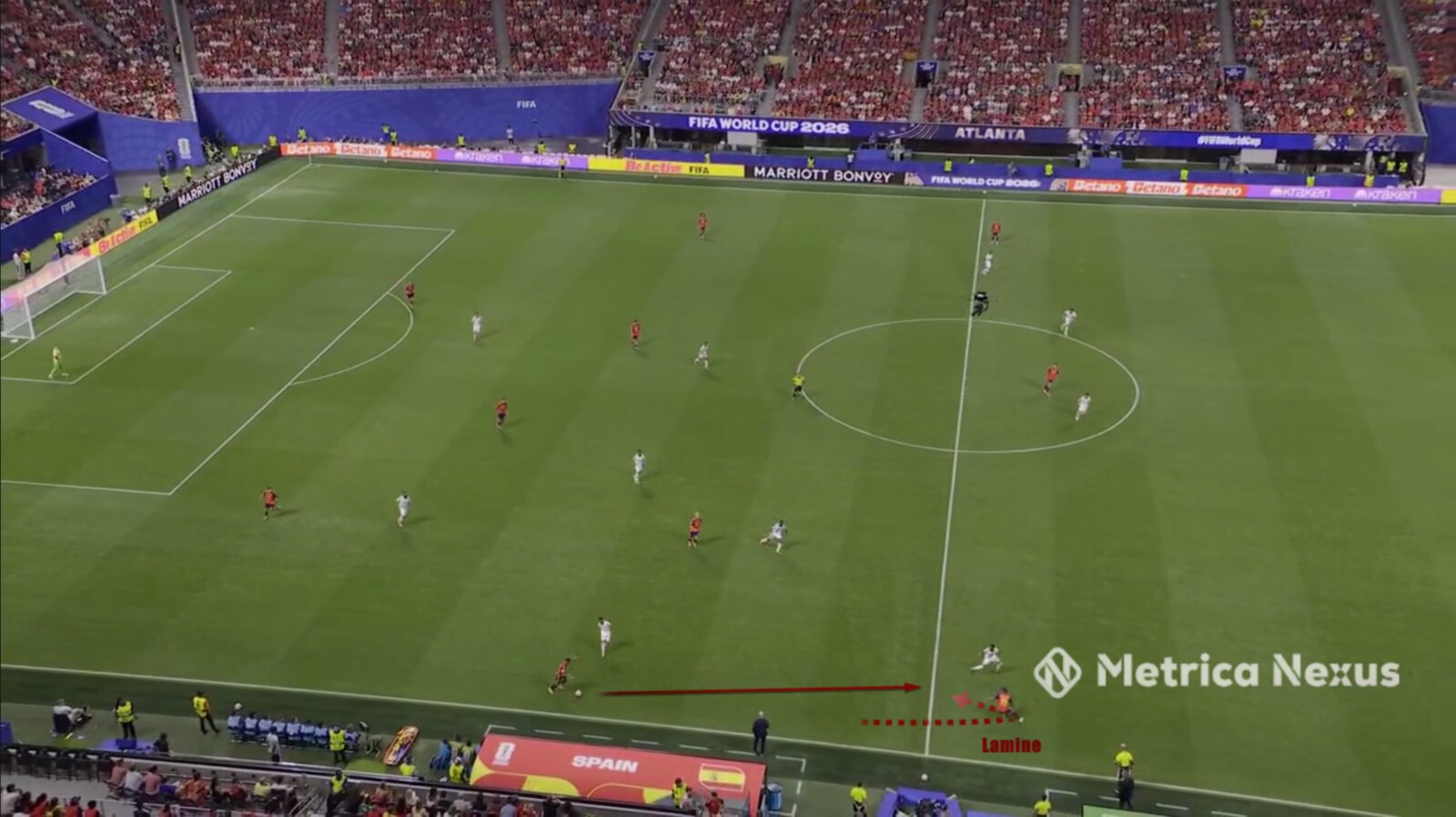
From Lamine to Olmo.
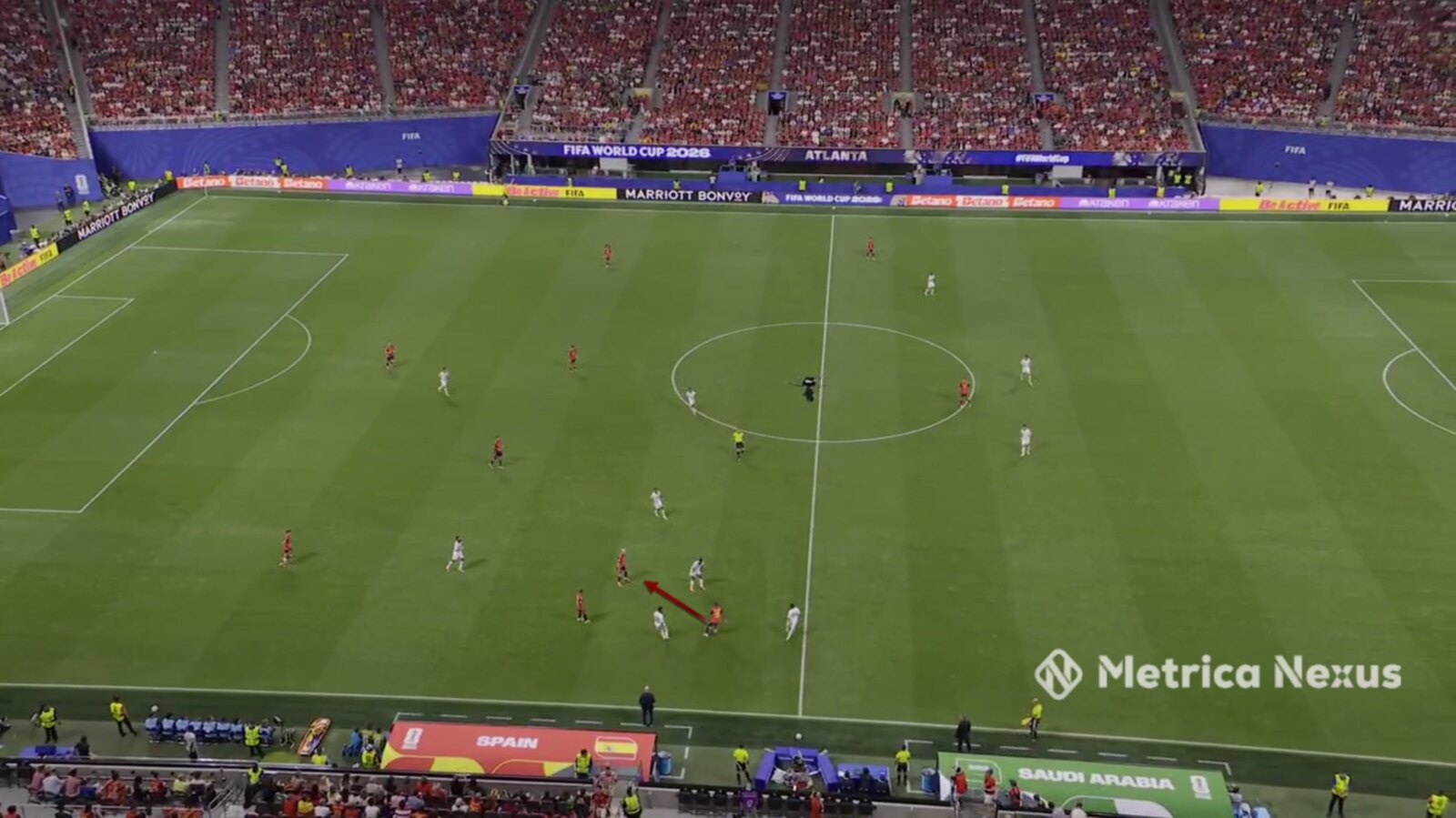
Olmo to Rodri, who finds himself free because Nasser Al-Dawsari got worried about the depth and the open pass to Oyarzabal, so he left Rodri and closed off the space behind.
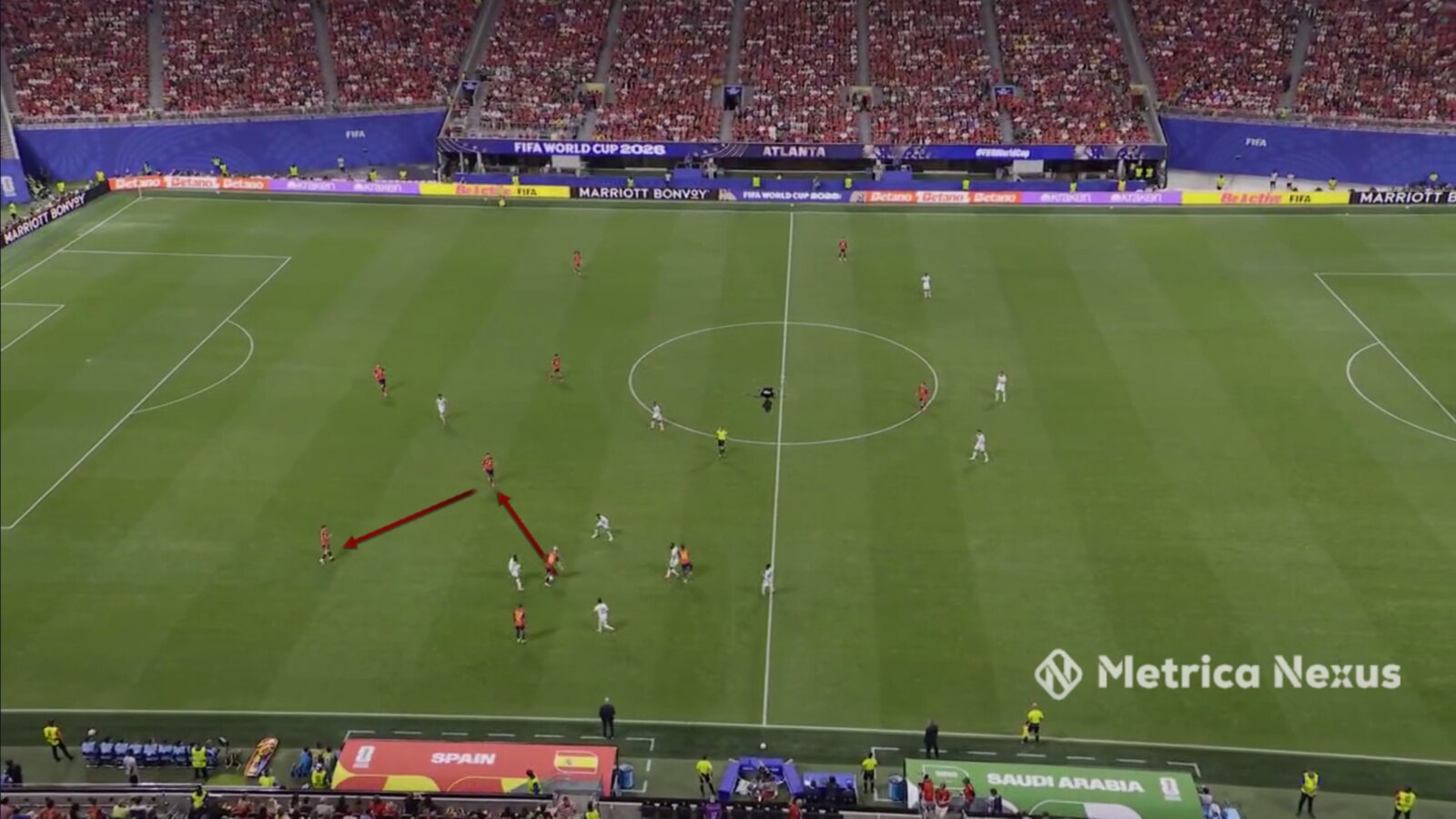
Rodri to Cubarsi, from him to Laporte, who finds himself free because Al-Juwayr went to Rodri, and from him to Cucurella, because Saud went to Pedri.
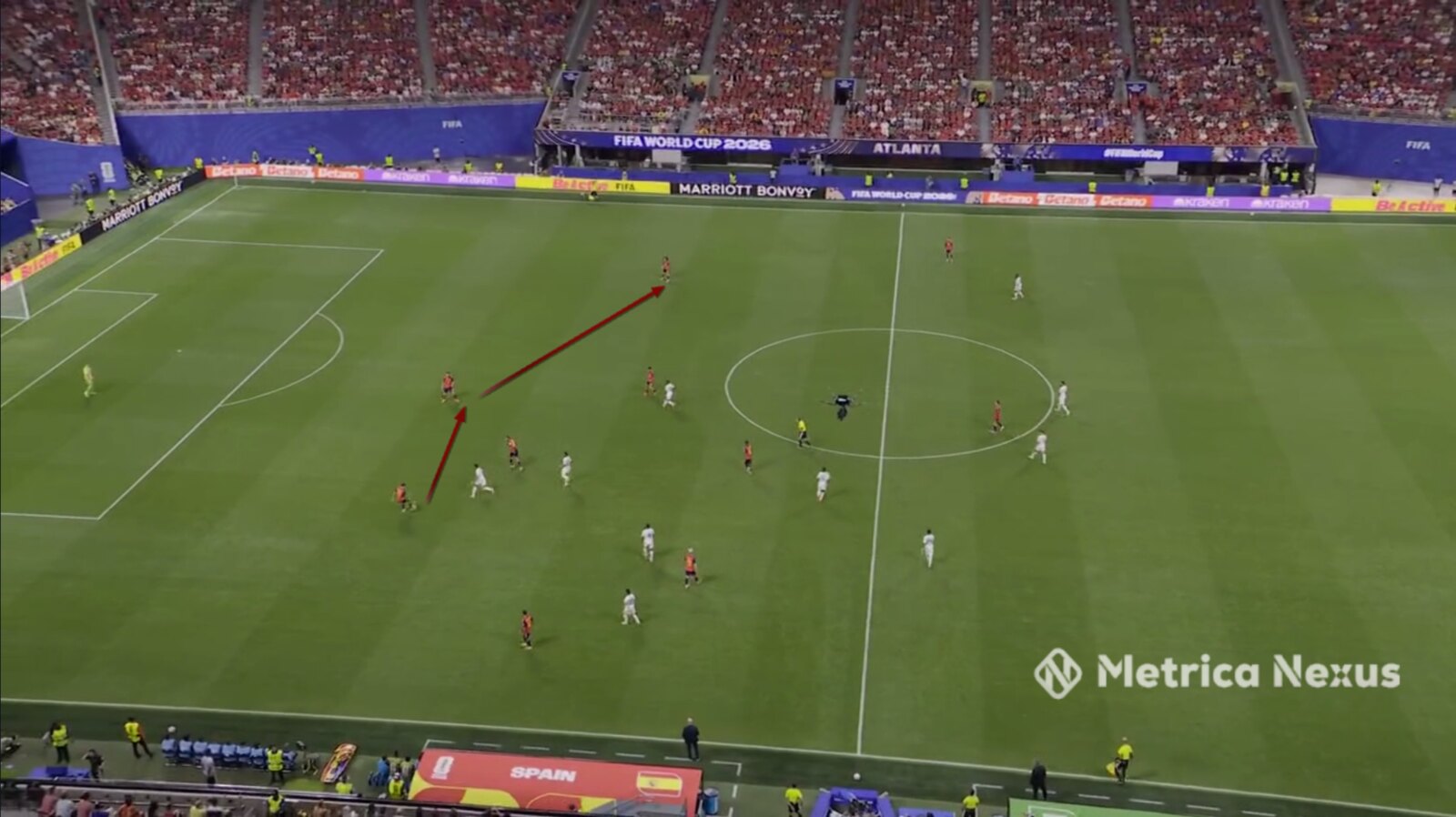
Al-Amri steps out to Cucurella, which leaves Baena free, but Cucurella receives it and holds onto the ball.
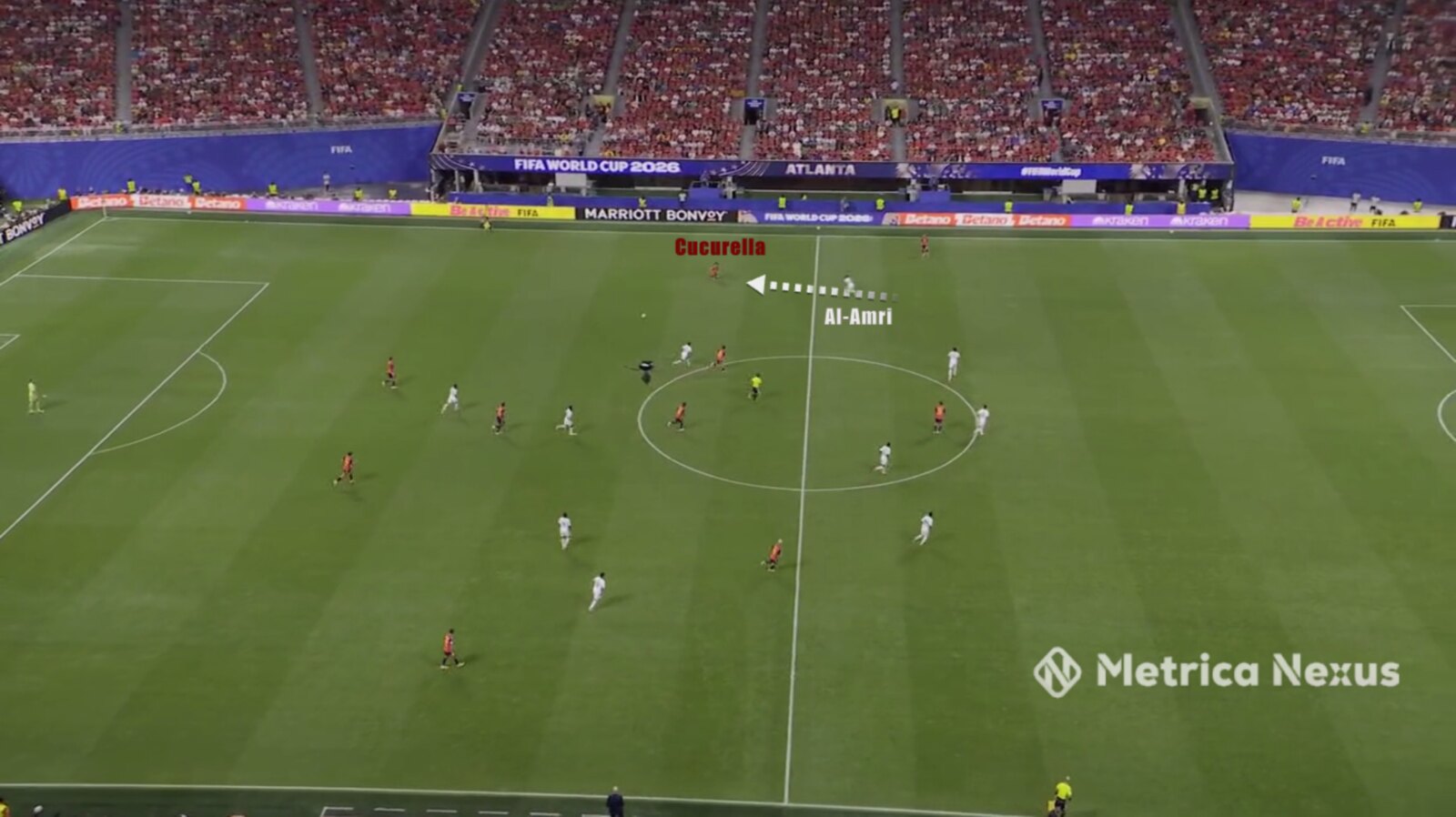
But Cucurella takes a heavy touch, so the ball gets away from him and gets intercepted.
Spain’s Final Third
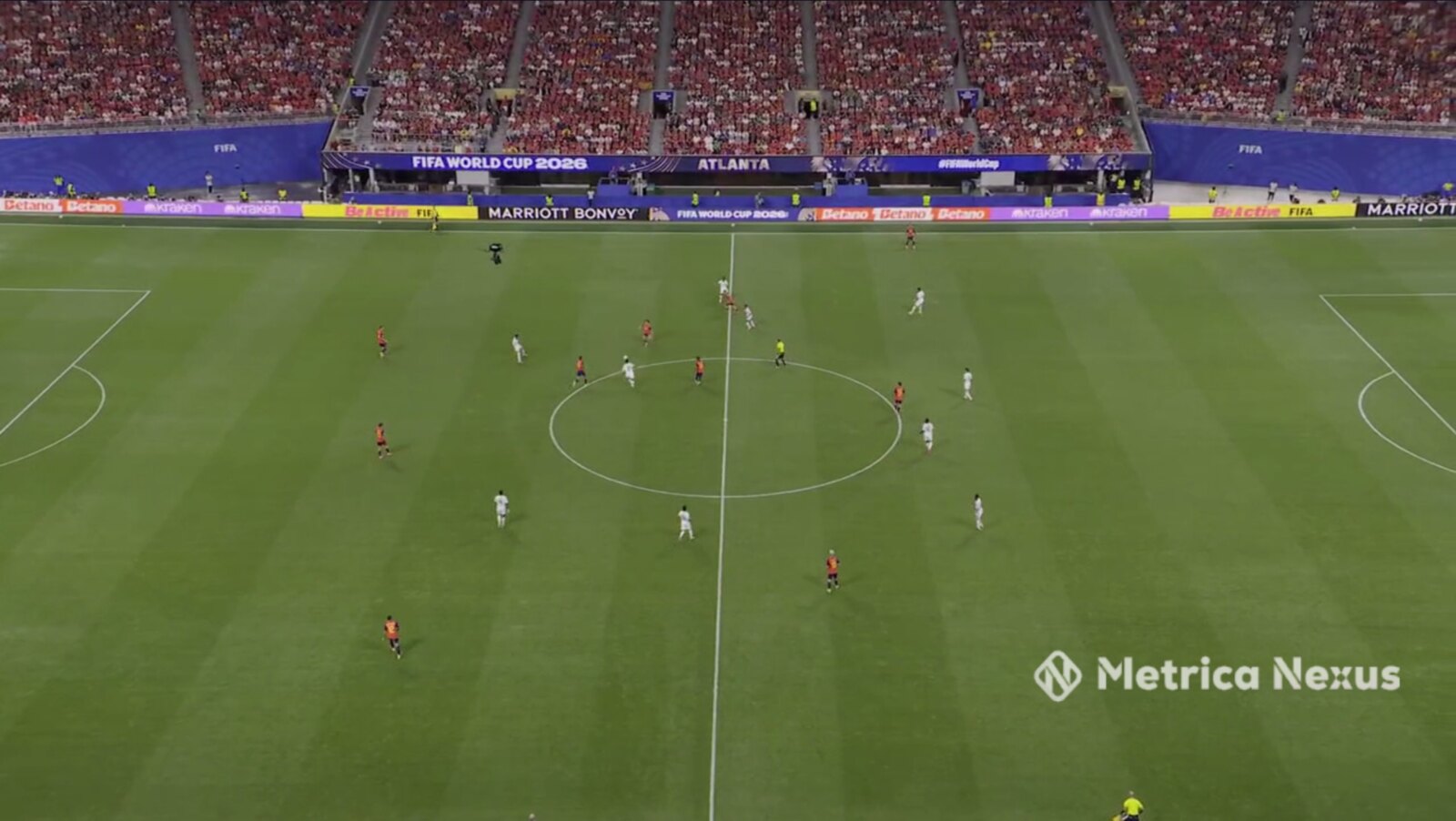
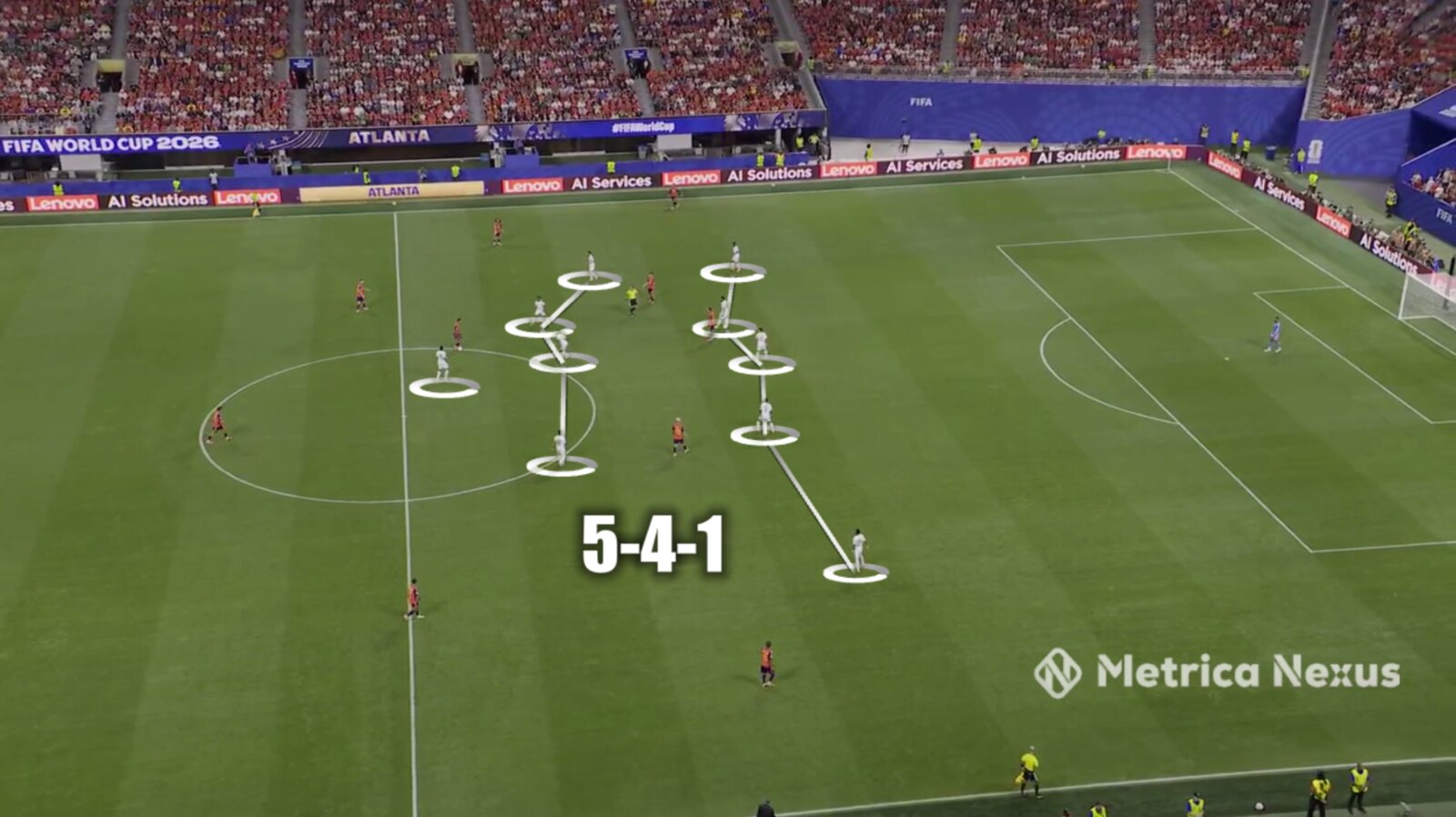
Saudi Arabia in low block were set up in a 5-4-1 shape. Saud drops back into the defensive line, Al-Juwayr leaves Firas up front as a lone striker, and drops back as a winger in midfield in Saud’s position.
Spain, in the final third, were lined up as: Cubarsi and Laporte, with Rodri in front of them. On the right, Lamine Yamal, Olmo, and Porro. On the left, Baena, Pedri, and Cucurella. And through the middle, Oyarzabal.
This shape is just a starting point, and it keeps changing constantly with the movements and interchanges between the trio on both wings.
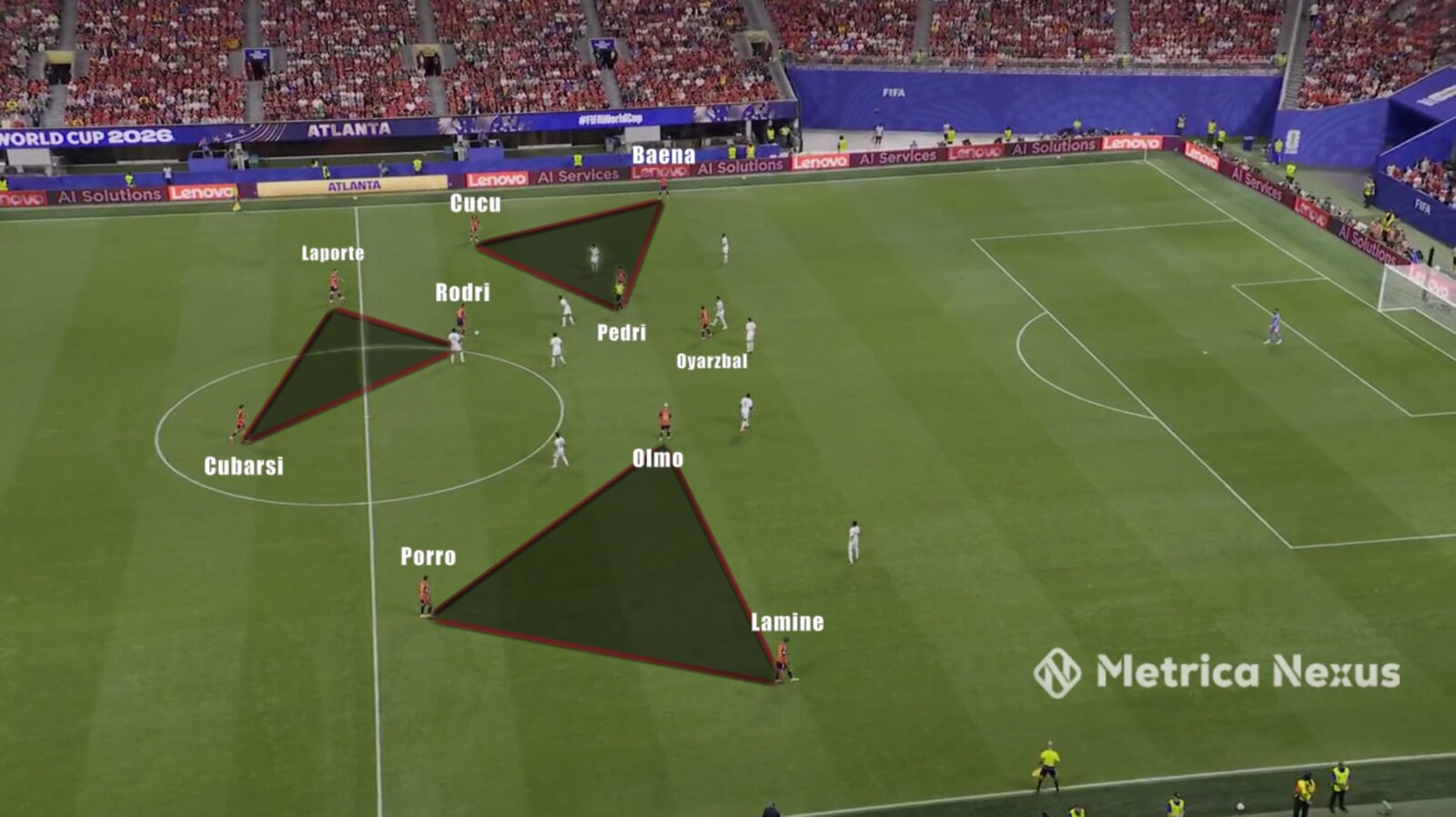
Spain relied on two main ideas.
-
The first was creating an overload and stacking players on one wing, then switching play to the other side to create a 1-vs-1 or 2-vs-2 situation, then whipping a cross into the box.
-
As for the second idea, it was playing through the middle, by pinning the right center-back Al-Amri and creating an overload against him, which forces him to step out of his position, then someone attacks the space he leaves behind.
Here we’ll see the ball with Rodri, Oyarzabal drops deep with Al-Amri tracking him, and at the same time Pedri attacks the space.
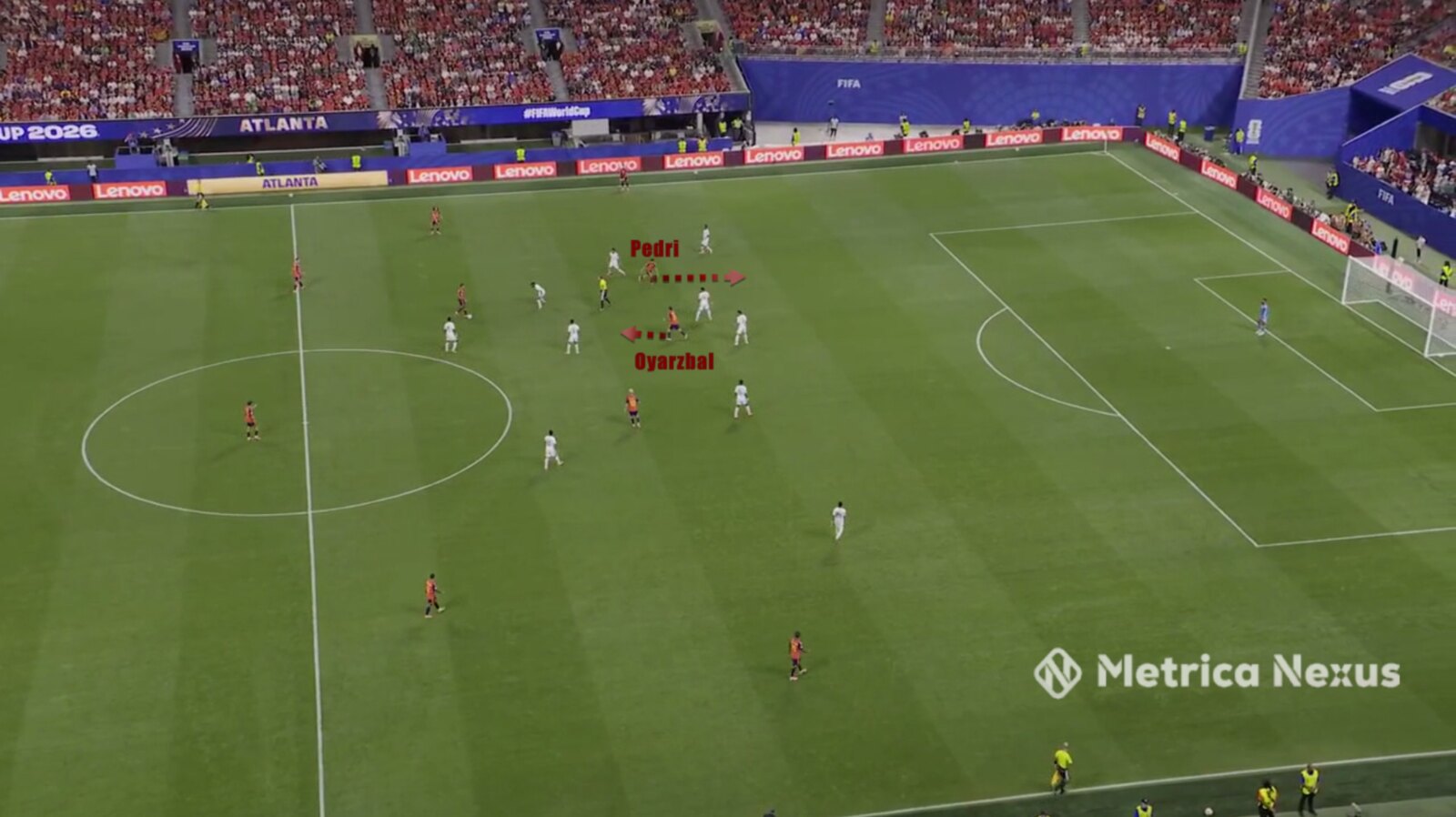
But Rodri doesn't play it to Pedri and passes it to Cucurella.
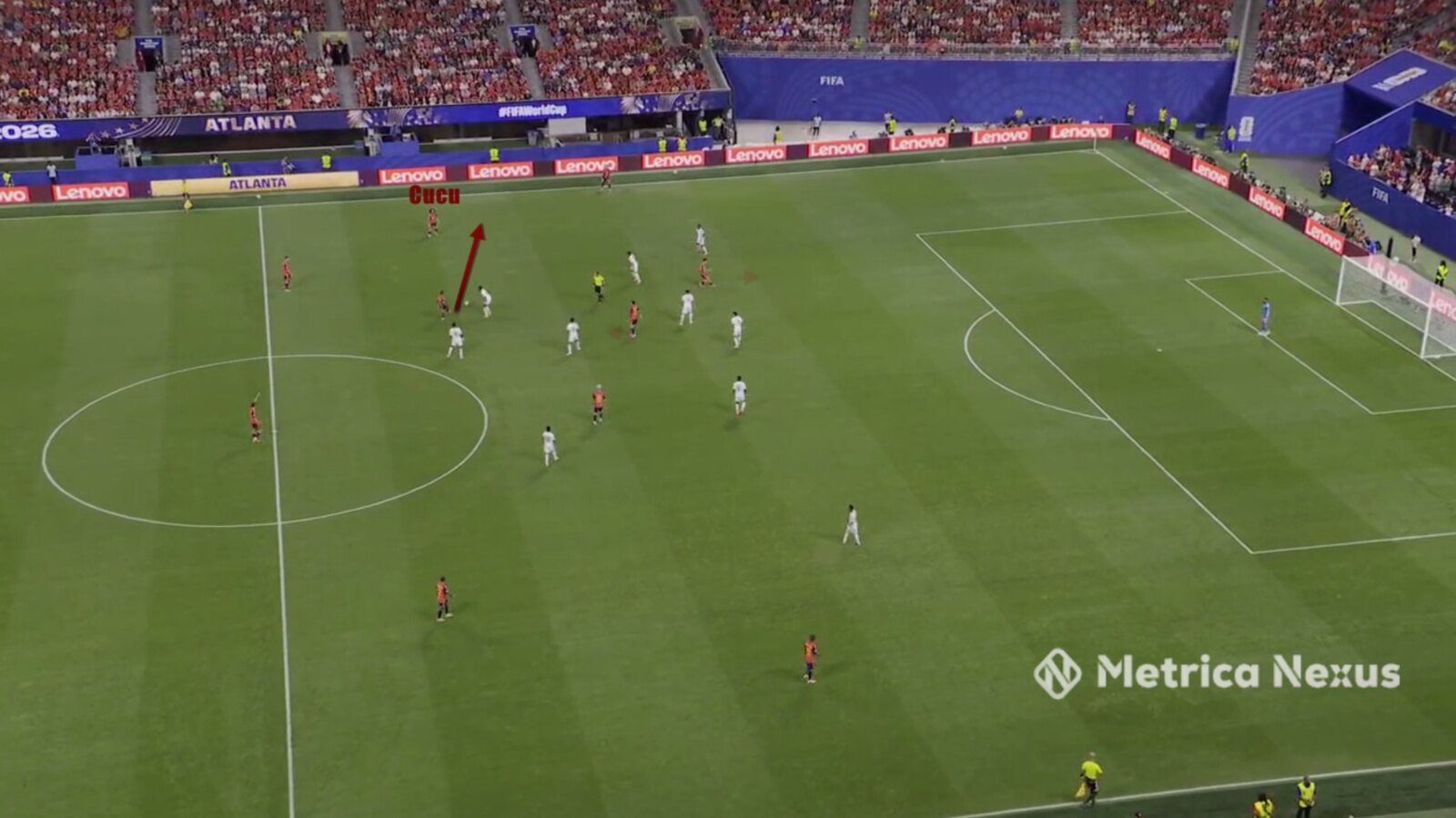
Al-Juwayr steps out to Cucurella, Saud is ready to step out to Baena, Oyarzabal goes to pin Al-Amri, and Pedri drops again into space. Pass from Cucurella to Pedri, who turns and plays Baena through.
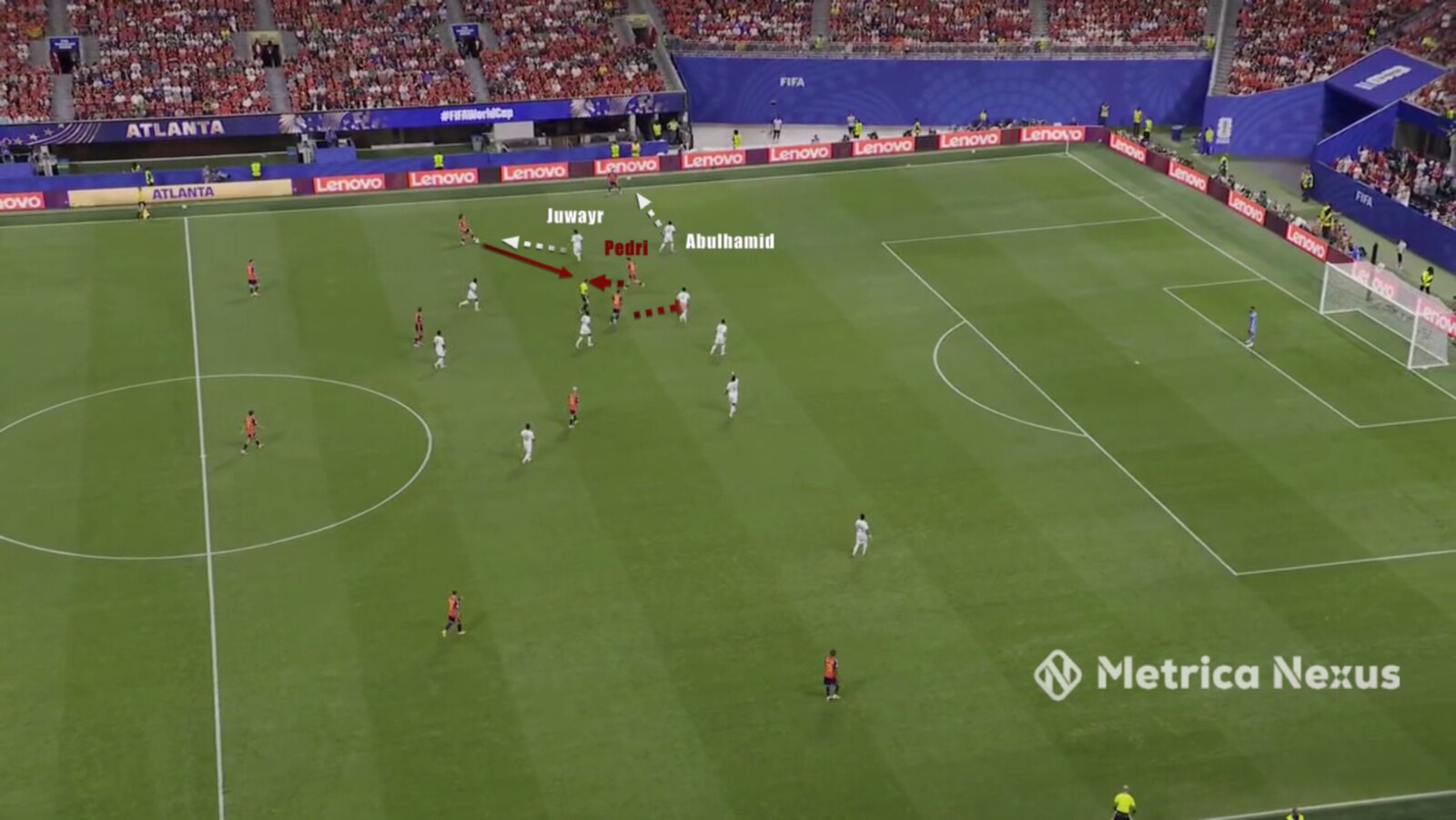
Baena finds himself in a 1-vs-1 situation, with options to play in behind or to drop back again.
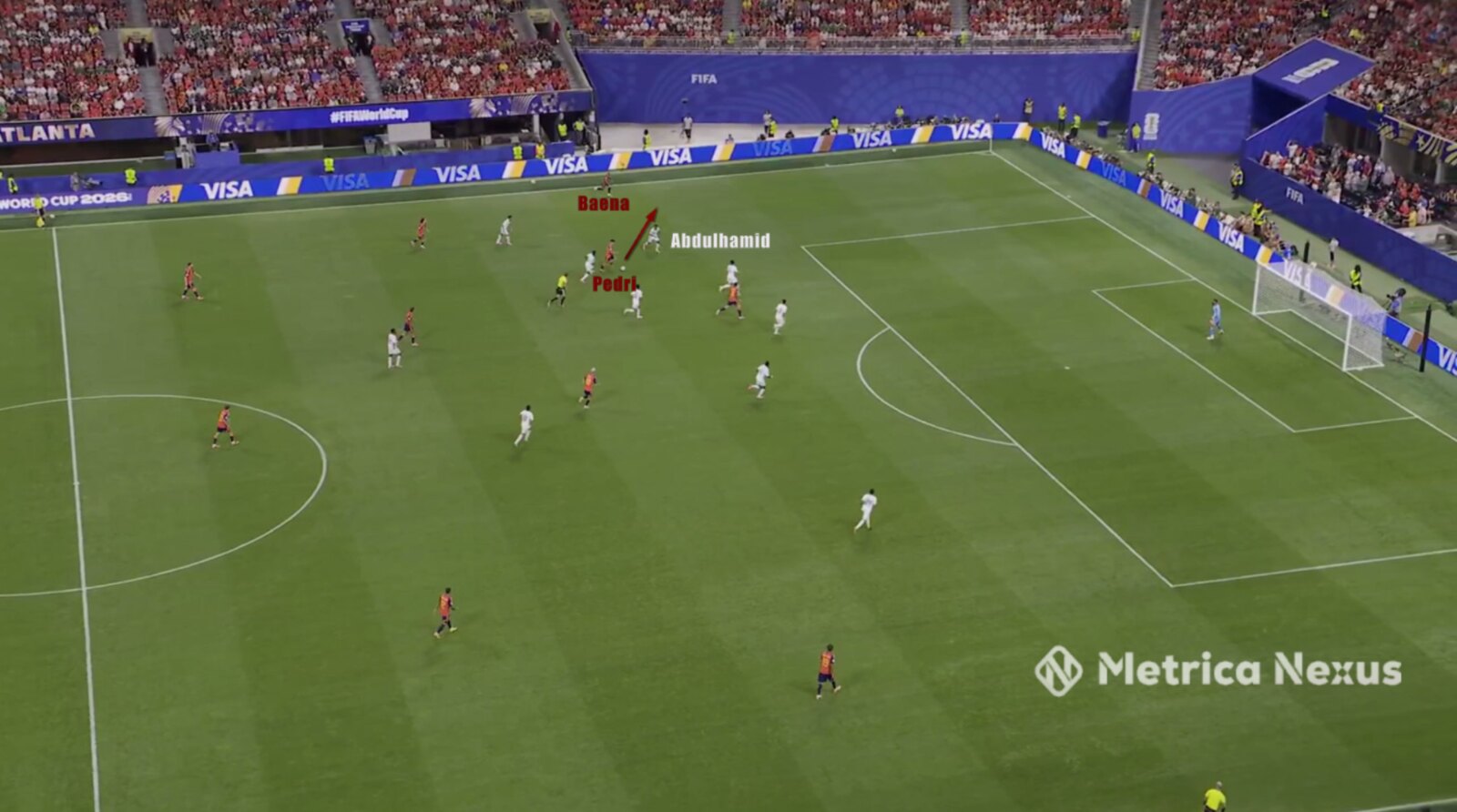
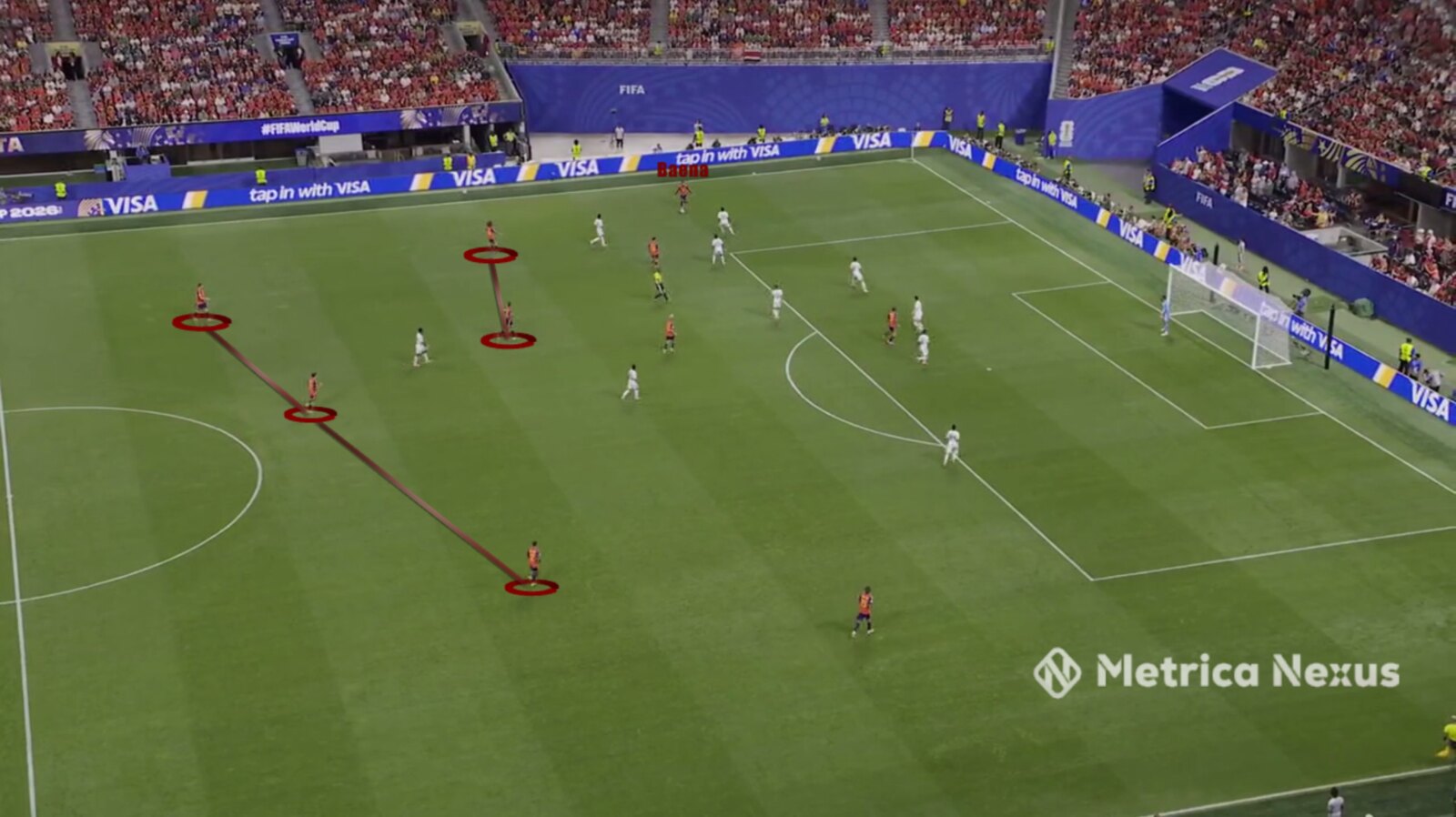
Another thing from Spain's setup is their readiness for transitions through their Rest Defence, which meant that even when the ball was intercepted, they were able to win it back quickly.
Olmo comes over to the left side to pull Khaibari with him, and Salem also shifts with them, which leaves Porro and Lamine free on the other side.
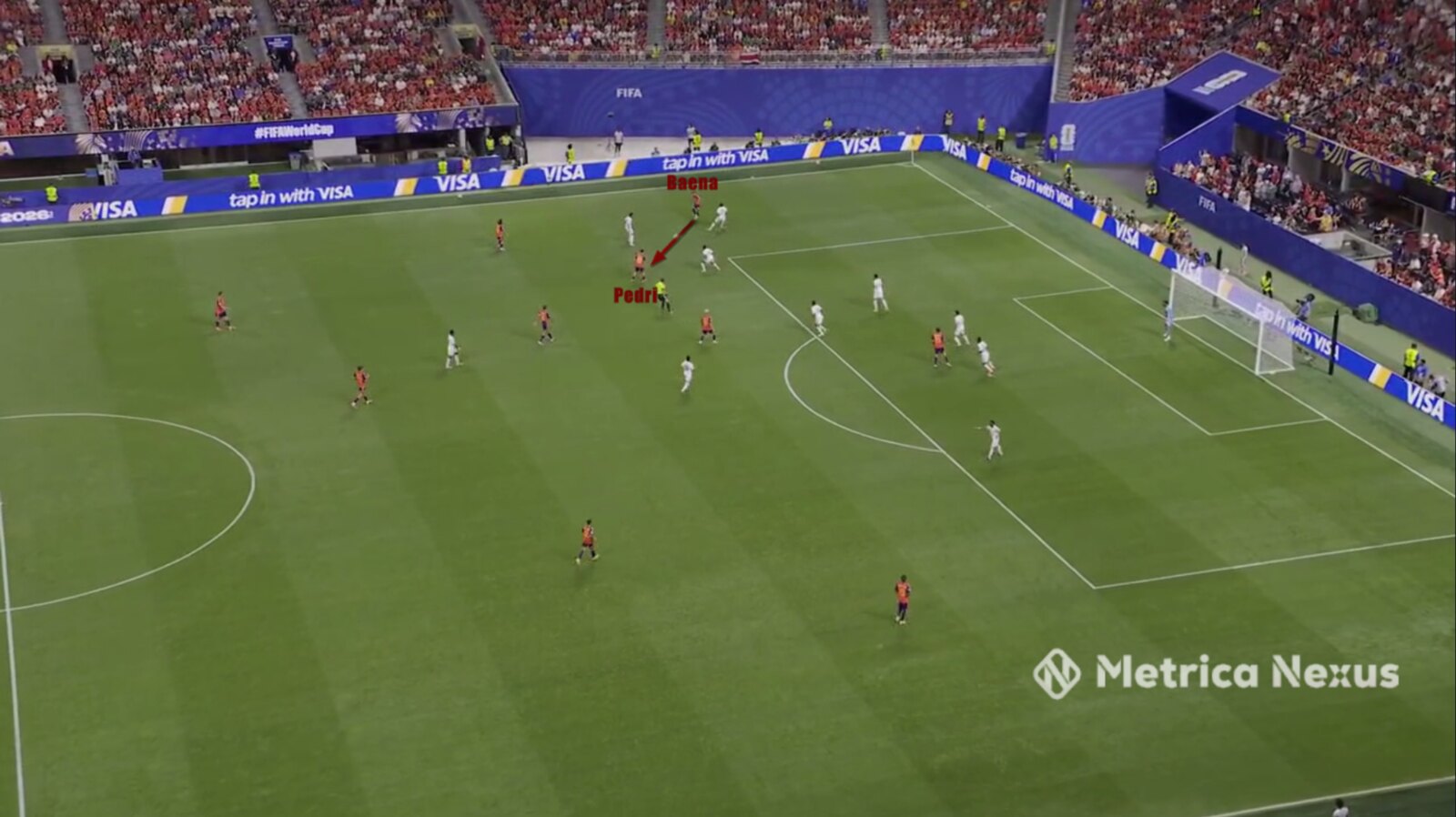
From Pedri to Porro.
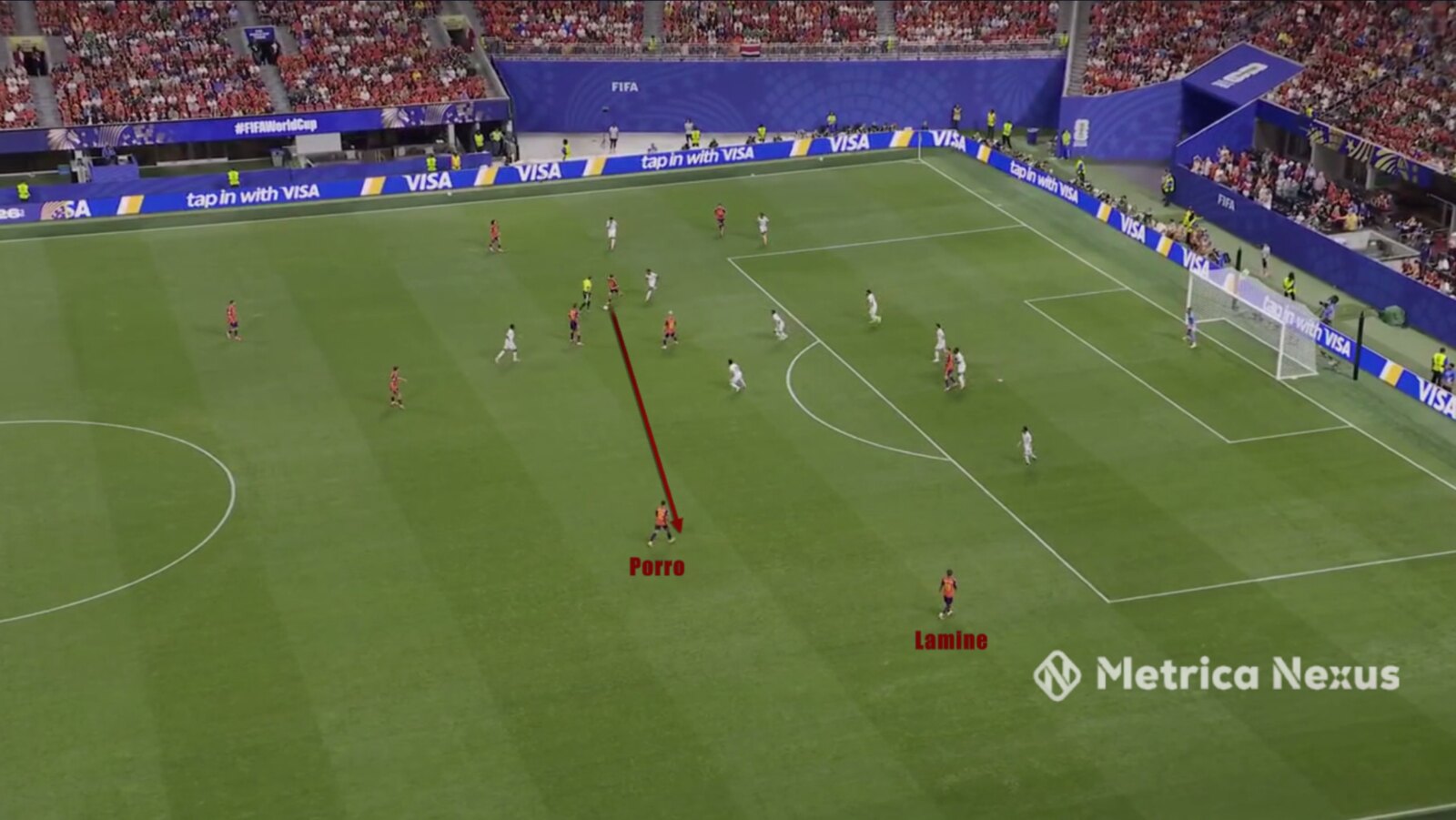
Salem gets pulled out of position, but this is a situation Lamine loves: 2-vs-2 with Porro.
Porro to Lamine.
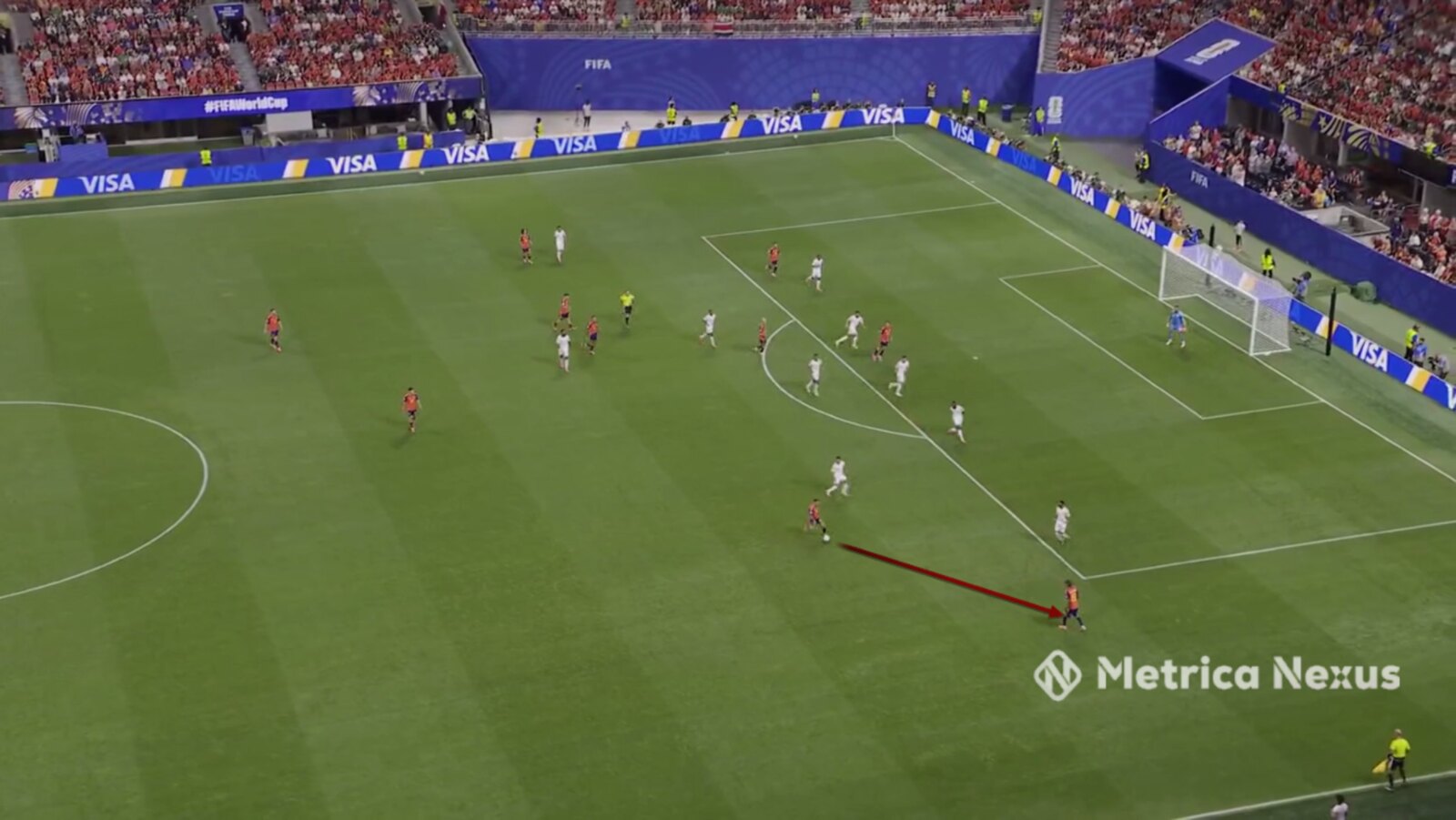
And a cross to the far post, which Spain attacks with a numerical advantage through Olmo, Oyarzabal, and Baena. And here we see another benefit of shifting Olmo to the left, which is that when the cross comes in, he's closer to attacking the box and creates a numerical overload alongside Baena and Oyarzabal.
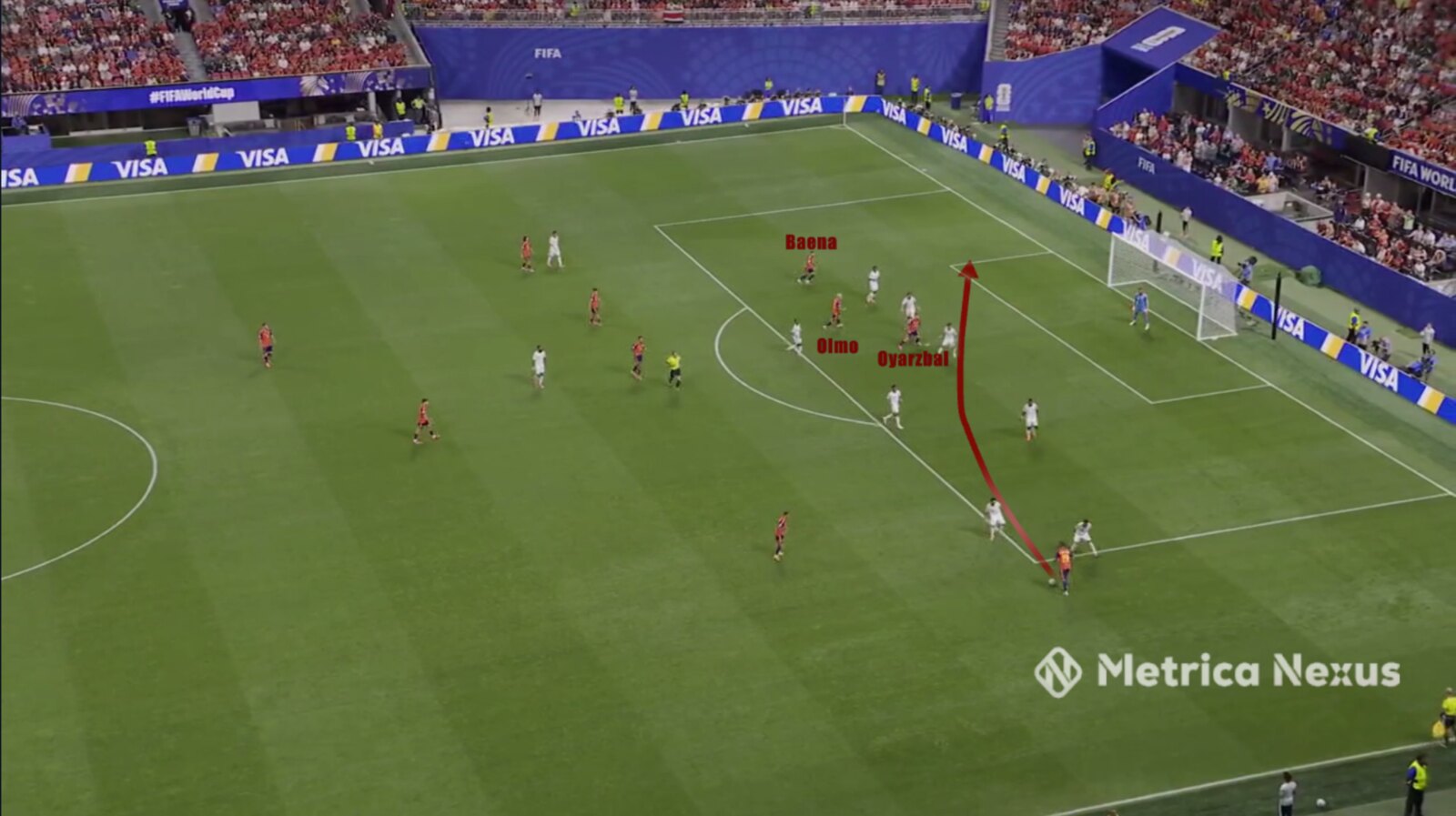
But the Saudi defender clears it away.
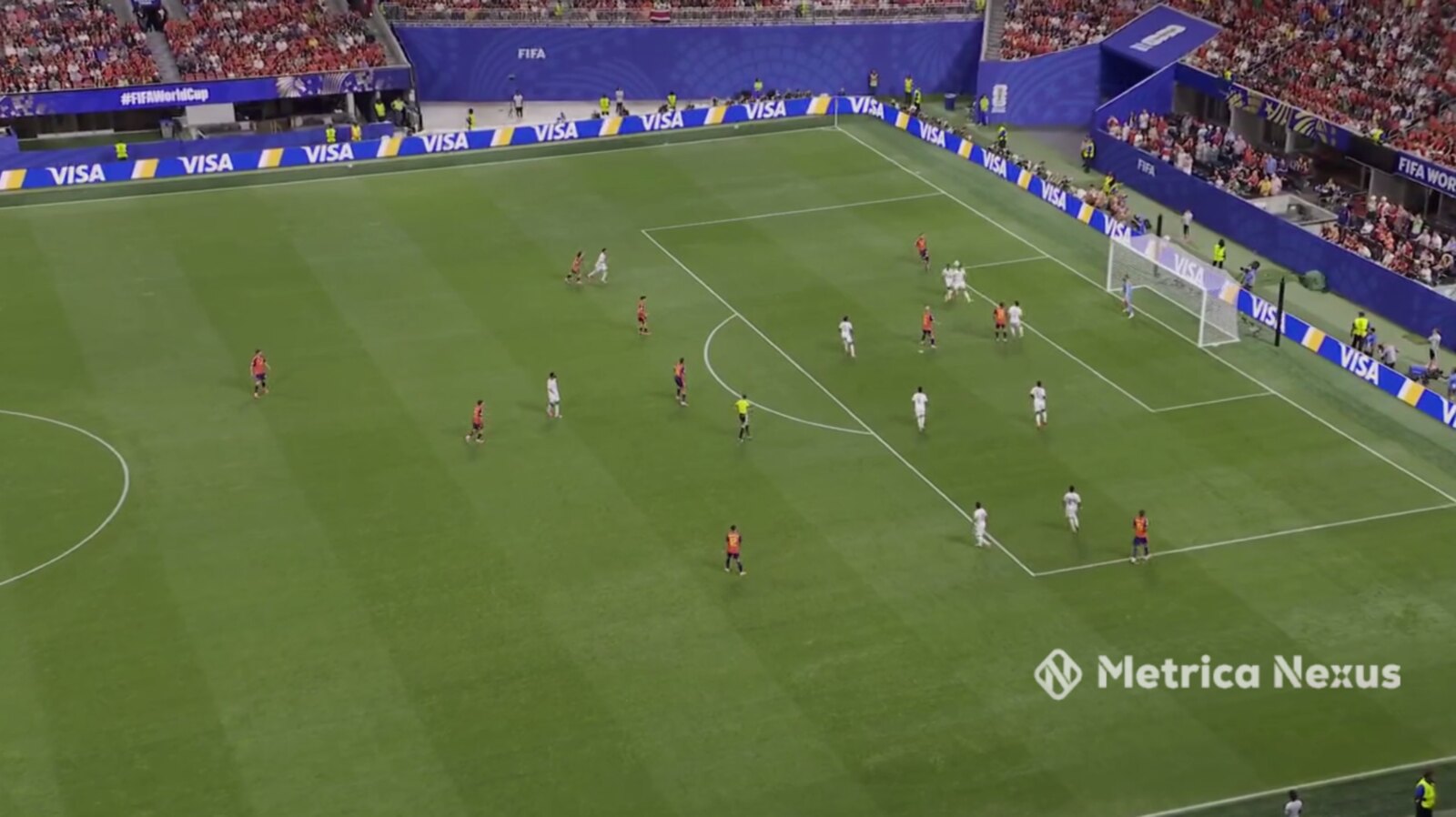
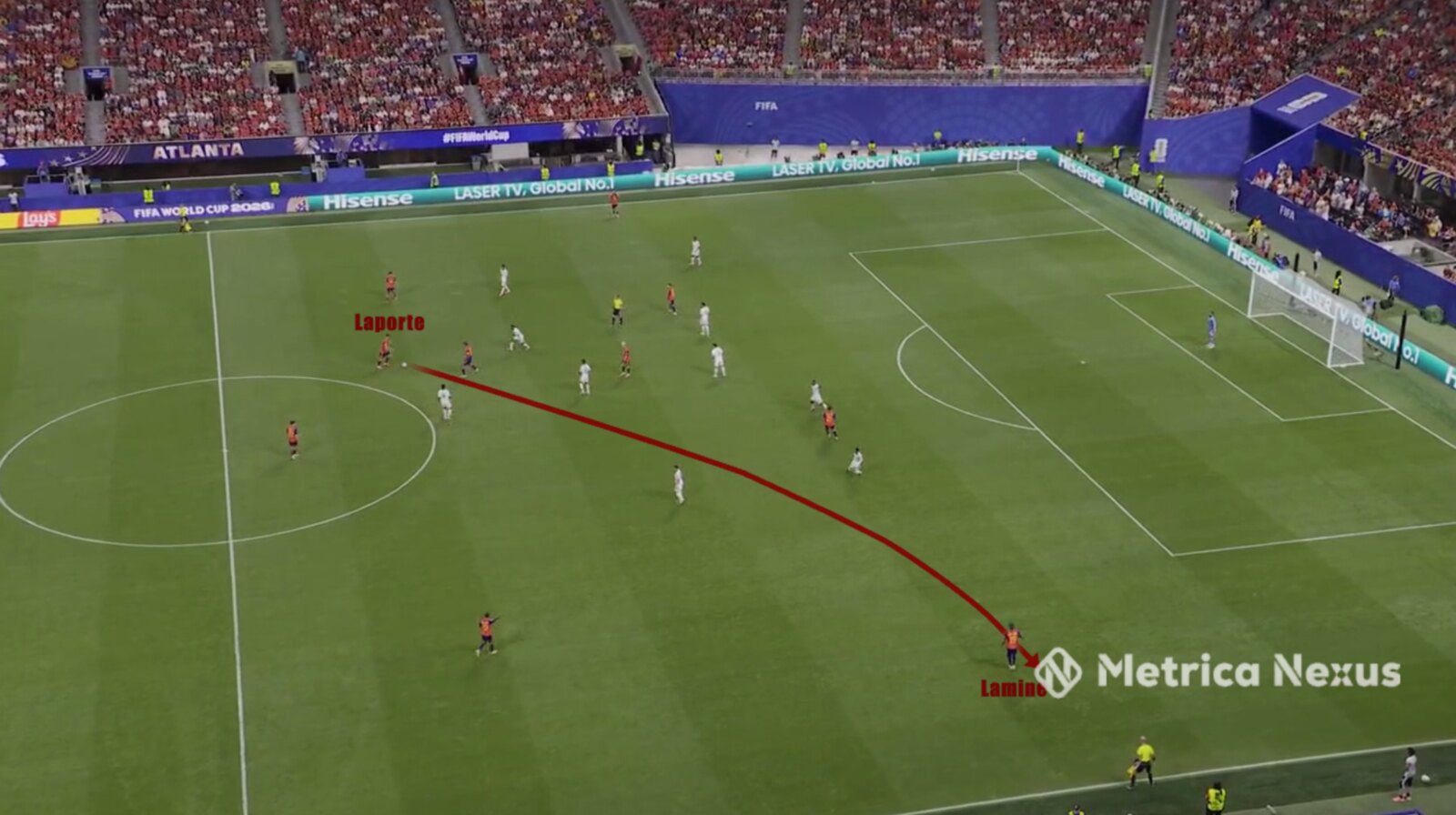
Once again, Spain overloads the left side, and Laporte switches play with one touch to Lamine.
Lamine in a 1-vs-1 situation, with the same far-post attacking runs into the box from Olmo, Oyarzabal, and Baena.
Lamine draws Tambakti with him, as well as Salem and Al-Harbi.
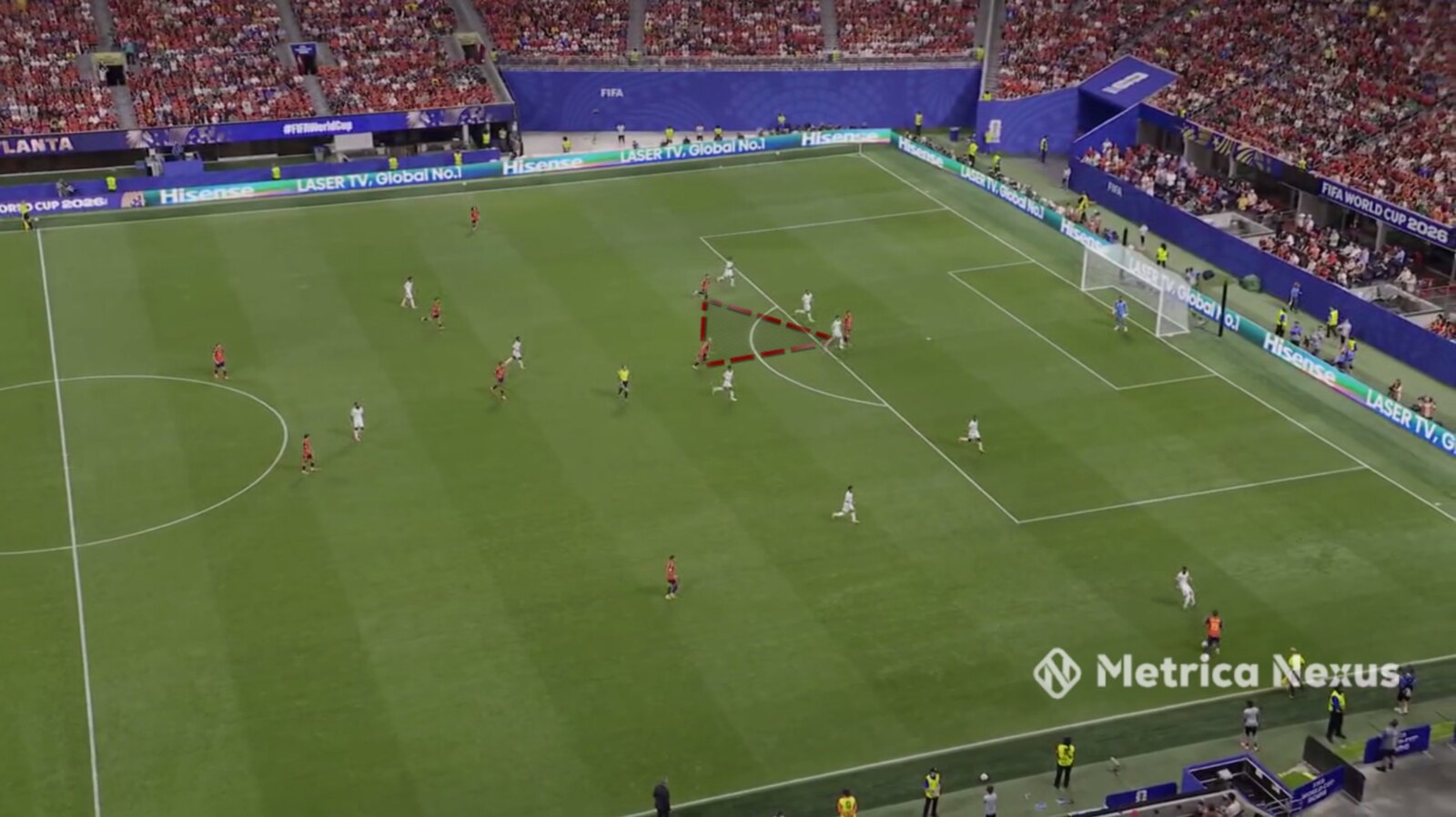
And that leaves Olmo attacking the space Tambakti left behind, and creates better positioning for Spain's players across the width of the pitch.
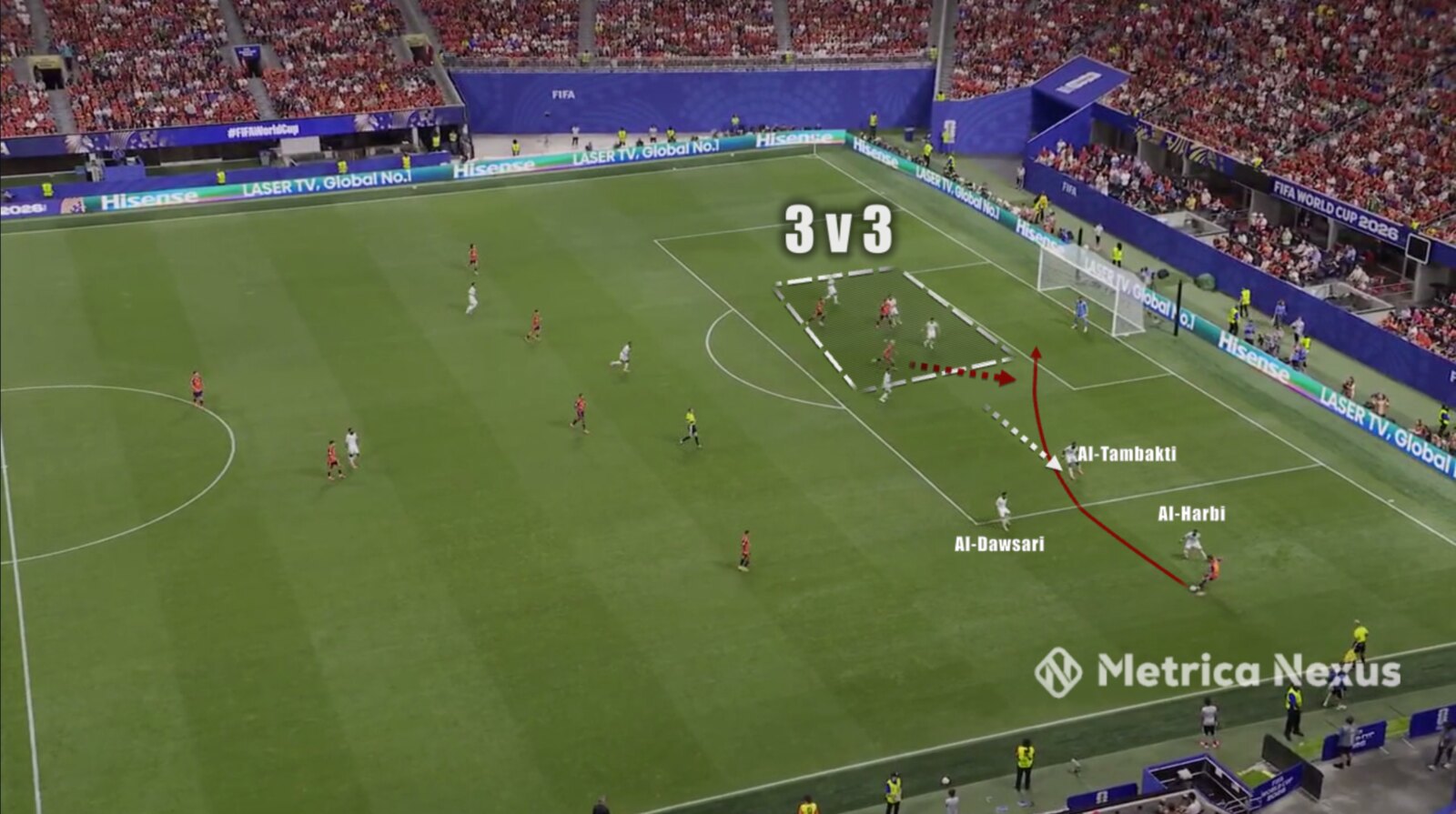
But Olmo arrives just a fraction too late, and the ball ends up in Al-Owais's hands.
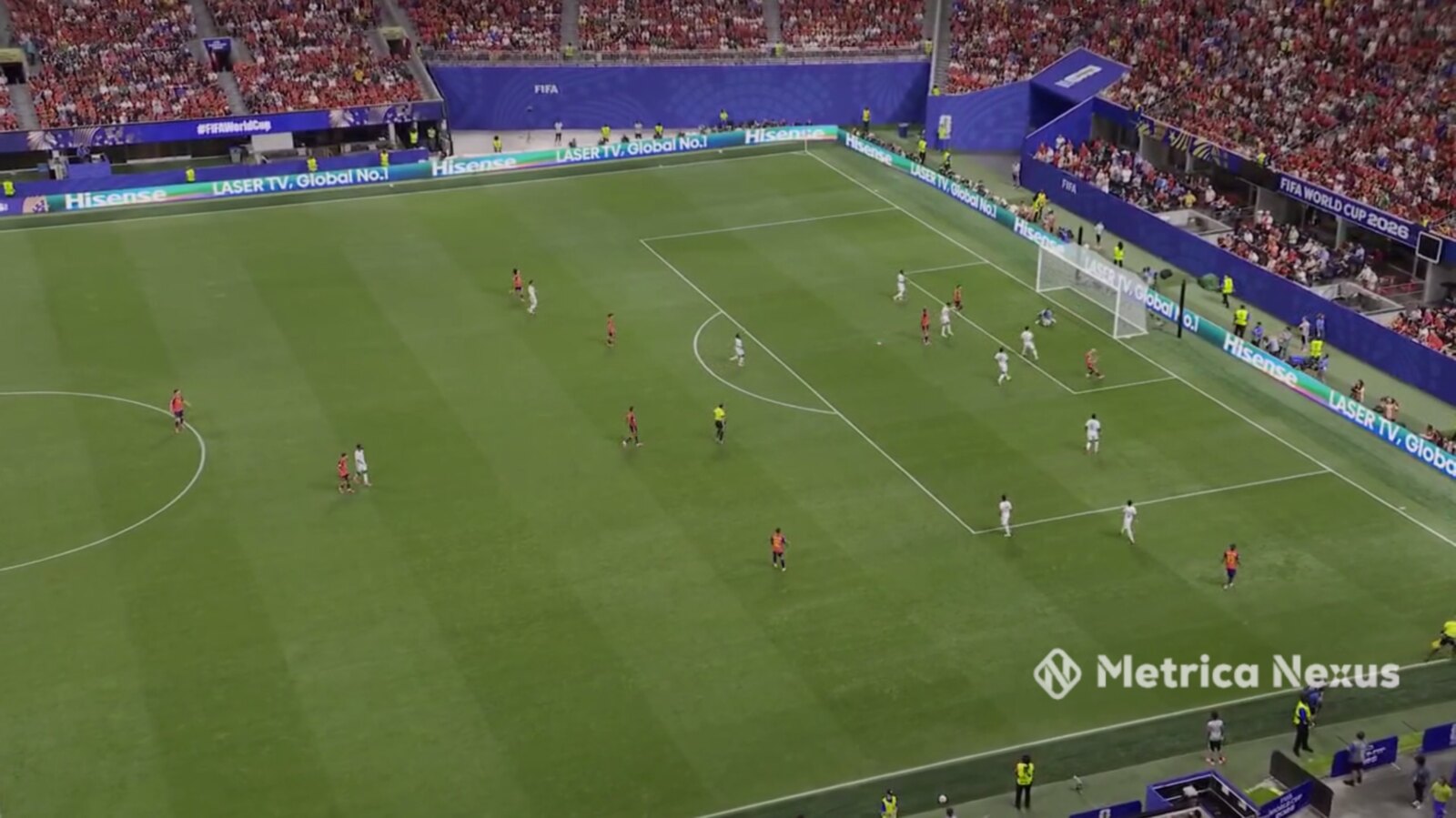
Once again, Baena cuts inside and plays it out wide to Porro.
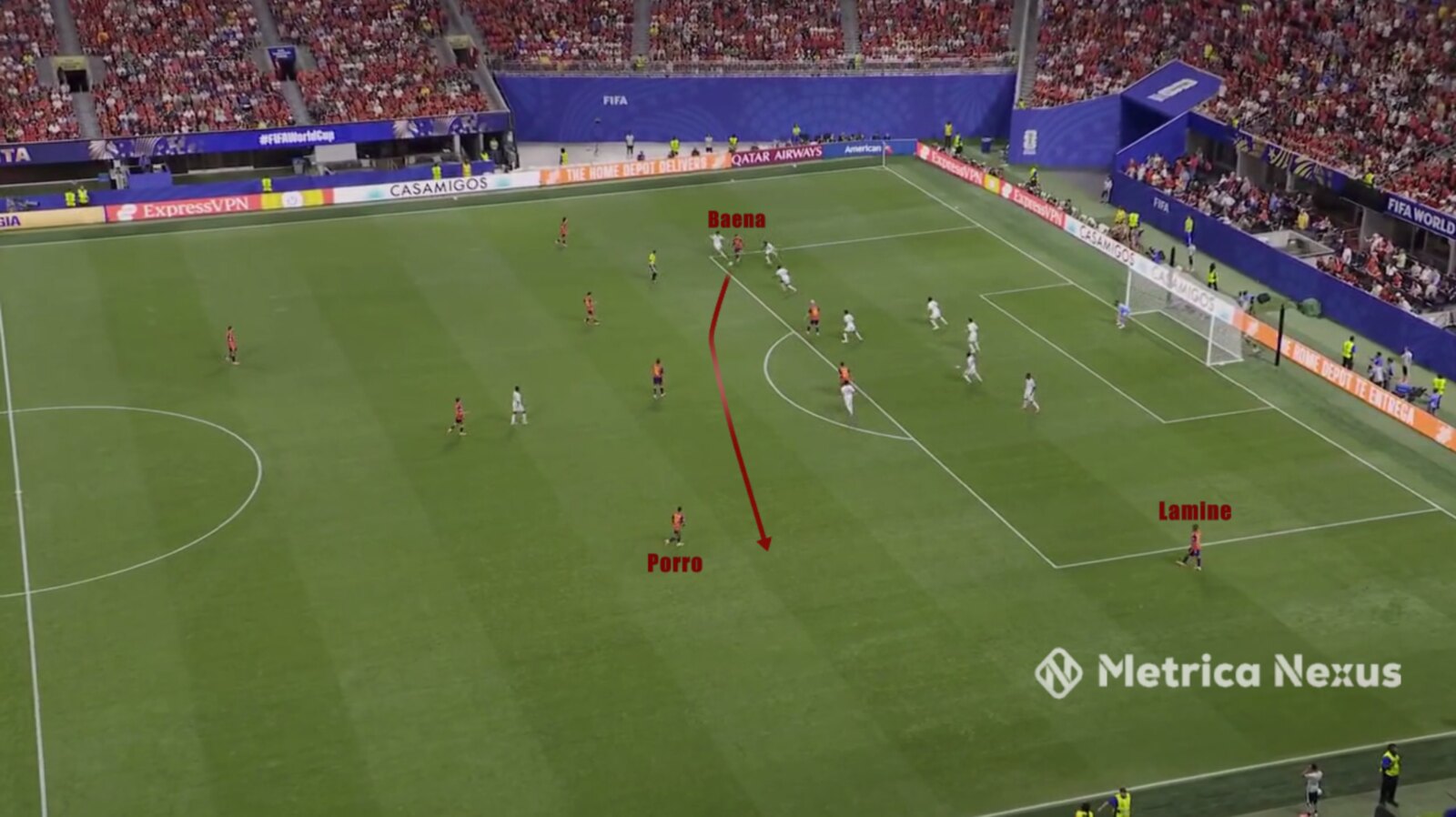
Porro receives the ball, and Al-Harbi, Tambakti, and Lajami are all set, expecting the ball to be played to Lamine. But the cross is played by Porro to Olmo, Cucurella, and Baena.
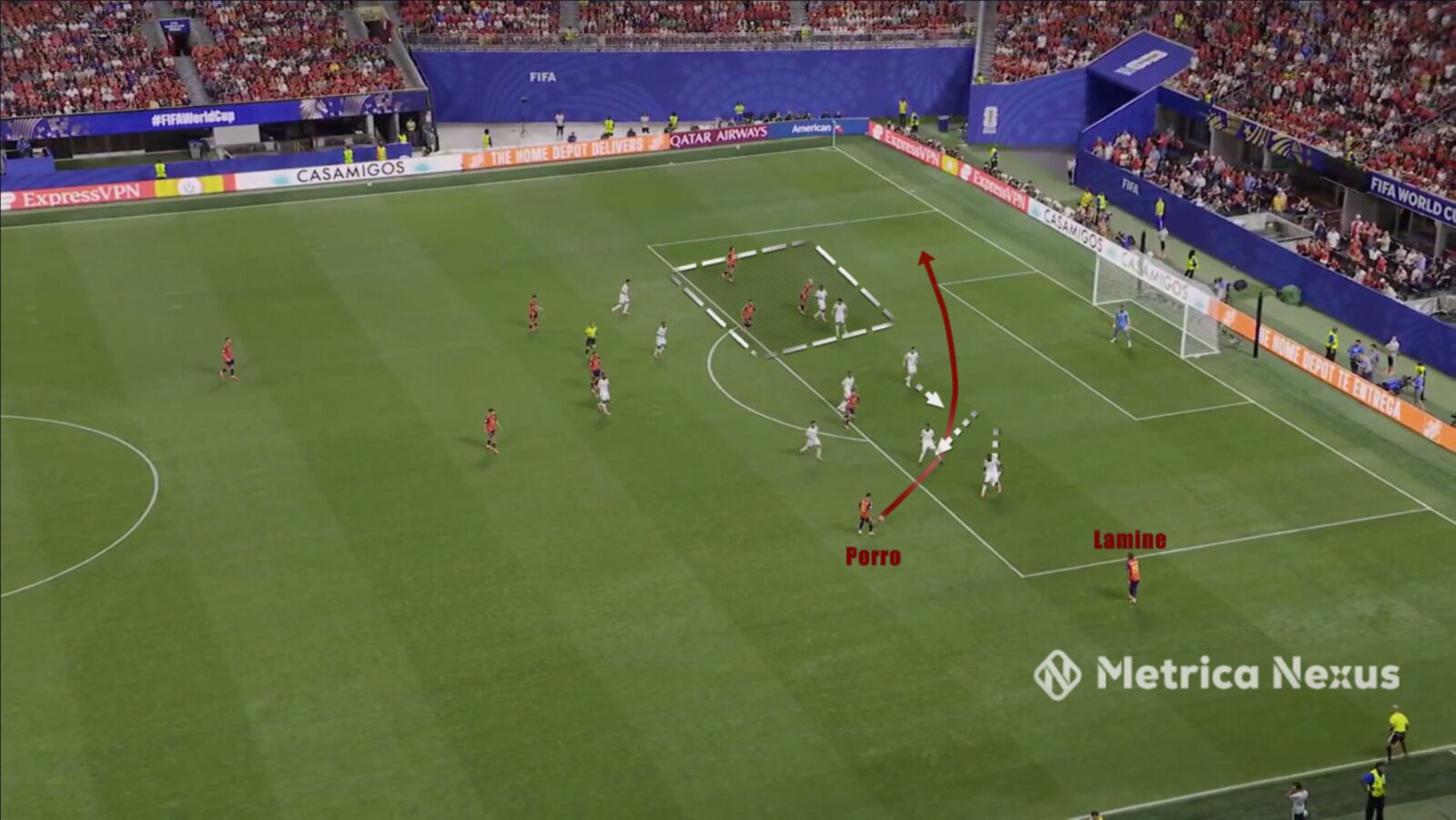
It gets deflected from Cucurella to Olmo, and Olmo knocks it to the far post.
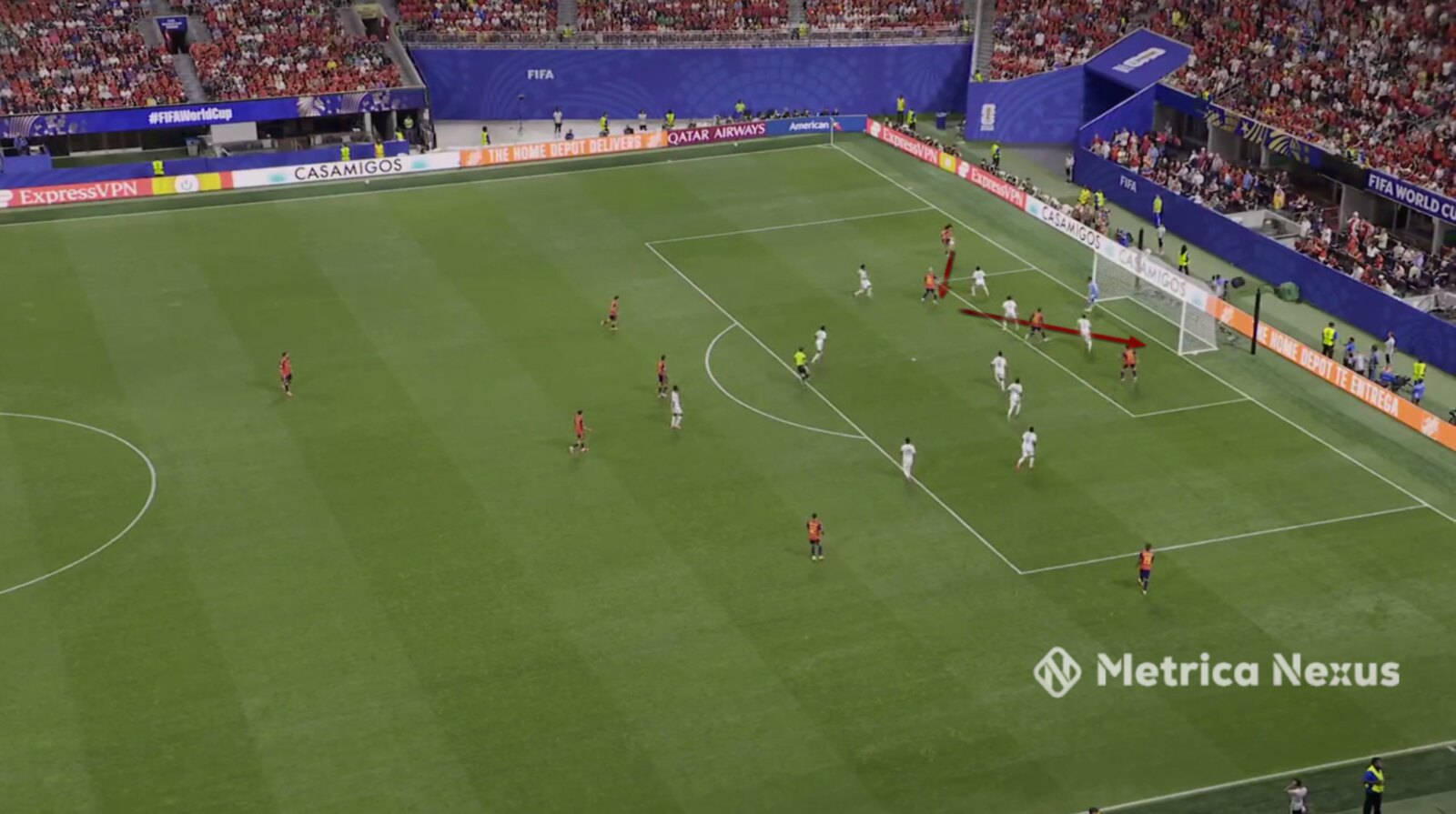
And Oyarzabal scores.
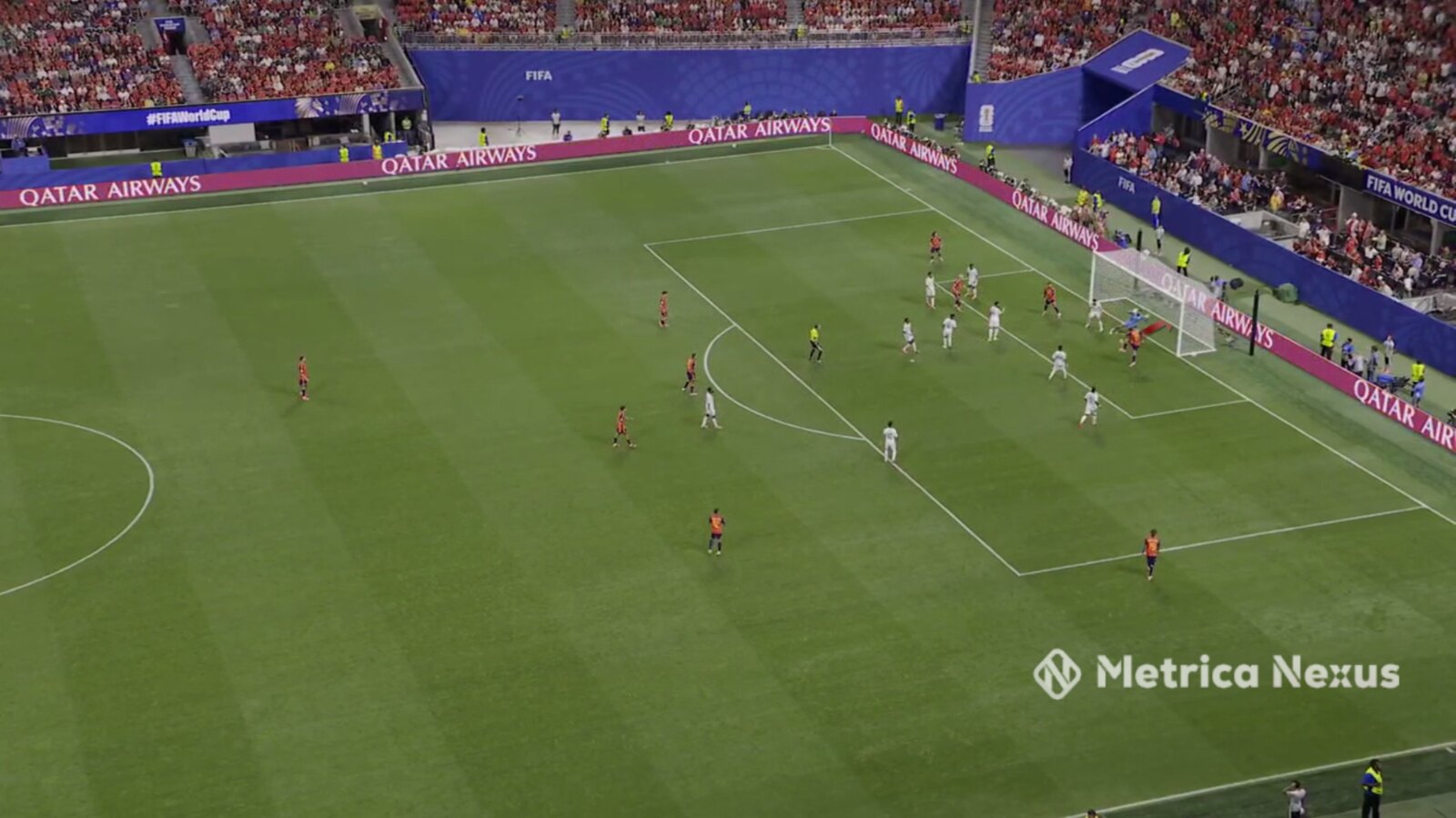
One of the advantages the national team provides for Lamine, which doesn’t happen at Barcelona, is that with the presence of an offensively strong full-back like Porro, it gives the team a solution from dangerous areas. If the opponent decides to defend against Yamal with more than one player, he can easily play a pass back, and the full-back will have time on the ball to play a cross or shoot from a dangerous position.
Second, the full-back’s ability to make runs from deep gives Lamine more time in 1-vs-1 situations or an easy passing option inside.
Third, the full-back’s ability to open up the flank allows Lamine to receive the ball in positions closer to the goal, making it easier for him to shoot. Unlike at Barcelona, where he’s forced to take on more players in many situations just to get that shooting opportunity.
So here we’ll see Pedri passing to Rodri. Lamine and Porro are opening up the other side, but it’s Porro who’s holding the width, while Lamine is tucked inside.
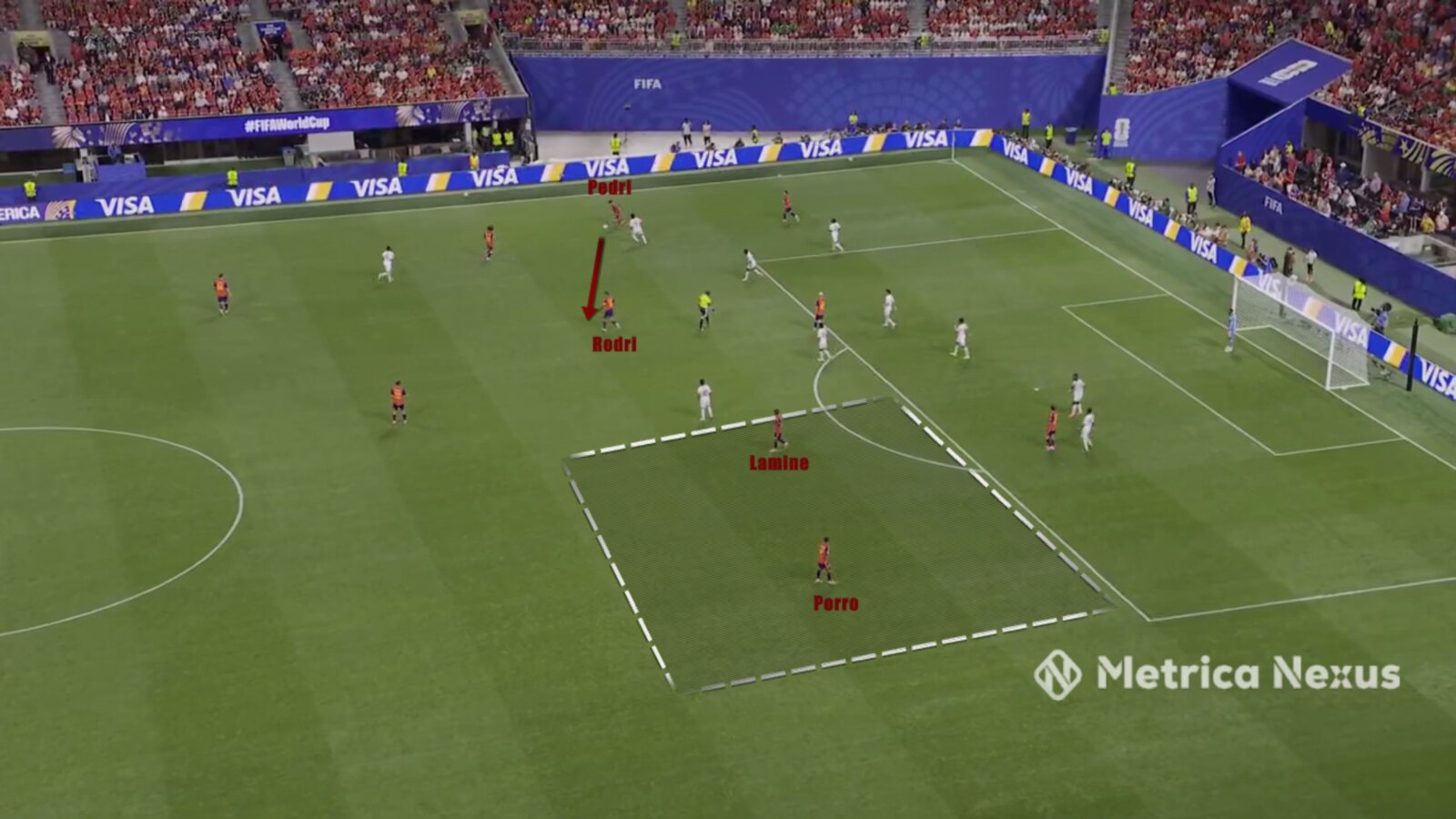
Rodri receives, Lamine drops to receive to feet, and Porro runs to open up the width.
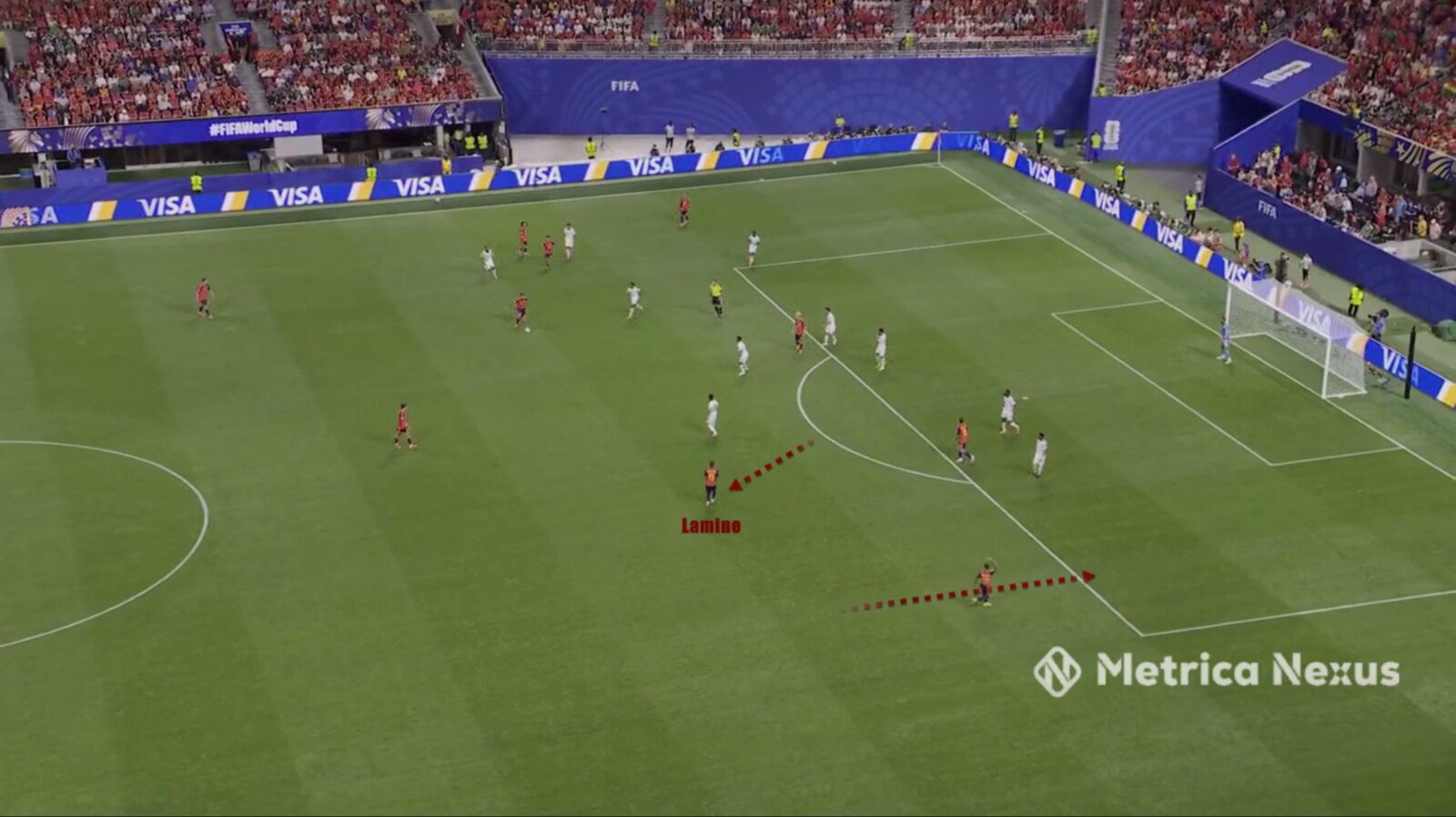
Switch from Rodri to Porro.
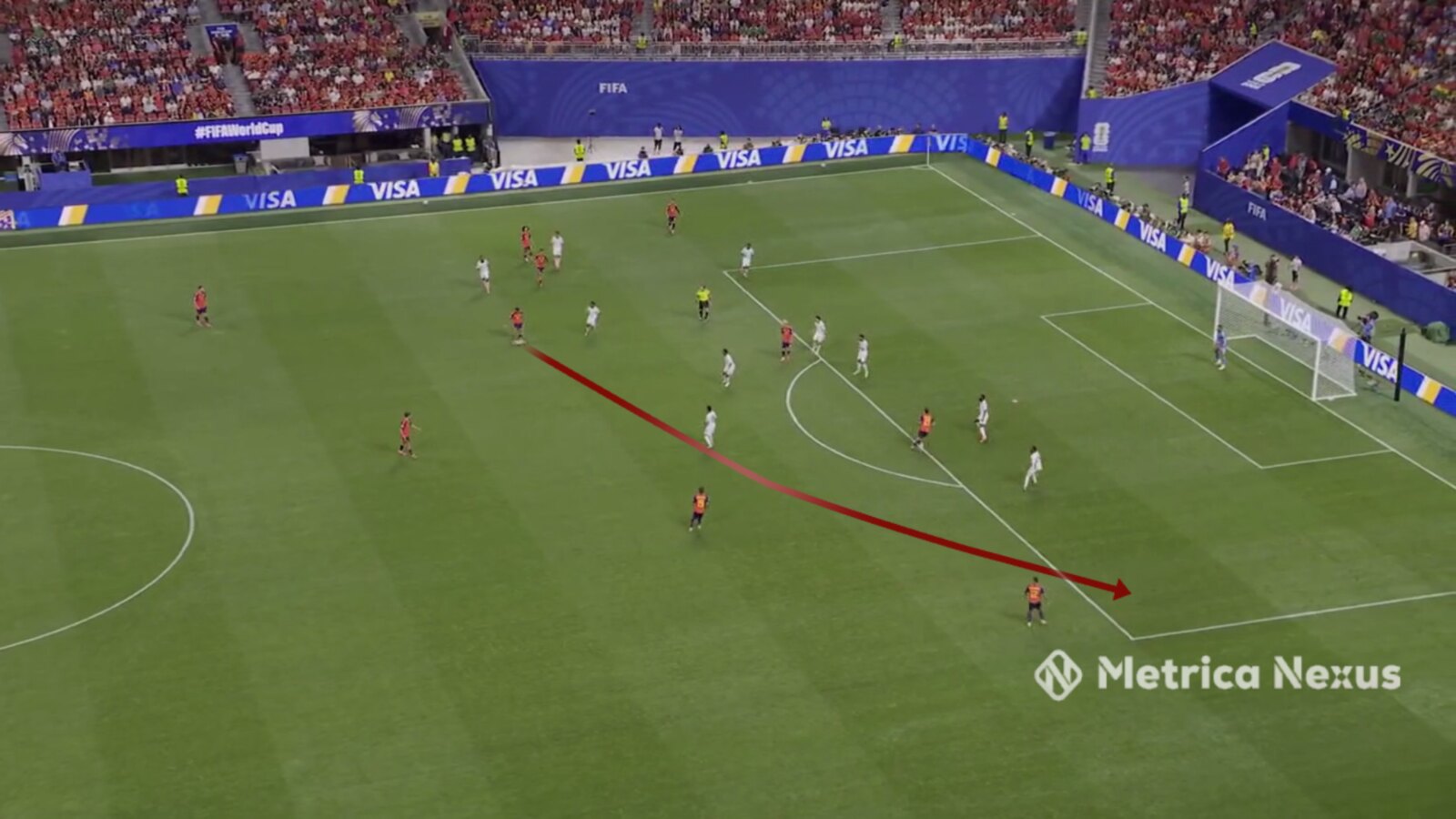
Porro passes it back to Lamine.
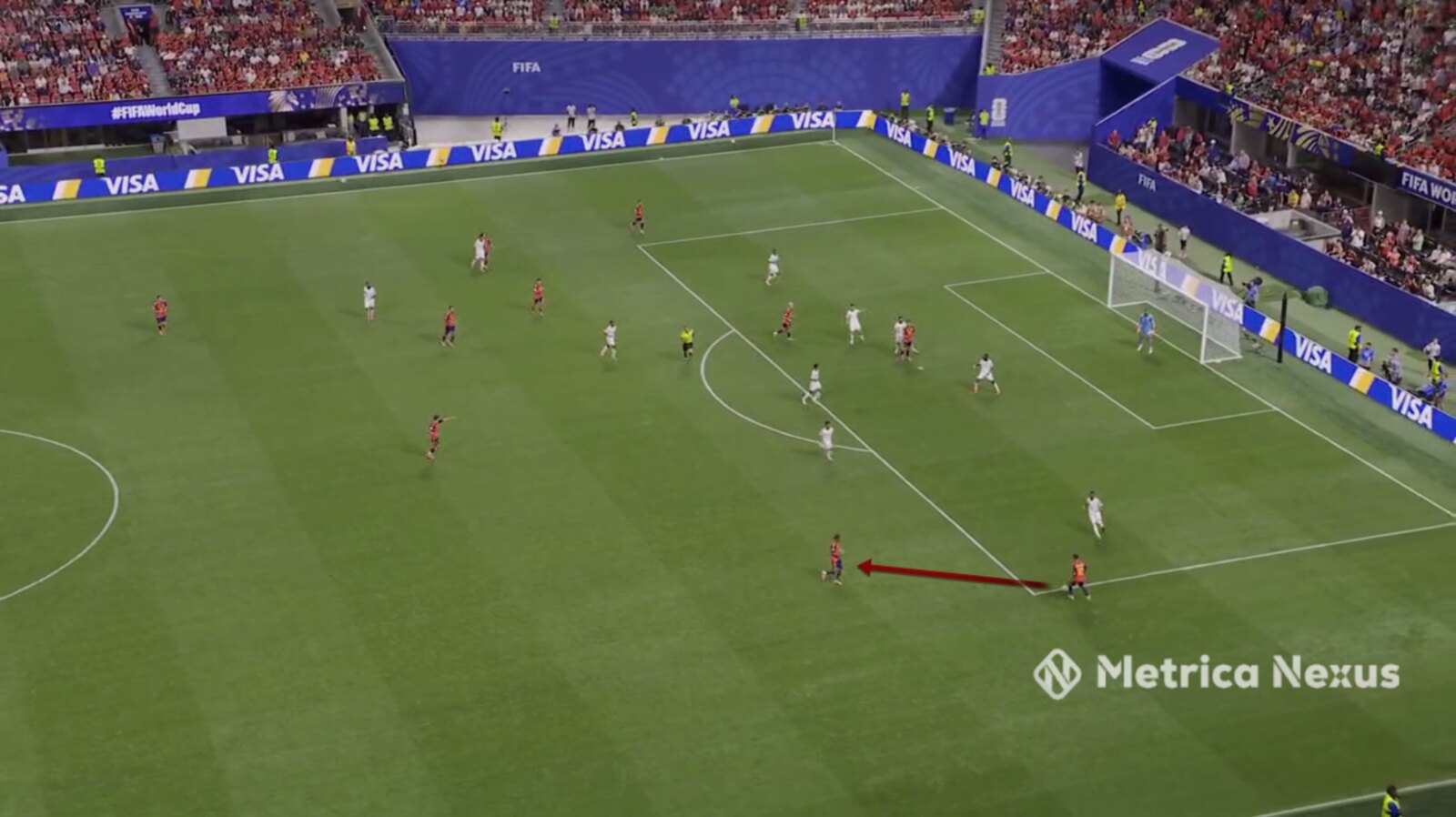
Lamine adjusts and shoots, but the ball goes wide.
The point here is that he didn’t need to take on multiple defenders to get that shot off.
Of course, this sometimes affects defensive cover, but the best player in the world needs to be given these situations, and that can be compensated for in other ways.
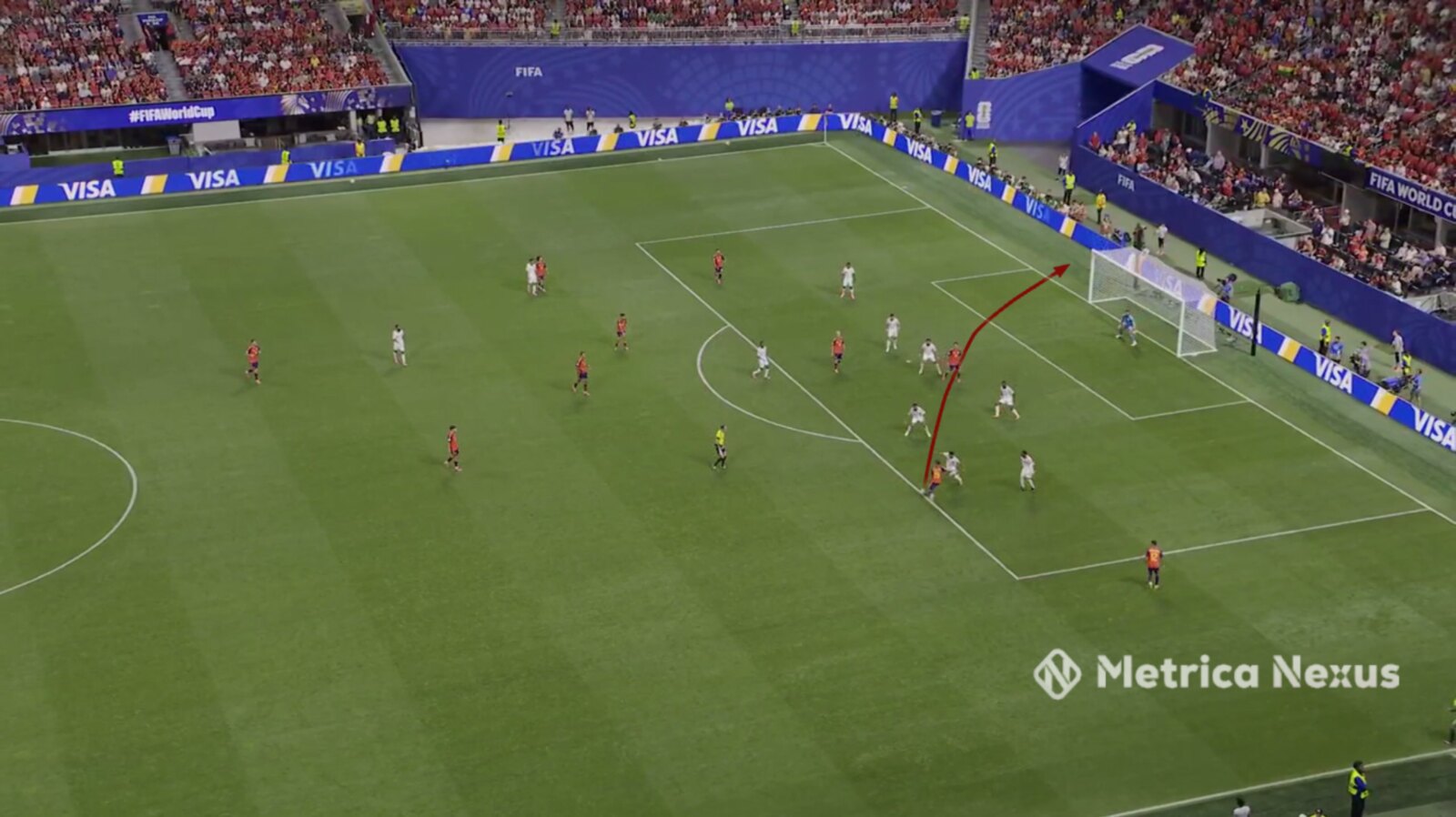
And that brings us back to the best goal of Lamine’s life so far, as he described it.
The ball is with Nacho and Jesús Navas, and the right-back is the one holding the width. Lamine is in the middle with Olmo and Fabián.
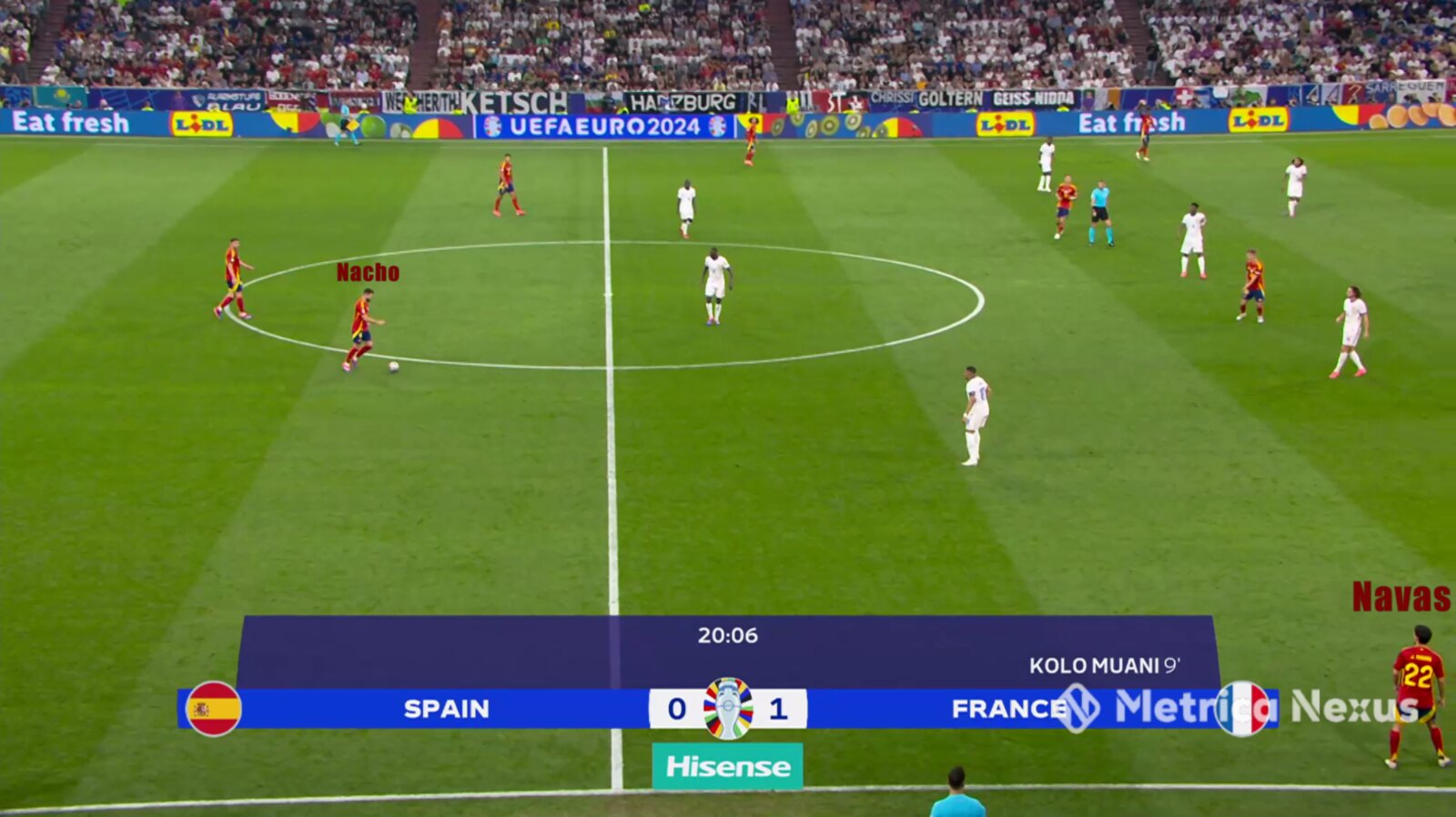
Pass from Nacho to Olmo.
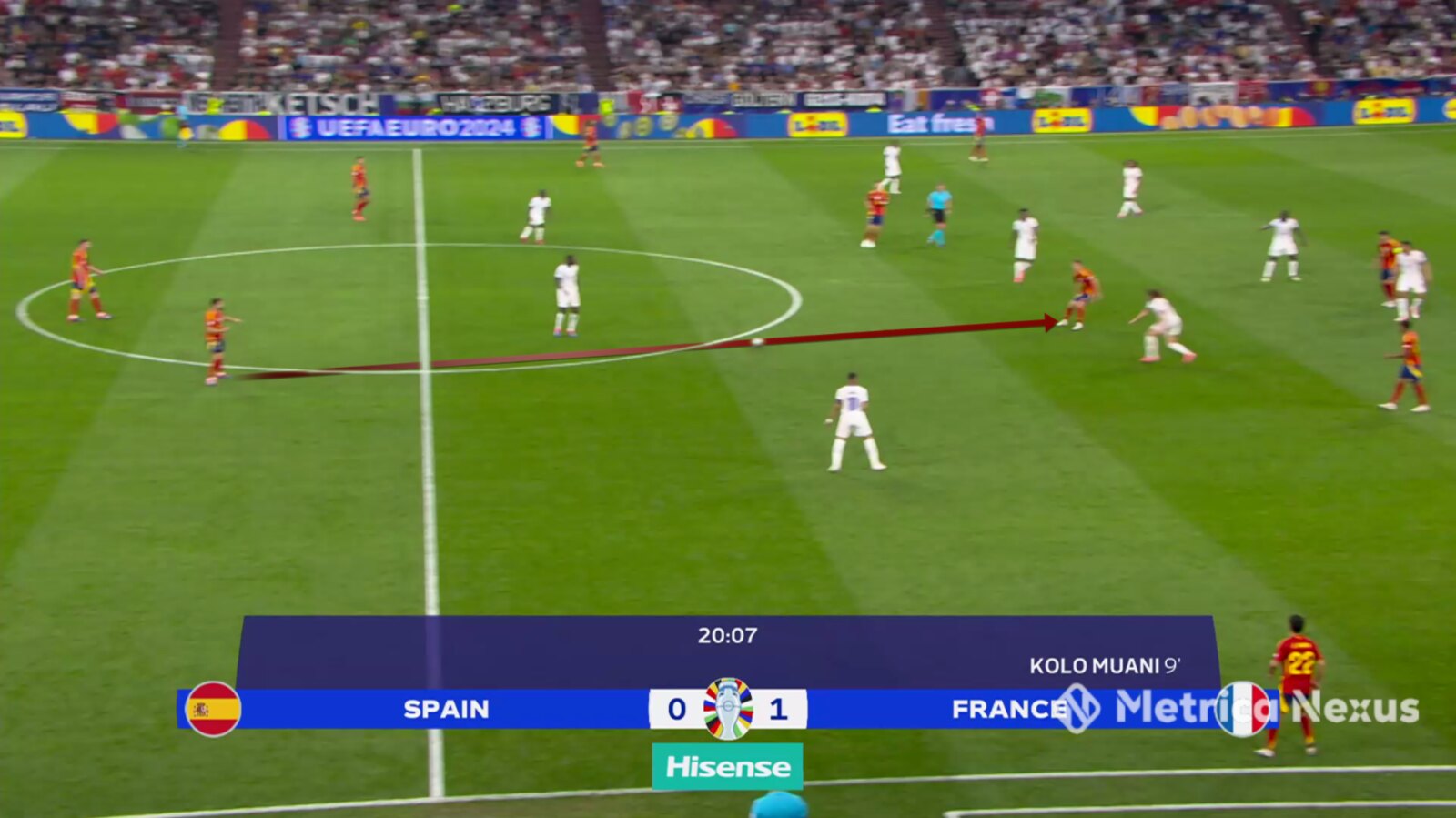
Olmo to Morata.
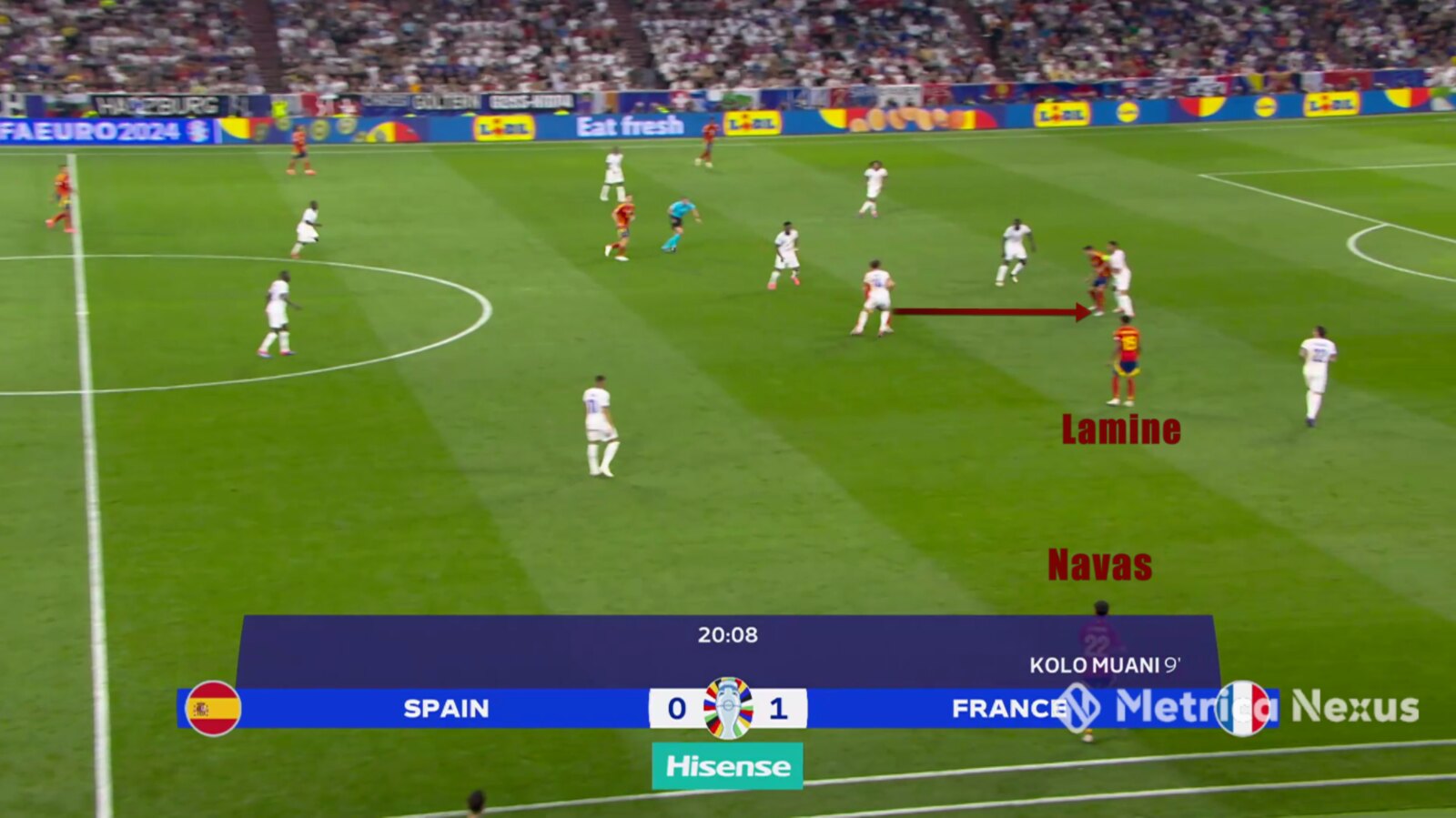
From him to Lamine.
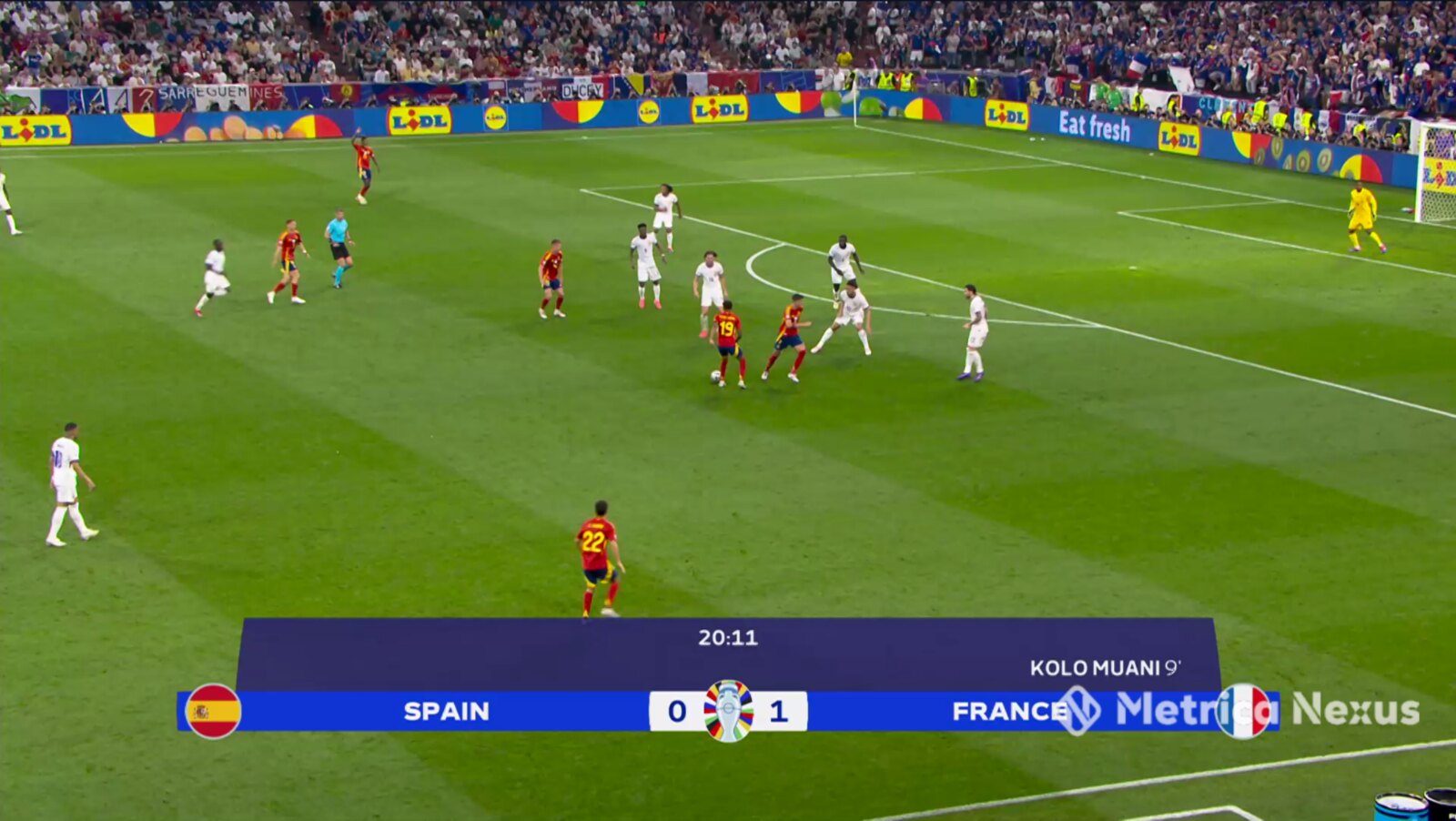
And the rest everyone knows.
A difficult shot from distance, but the same principle. Receiving it inside meant he only needed one feint to get the shot off.
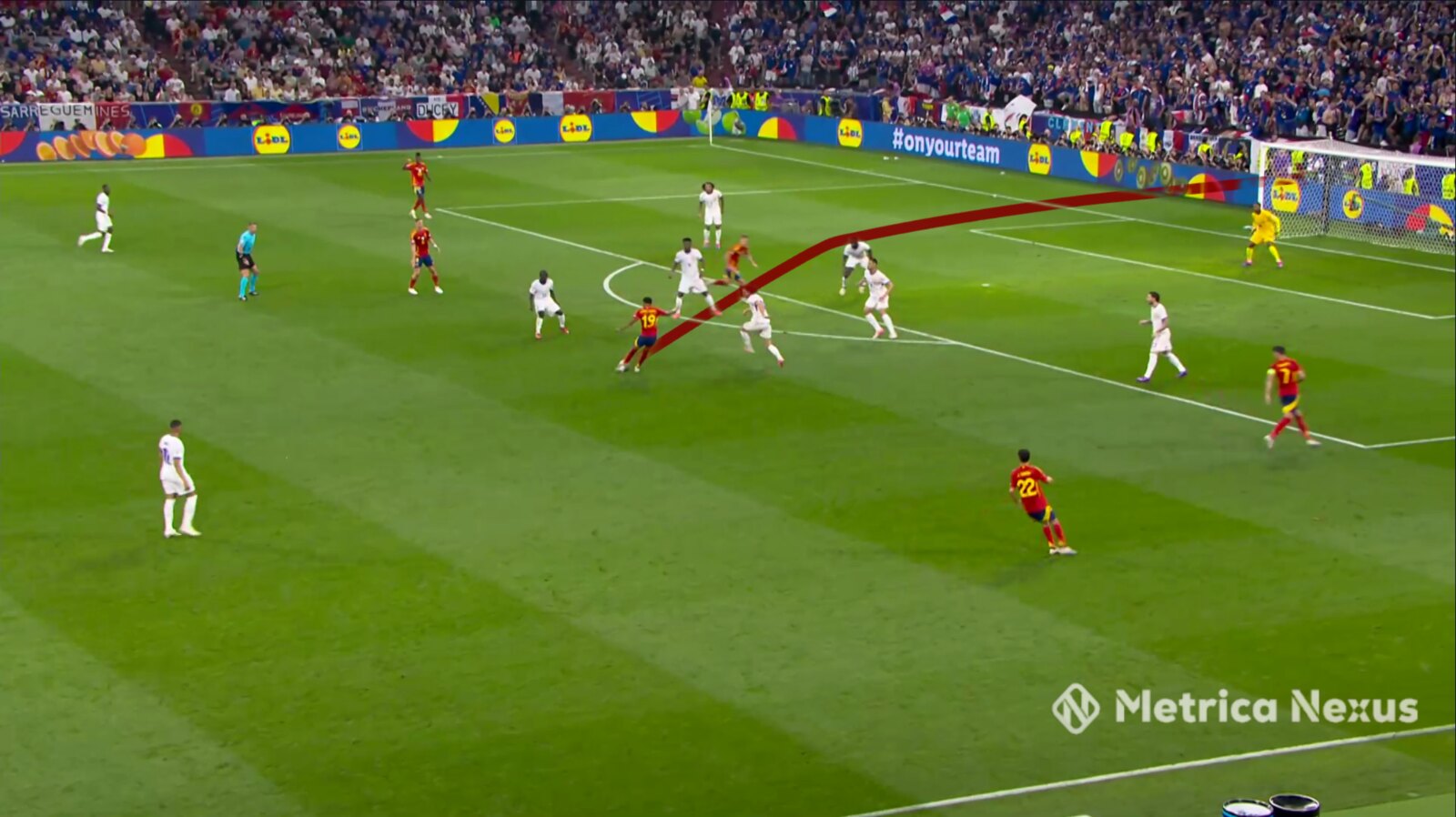
Let’s go back to Spain’s ideas, and the second idea, which is penetration through the middle. Here we’ll see Cucurella is the one holding the width, Baena is in the middle, and Oyarzabal is pinning Al-Amri.
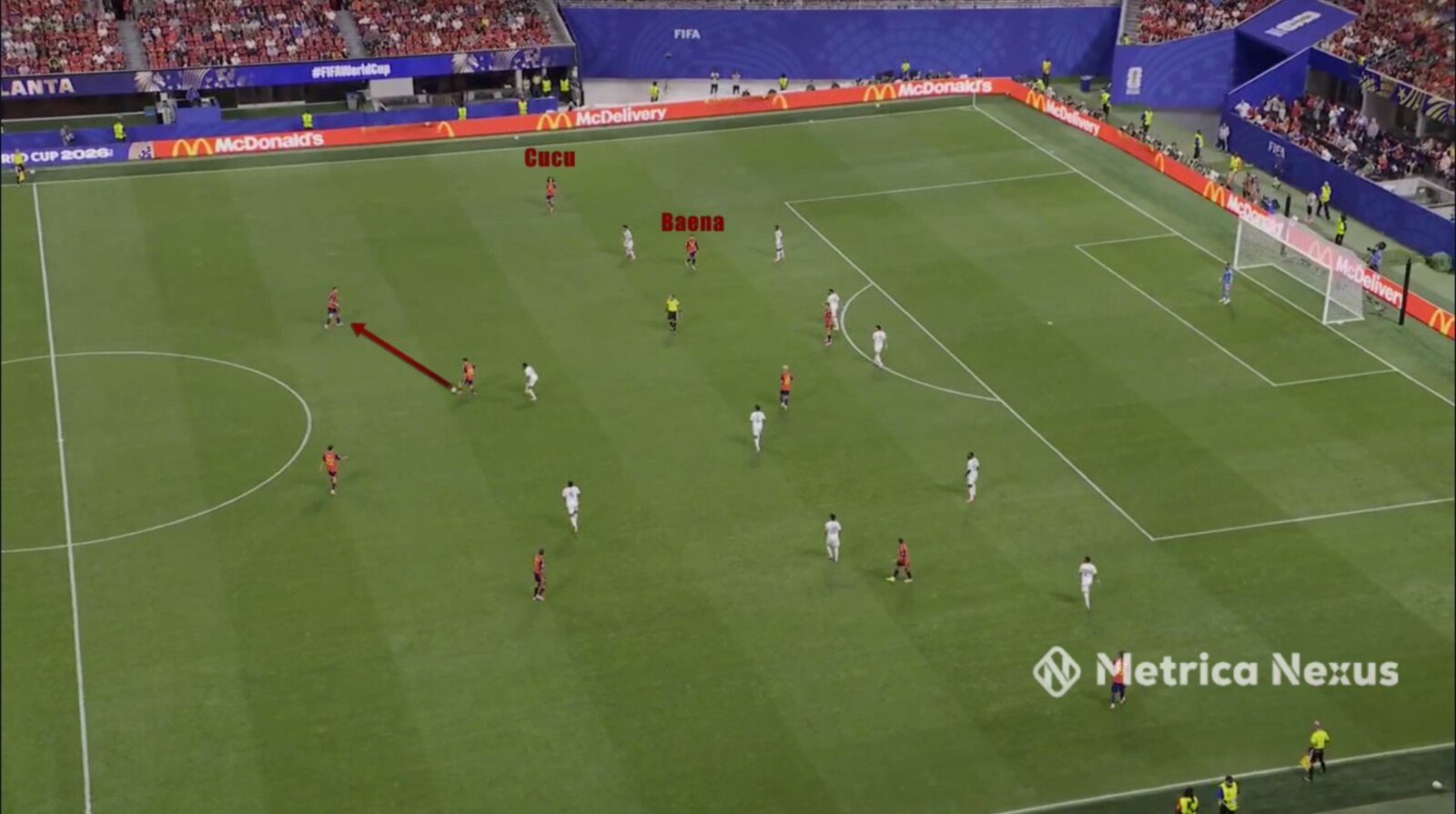
And Pedri underneath at the edge of the circle. Pedri passes to Laporte. Laporte steps forward with the ball, and Olmo moves off the back of Al-Dawsari, taking advantage of the fact that Al-Amri went with Baena, and Oyarzabal took Lajami.
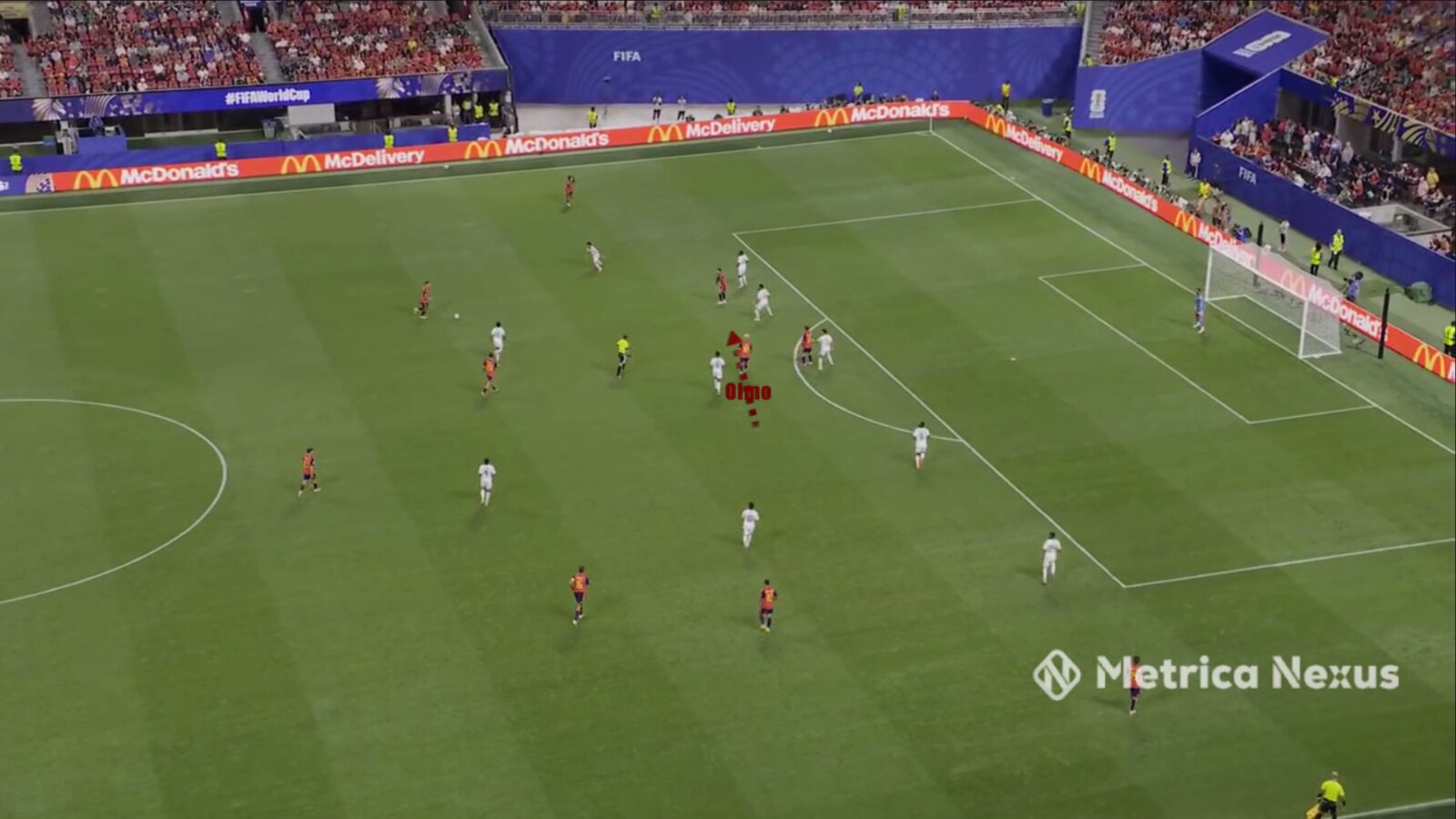
Pass from Laporte to Baena, who has Al-Amri following him and leaving his space behind.
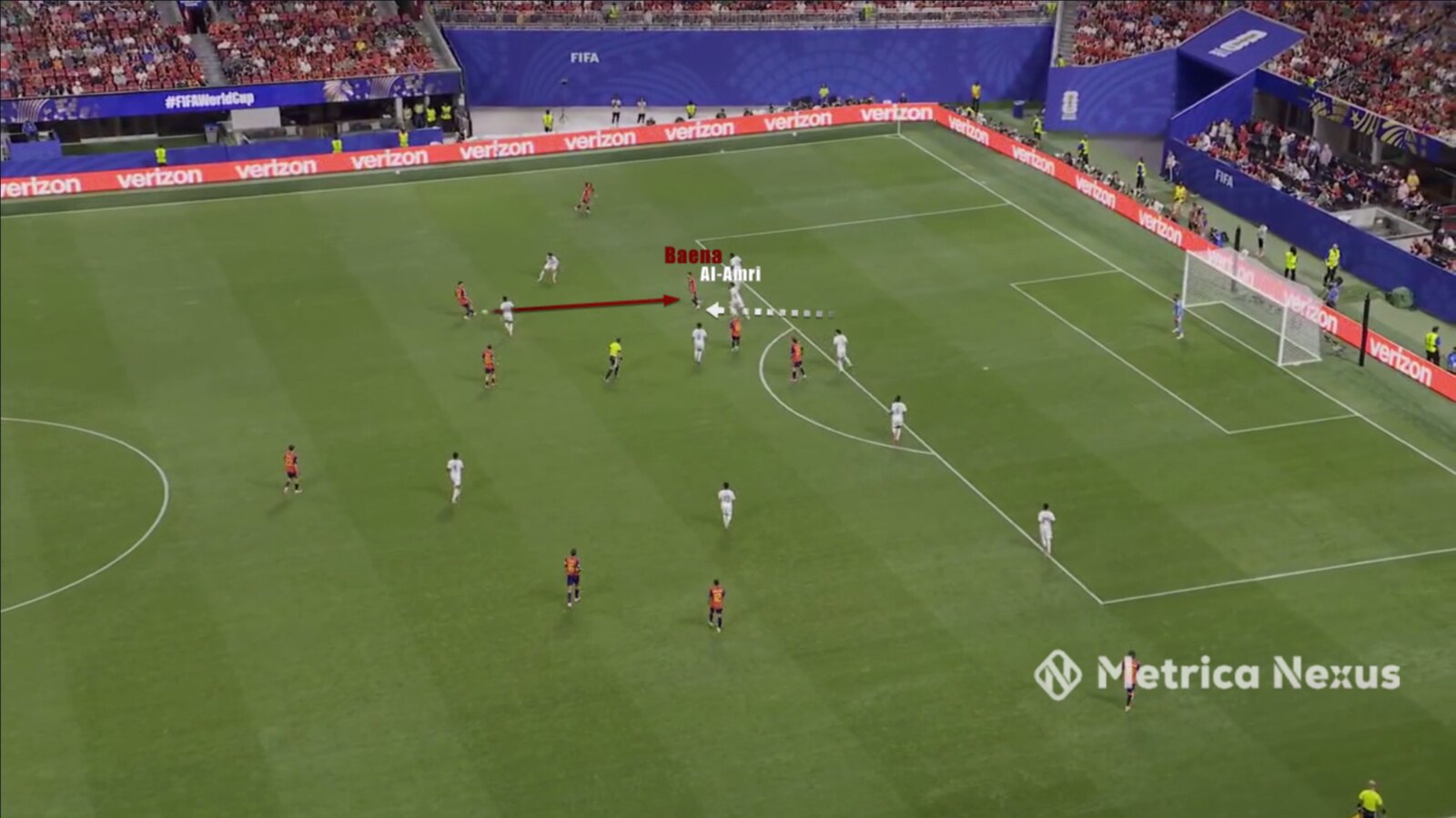
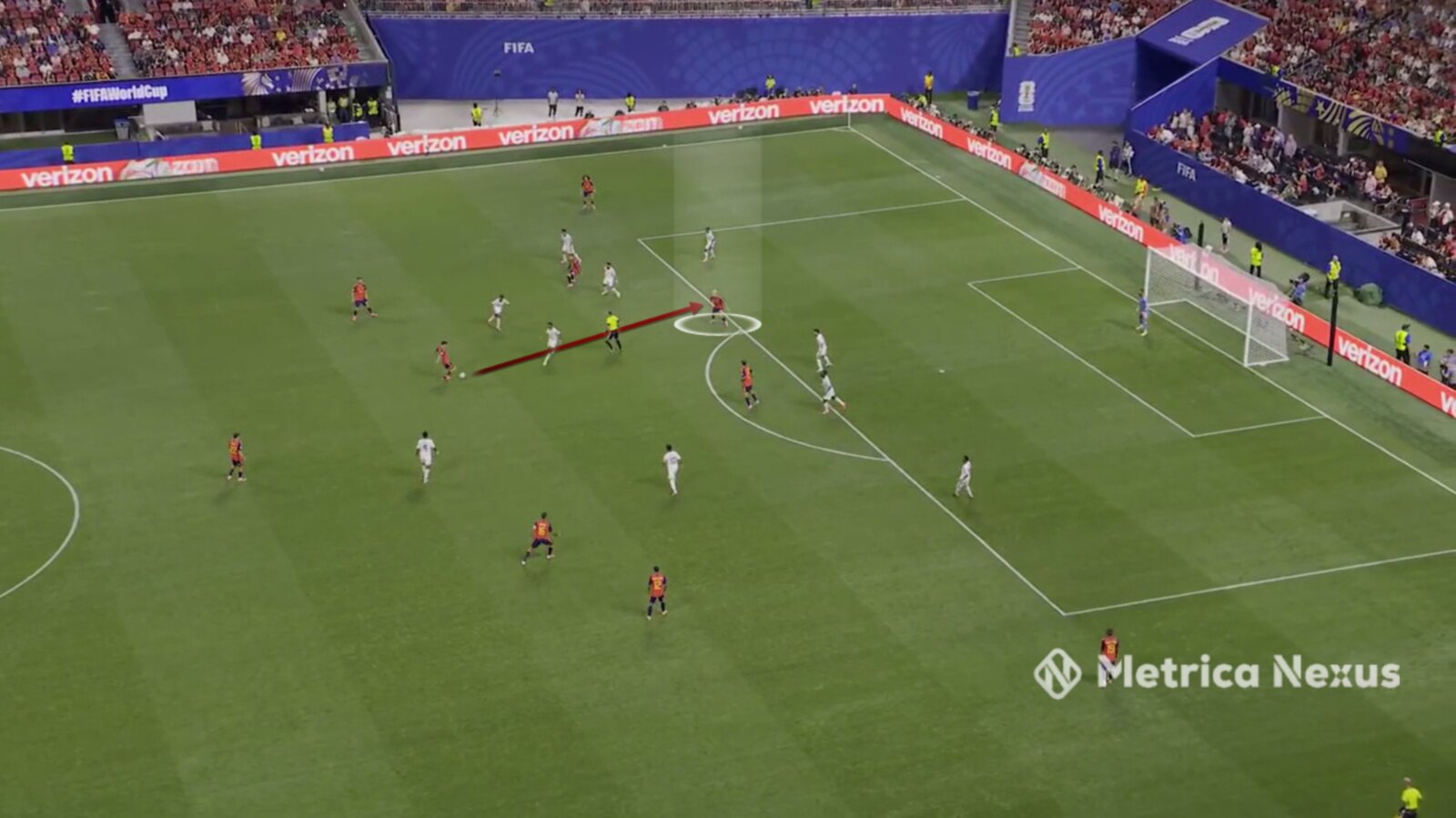
Baena lays it off to Pedri.
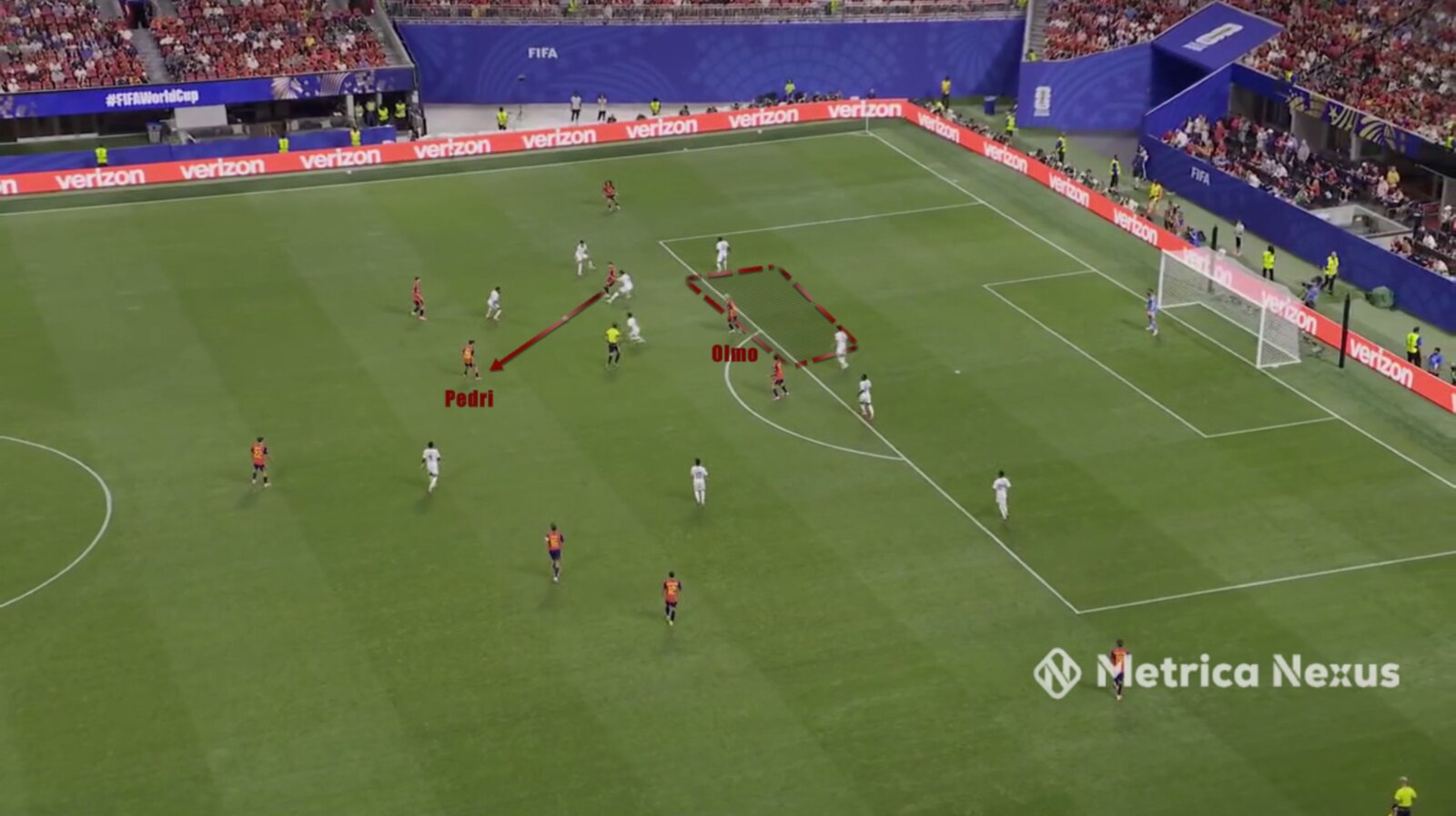
Who plays it first-time to Olmo, who attacked Al-Amri's space, but the pass comes in behind Olmo.
Spain’s High Press
Saudi Arabia in build up under high pressure, in a shape closer to 4-3-3:
Defensive line from right to left: Al-Amri, Lajami, Tambakti, and Al-Harbi. Al-Khaibari as a pivot, with Saud ahead of him on the right, and Nasser Al-Dawsari on the left. Ahead of them are Al-Juwayr, Salem, and Firas.
Spain pressed in a way closer to man-to-man at the start. Olmo and Oyarzabal on the center-backs, Lamine and Baena on the full-backs, Pedri on Al-Khaibari, Rodri on Nasser Al-Dawsari, Laporte on Saud, and Cucurella, Cubarsi, and Porro on Al-Juwayr, Firas, and Salem.
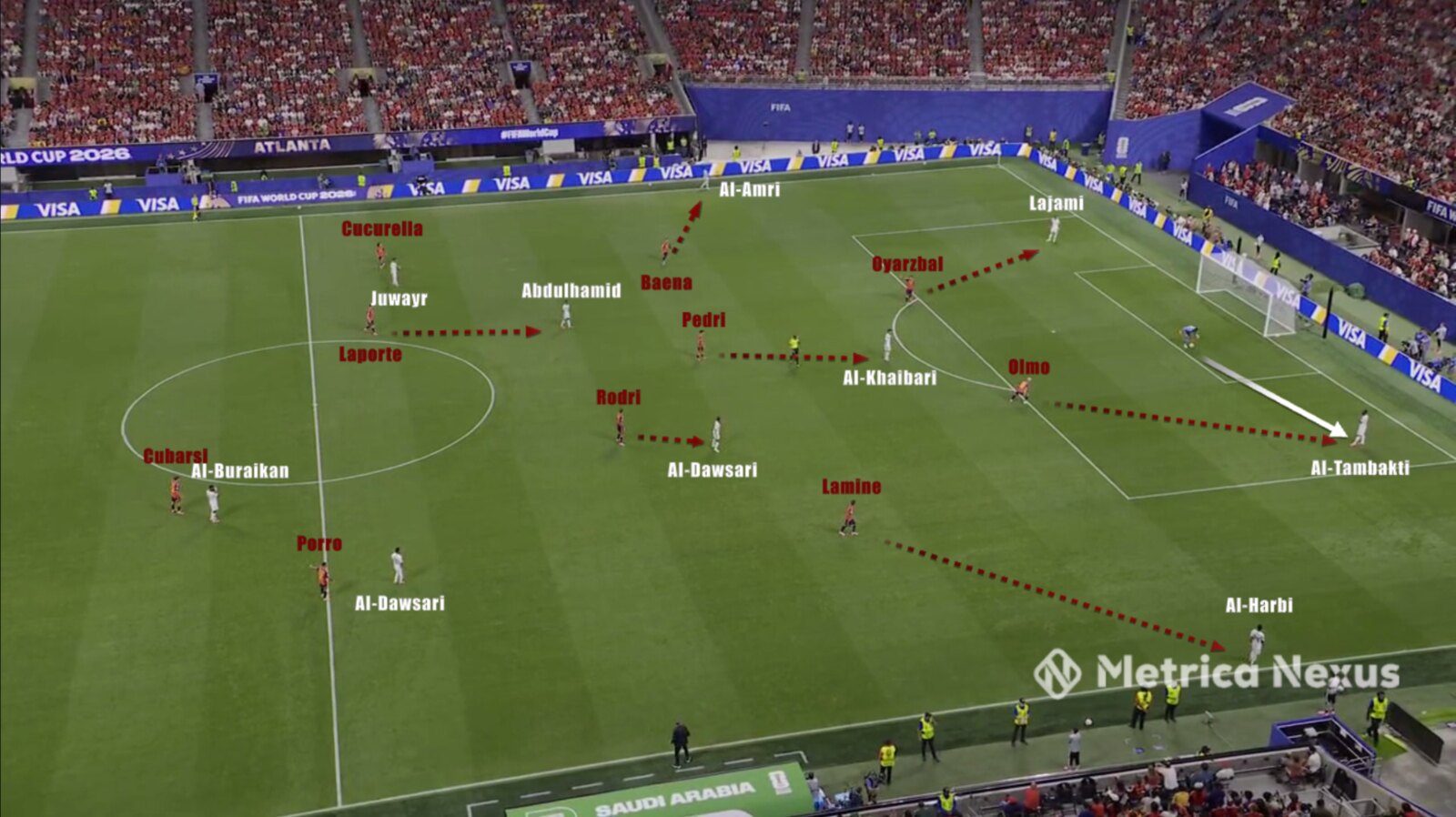
Al-Owais passes to Tambakti, and from him to Al-Harbi. And here, as soon as the ball takes its direction, Laporte drops back, and Baena, the opposite winger, leaves the full-back and drops to take Saud off Laporte.
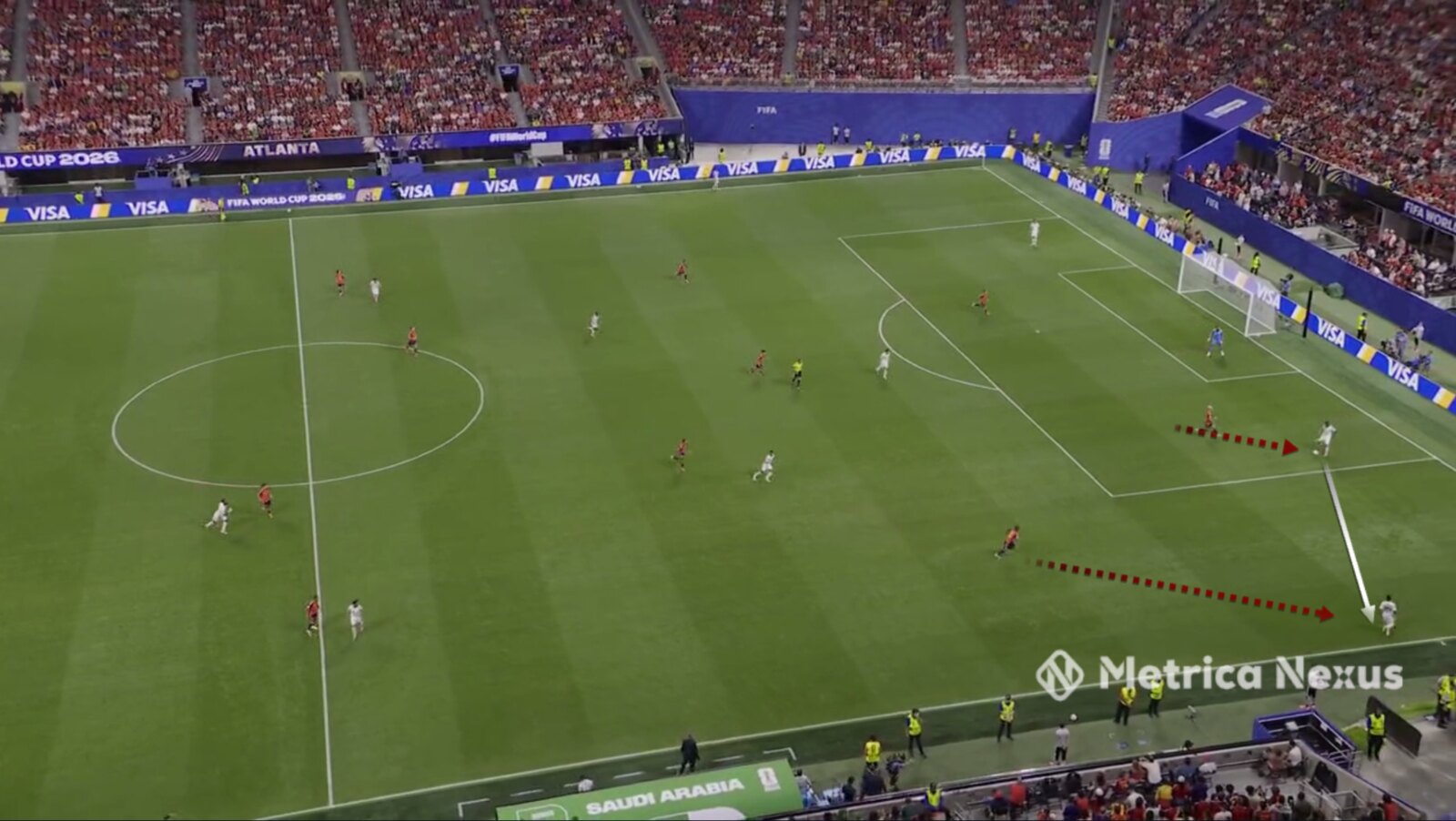
Ball down the line from Al-Harbi to Salem.
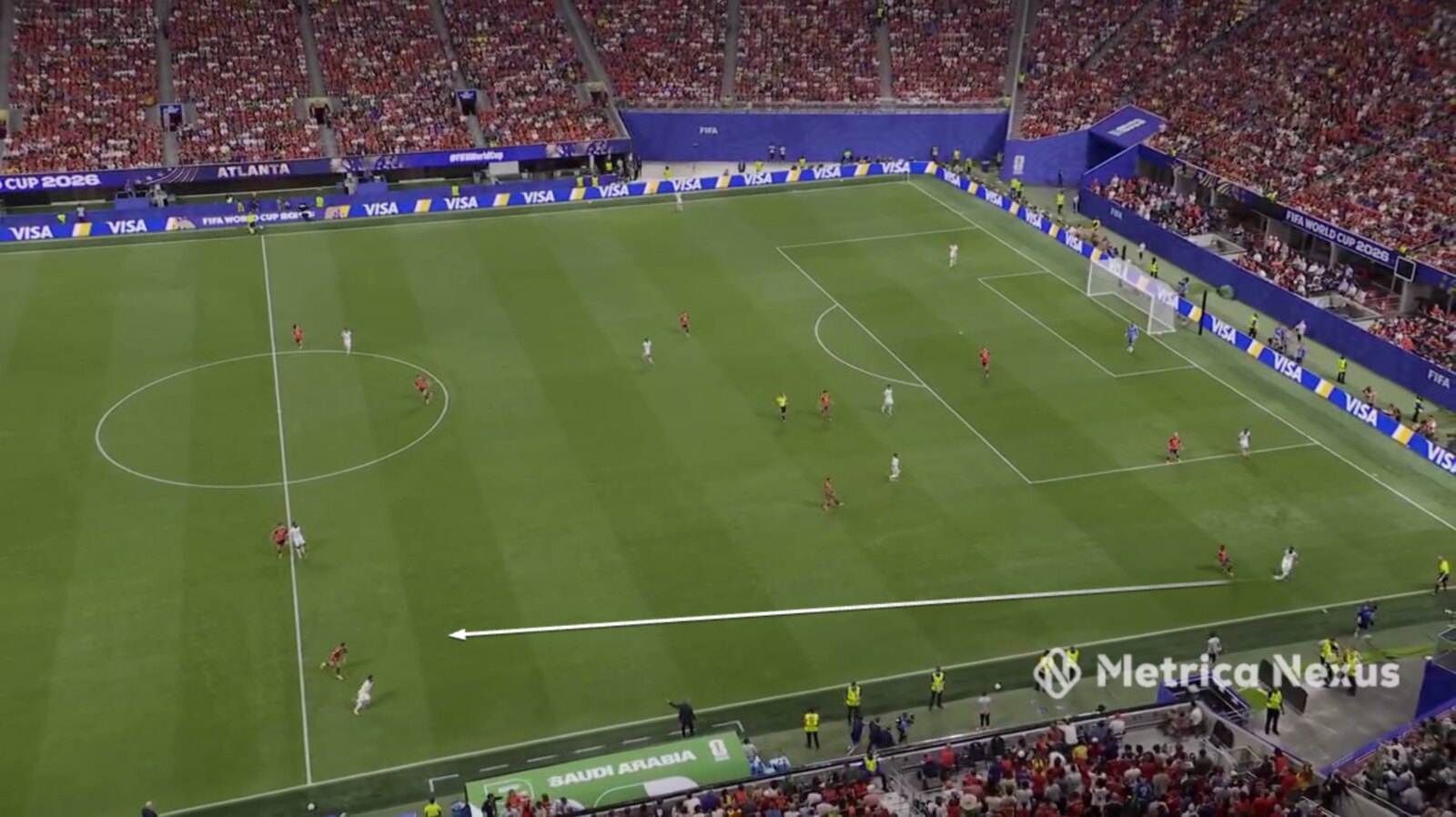
But Porro gets there before Salem.
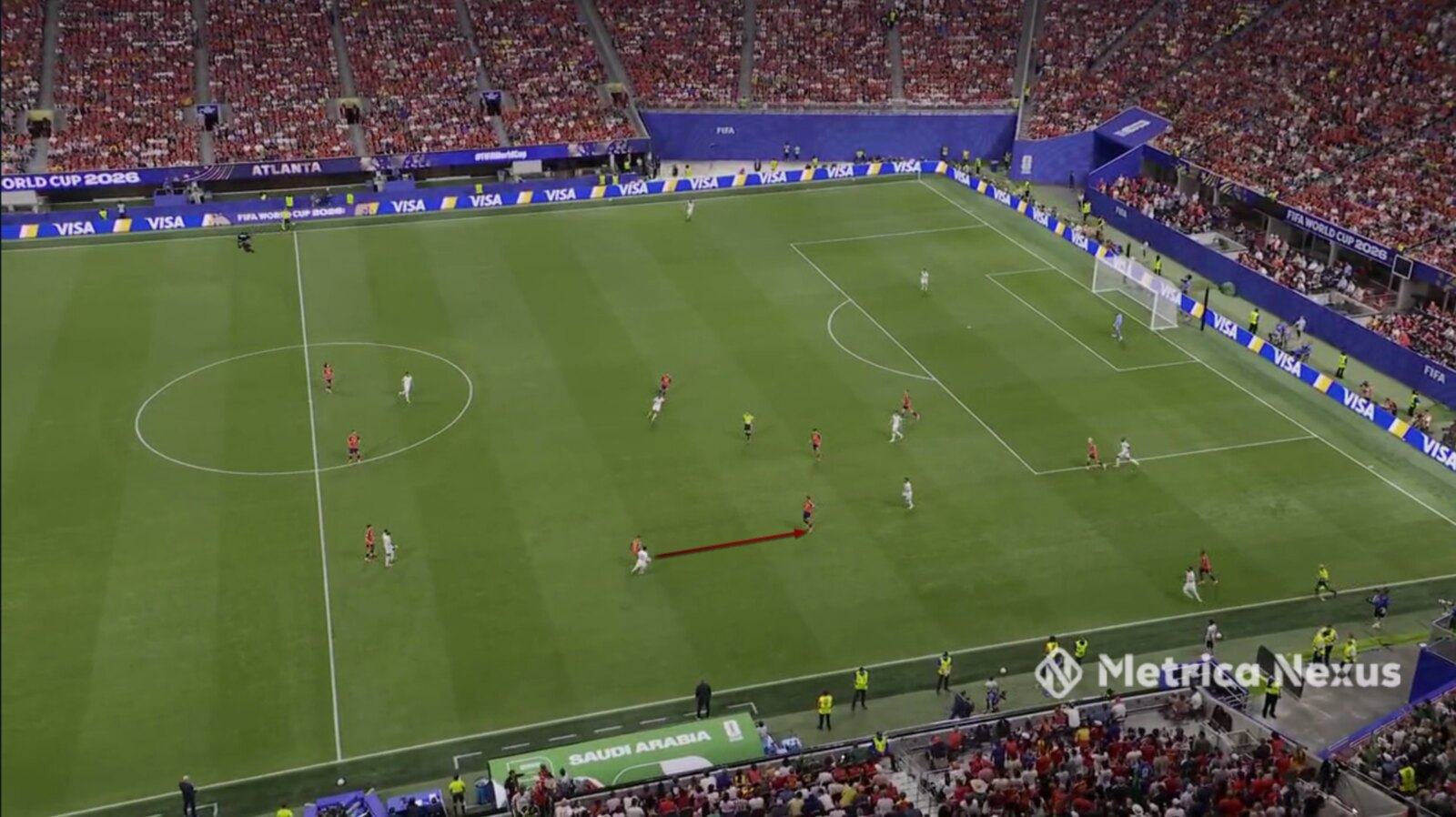
Once again, a pass from Al-Owais to Lajami, Oyarzabal presses Lajami, and Baena presses Al-Amri.
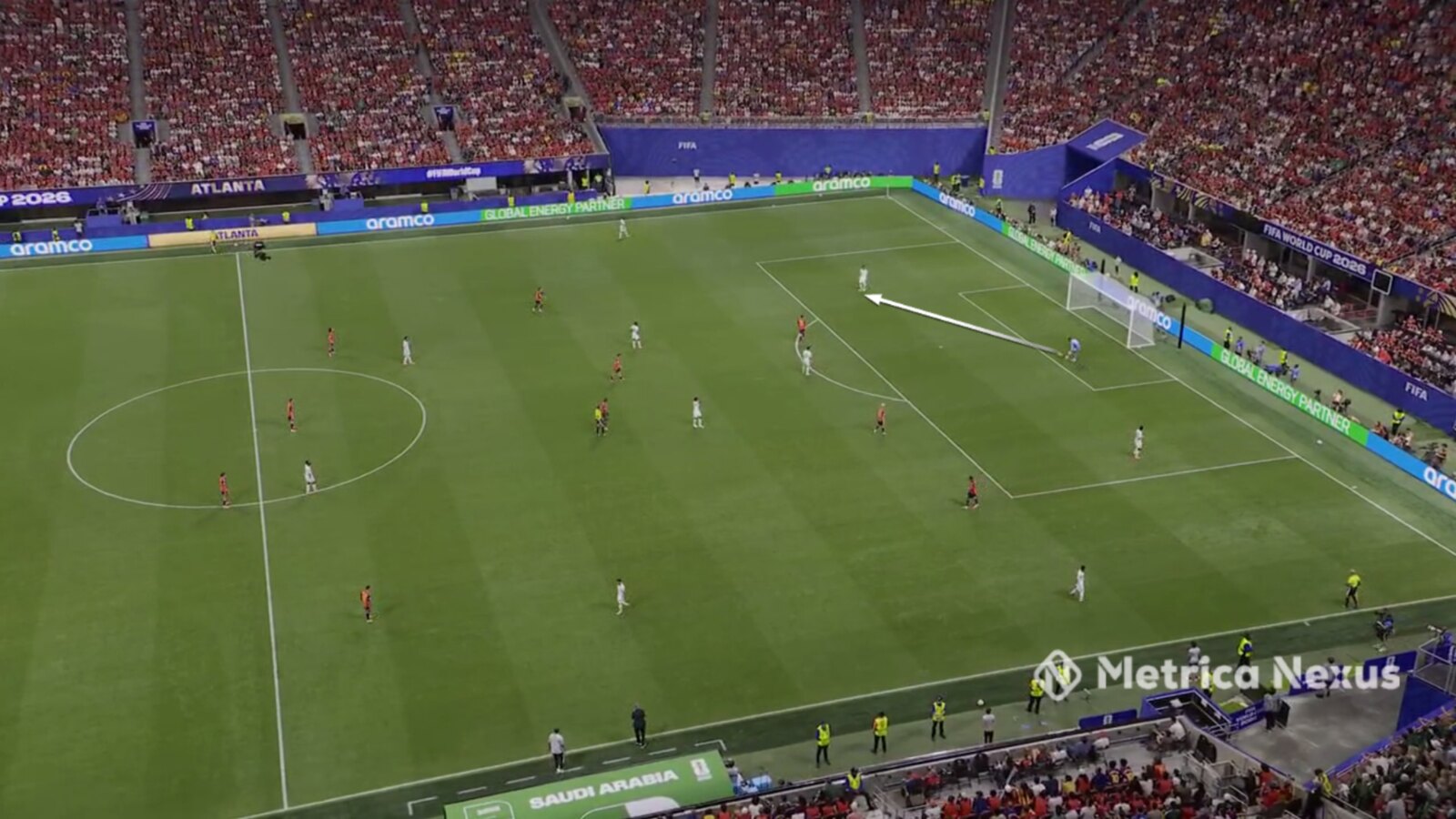
Pedri picks up Saud, Rodri picks up Nasser Al-Dawsari, and Lamine starts to tuck inside and leave the flank.
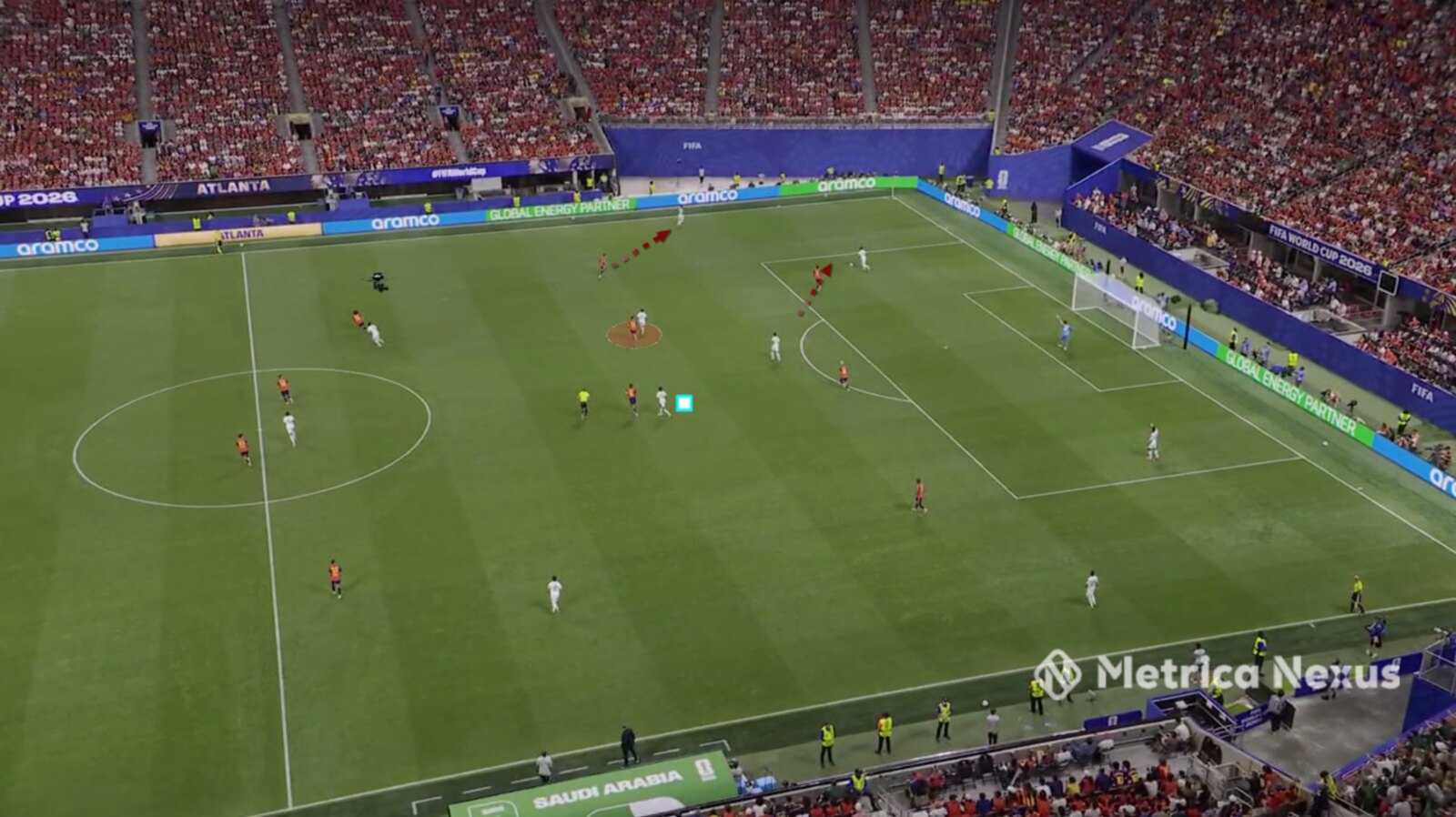
Pass from Lajami to Al-Amri, and from him to Saud.
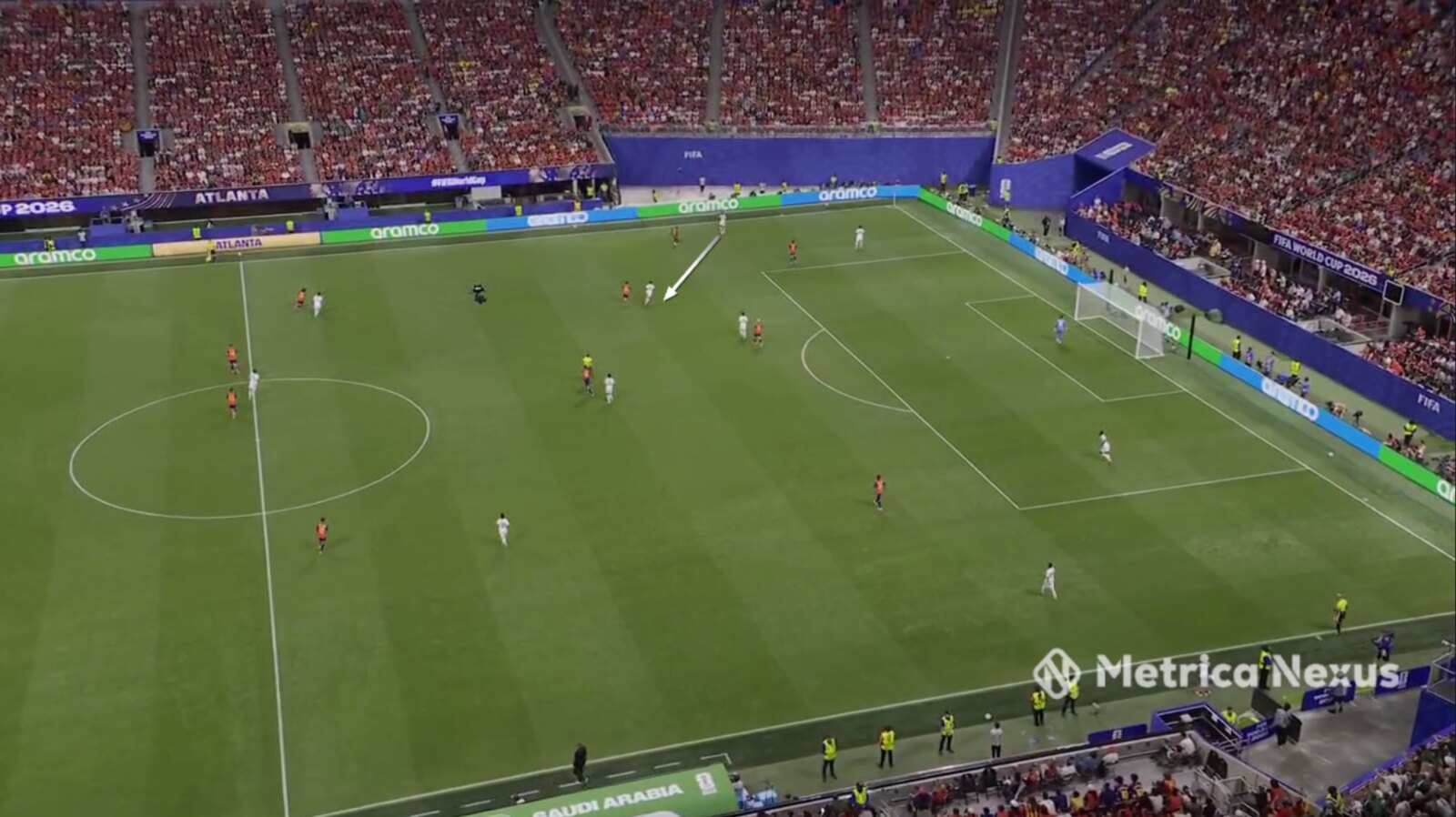
Pedri takes steps to close the pass to Al-Juwayr. But here, a problem in Spain's press will show up, which we expect they'll suffer from against teams with high-quality midfielders who have the ability to switch the ball back to the other side, and thus break out and push Spain deep.
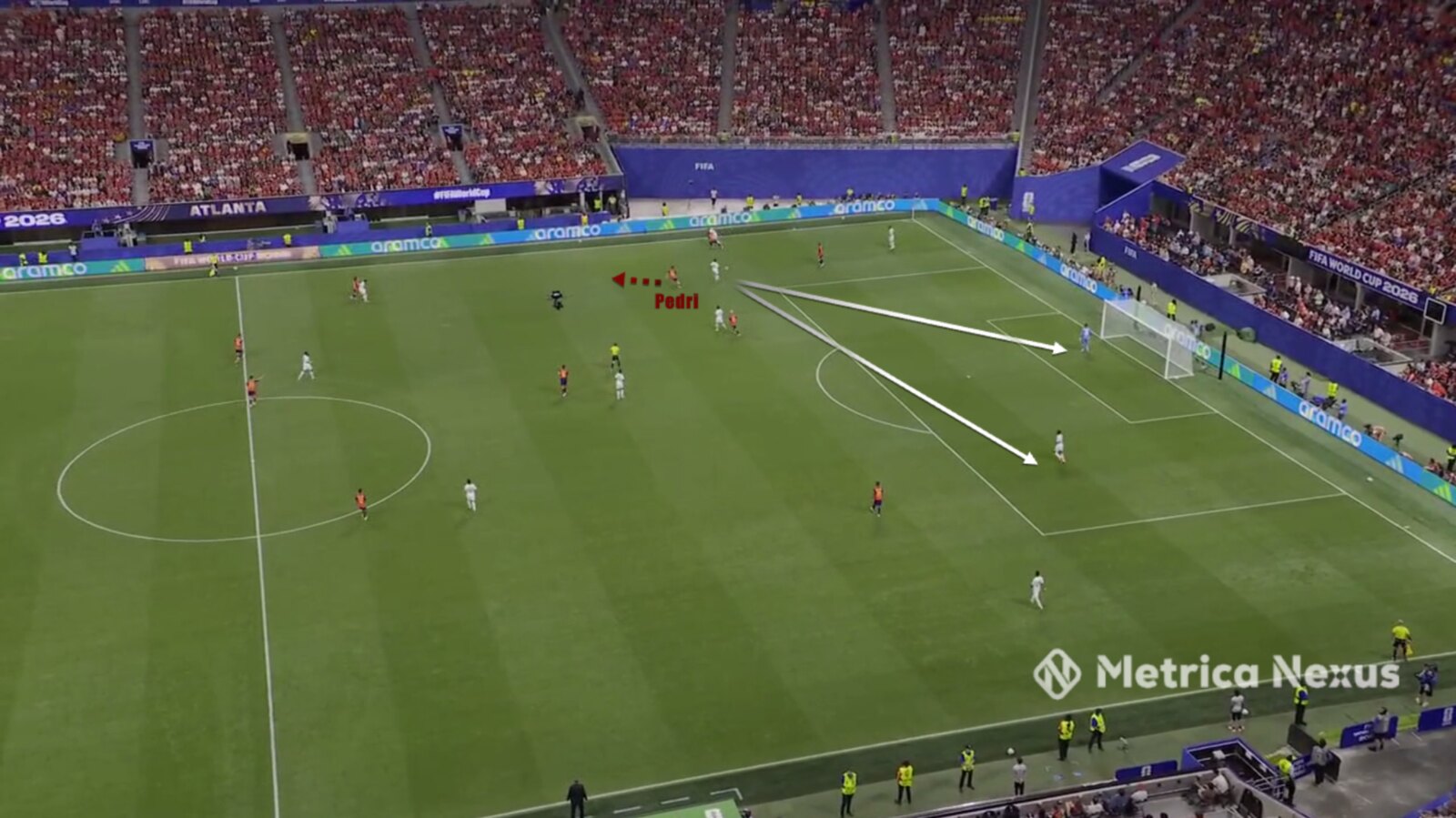
But let's go back again, pass from Saud to Al-Amri.
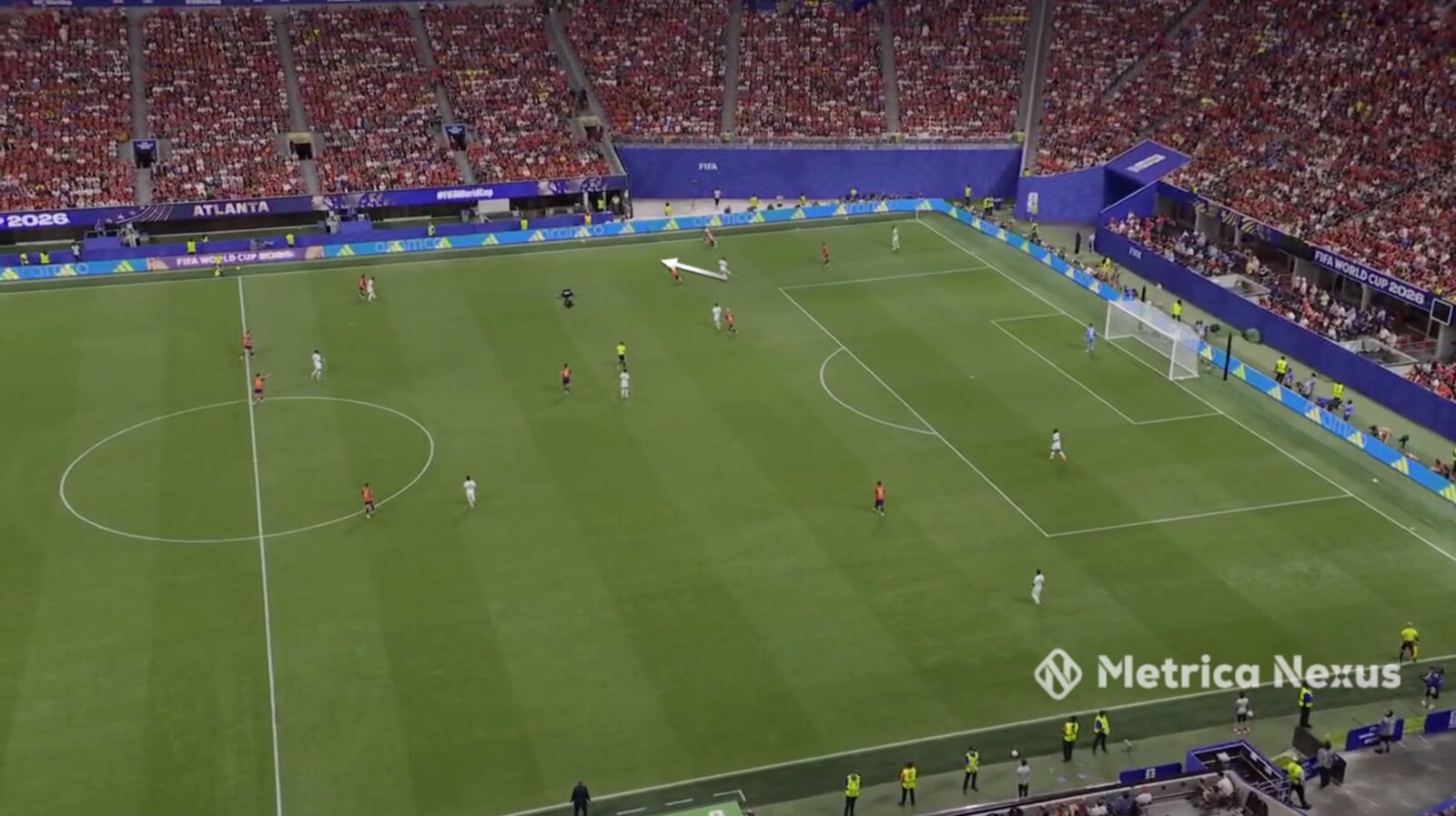
But Pedri intercepts it on the way.
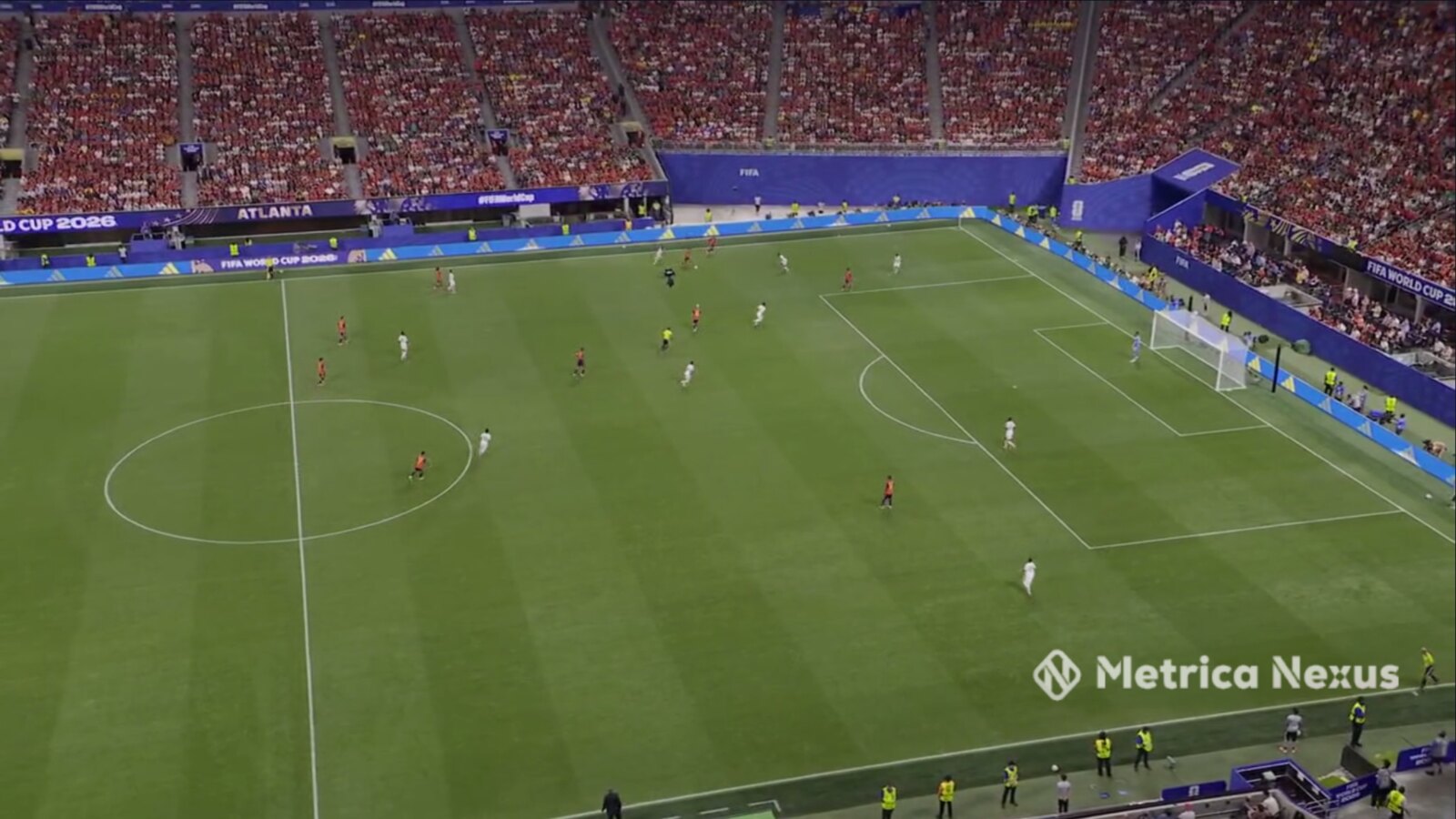
Overall, the team was better in this match for several reasons:
1- The return of Lamine, the best player in the world.
2- The presence of Baena compared to Gavi as a winger, who is better than him, but with the return of Nico Williams, this will add even more strength to the Spanish national team, because he is better in everything. Better dribbler, better at linking play from the flank, better at attacking spaces, and better at finishing than Baena.
3- And the presence of Olmo, who is incomparable to Fabián in everything. The only thing Fabián does better is defensively, especially in aerial duels and tracking back.
Browse our collection of football analysis insights.